
ArticlesMessages
Is that email passive aggressive, or just short?
Not one of the phrases people call passive aggressive at work has been studied. What has been studied is the full stop, message fragmentation, emoji and exclamation marks, and the cost of ambiguity to the person receiving it.
By Samet Durgun · Co-founder of Subtext · 10 min read
· Updated October 14, 2026
“Per my last email.” “Noted.” “Just circling back.” You know the ones, and you have probably had the experience of staring at three words from a colleague and not being able to tell whether anything is wrong. I co-founded Subtext, and work messages are the ones people send us screenshots of most, usually with the same question attached.
Nobody writing about this will tell you that there is no peer-reviewed research isolating any of those phrases. Not “per my last email”, not “noted”, not “as previously discussed”. The famous rankings all come from one vendor survey. What does have research behind it is narrower and more useful. It points at punctuation and formatting, not at wording.
What the phrase lists are built on
The source behind almost every article on passive aggressive work email is a 2023 survey of 1,000 Americans by a language-learning company. It reported that 83 per cent had received a passive aggressive work email and that “per my last email” topped the list.
That is a vendor survey measuring self-reported perception. It never tested what any sender meant. I’d call it a decent read on what phrases annoy people, which is a real thing worth knowing, and not evidence that anyone was being passive aggressive.
I would take the same care with the cost figures that circulate alongside it. I chased the claim that US businesses lose 1.2 trillion dollars a year to poor communication, the 62.4 million per company figure and the various per-employee numbers, and every one traces to a press release or a vendor blog, never to a study.
The sender is worse at this than they think
The load-bearing research finding here is about overconfidence, and it comes from Kruger, Epley, Parker and Ng1. Across five experiments, senders consistently overestimated how well their intended tone would land. In the largest study, with 154 pairs, senders predicted 88.8 per cent accuracy and readers delivered 70.4, pooled across email, voice and face to face. By email alone, readers got 62.8 per cent right.
The mechanism is that you hear your own intended tone while you write and cannot switch it off. Which means the colleague who sent “Noted.” heard it as efficient, and had no way to check. It is also why a second reader, human or otherwise, is worth having before you send something that could land wrong.
Byron’s paper is the one writers usually cite for the claim that people read work email more negatively than intended2. I’d note that it’s a conceptual paper in a theory journal. No sample, no experiment, no effect size. It proposes that readers take neutral messages as negative and positive ones as neutral. Those are propositions, not measurements, and anyone quoting a number from it is misreading it.
The field evidence cuts both ways
Sillars and Zorn asked people to supply real emails they had found upsetting, then had independent observers rate the same messages3. Receivers rated them more negatively than observers did. The authors call this negative intensification, and they state plainly that the effect sizes were small, the sample was not random, and they screened out anyone who could not recall an upsetting email. It was stronger in poor communication climates and among people in subordinate positions.
Pollmann and Roos point the other way4. Using real messages between people who already knew each other, and asking both the sender and the receiver, they found receivers got the intended tone about right. I cover the reader’s side in what does this text mean? Their second study covered work and educational emails, with 361 receivers and 61 matched senders, and found no meaningful gap. In their study of text messages they also found no effect of message length on accuracy. For the emails they had too few complete cases to test length, and the paper says “we had only 28 data points”.
My read is that both can hold if the misreading concentrates in one-off ambiguous messages between people without a shared baseline, which is exactly what a new client or a colleague two departments away is. It also means the thing driving misreads at work is how much history the two of you have, not tone in the abstract. Whether emotional intelligence really matters at work is a separate question, and the evidence there is weaker than its reputation.
Reading a single message and reading a message against the fifty before it are different problems, and you can solve only one of them by looking at the words.
What has been tested
The full stop. Gunraj and colleagues found a one-word reply ending in a full stop read as less sincere than the same reply without one, and the effect vanished when participants saw the same exchanges as handwritten notes5. I’d call that handwriting control the cleanest demonstration in this literature that the same words shift meaning with the channel. It also indirectly supports the idea that “sure.” and “thanks.” with a full stop read as cooler. Note the limits: 126 undergraduates, one-word casual replies, and texting, not Slack or Teams. Full-sentence business email uses grammatical full stops as a baseline, so the finding does not transfer to a normal paragraph.
Fragmentation. Poirier, Cook and Klin ran the only controlled evidence I found on this6. Putting a full stop after every word, as in “No. Just. Go.”, raised rated emotional intensity from 5.13 to 5.45 on a seven-point scale, in an experiment with 80 participants. Breaking the same message into a series of separate one-word sends did something similar. Putting each word on its own line inside one message did not, which rules out the explanation that it is about taking up more space. I’d note the raw difference was 0.32 of a point even though the standardised effect was large, so the size comes from small variance. Readers were not swinging wildly.
Emoji in formal contexts. Glikson, Cheshin and van Kleef tested smileys in first-time professional contact across three experiments with 549 participants from 29 countries7. Smileys did not raise perceived warmth and did lower perceived competence. A preregistered replication did not fully agree. The competence penalty held, but warmth went up, and the formality moderation did not replicate8. Courtice, Lawrence, Collin and Boutet tested emoji in simulated workplace instant messages with 243 participants and found no emoji scored highest for competence and appropriateness, a grinning face held roughly steady when paired with positive or neutral text, and a frowning face lowered ratings across every kind of message content9.
Exclamation marks. Three sources that need separating by what they measured. Waseleski content-analysed 200 exclamations across two professional discussion lists and found 32 per cent were friendly, 29.5 per cent emphasised a point, and only 9.5 per cent indicated excitability10. That is an analysis of what people wrote, and Waseleski explicitly names reader perception as an open question. Yin, Appel and Wakslak ran five preregistered studies plus two archival ones and found exclamation marks read as feminine, raised perceived warmth and enthusiasm, and lowered perceived power and analytical thinking, regardless of the sender’s gender11. I’d reconcile it by saying that exclamation marks buy warmth, cost little in competence, and cost something in perceived authority. Which is a trade, not a mistake.
Capitals. Byron and Baldridge found people rated a request in all capitals as less likable than the same request in standard case12. One study, and an extreme cue.
Greetings, sign-offs and hedging. No controlled workplace perception studies exist for greetings or sign-offs. Every confident claim about them is convention, not evidence. Hedging has partial support from Körner and colleagues, who found tentative words associated with lower perceived power, though their materials were short self-descriptions written by strangers, not work emails13.
The status claim nobody has tested
People widely repeat the idea that readers excuse a manager’s clipped “Noted” as efficiency while an identical message from a junior colleague reads as poor awareness. I went looking for the study. It does not exist. No published experiment manipulates sender status and message brevity together.
What the evidence supports is thinner, and I find it more interesting. Sillars and Zorn found negative intensification was stronger among people in subordinate positions, which is about the receiver side, not the sender side3. De Felice and Garretson analysed a subset of a large released email corpus and found differences across hierarchy levels related to what messages were about rather than to their tone14.
The same applies to the gender version. The backlash literature on women expressing directness is robust, but it comes from hiring and evaluation vignettes, not chat messages. Meanwhile the meta-analysis on gendered tentative language pooled 29 studies and 3,502 participants and found a small effect, d = .23, heavily moderated by context15. And three of the recent messaging studies found no sender gender effect at all on competence or likability.
What a misread message costs
This is where the evidence is better than I expected.
Yuan, Park and Sliter separated active email incivility, meaning overt rudeness, from passive email incivility, meaning terse replies and being ignored16. Across a survey of 233 employees and a daily diary study with 119, passive incivility was associated with insomnia, which then predicted worse mood at the start of the next workday. Active incivility was not associated with the same outcomes.
Their explanation, and the one that matters for this article, is that ambiguity does the damage. An overtly rude message is at least unambiguous. A three-word reply that might mean nothing is the one you take home. Resolving that ambiguity quickly, in either direction, is worth more than getting the wording perfect. Subtext does not tell you what the colleague meant. Screenshot the thread and it gives you one line on what is being asked of you and a few next steps, and if you decide to ask them what they meant, it helps you word the question.
Bernuzzi, O’Shea, Setti and Sommovigo found a similar pattern across 199 Italian and 330 British workers, with email incivility from colleagues associated with work-life conflict and emotional exhaustion17. All of this is correlational self-report, so it does not establish that a terse message causes insomnia. Passive incivility in the Yuan study also covered being ignored, and a pattern of being ignored is a different thing from one short reply. What the data fit is the authors’ idea that ambiguity is the costly part, which is a good reason to ask early.
So what do you do
If you are the receiver, the base rate says you are probably reading it about right, especially with someone you know well. The zones where misreads concentrate are one-off messages from people you have no history with, and messages where you are supplying context the sender did not have. If it matters and you cannot tell, ask, because the alternative is carrying the ambiguity around for a day and the research suggests that is the version with a cost attached. If the same colleague does it every week, the question becomes how to deal with passive aggressive people.
If you are the sender, your tone lands worse than you think it does, and the fixes with actual evidence behind them are unglamorous. Do not send a three-word reply to something that took someone effort. Do not fragment a message into six sends when you are annoyed. Watch the terminal full stop on a one-word reply. Say the thing you mean explicitly. That one has direct experimental support, from a study of 4,004 working adults in which a single line setting expectations removed a documented misreading18. That is most of what makes work messages land firm, not cold.
Terse “Noted.”
Reads as efficient to the sender · tells the other person nothing about what happens next
Explicit “Got it, I’ll have the revised numbers back to you by Thursday afternoon.”
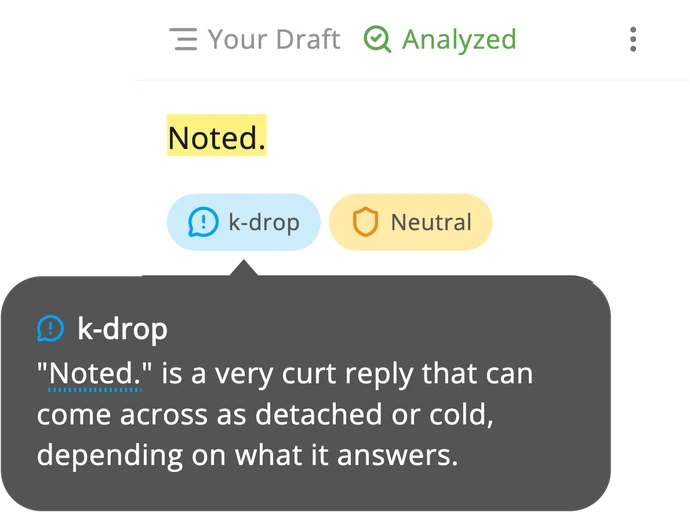
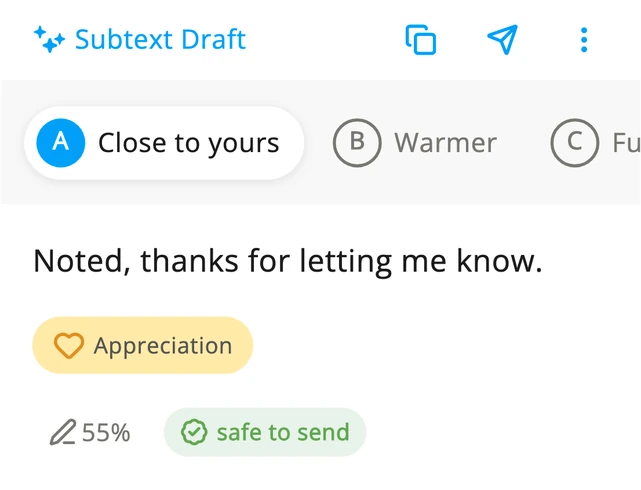
Subtext flags where your message reads colder than you meant, which at work can come from how short it is as well as from the wording. It does not factor status into how it reads a message, since no study has tested status and brevity together. Given that same “Noted.” as a draft, its one tag, which the app names k-drop, came with the note that it is “a very curt reply that can come across as detached or cold, depending on what it answers”. The version closest to the draft, marked safe to send, read “Noted, thanks for letting me know.” That is the app’s real output, unedited, and what happens next is still yours to add. Subtext also tells you when nothing is wrong.
Try Subtext in your browserDownload on the App StoreGet it on Google PlayScan it with your phone camera to install.
Think I have read a study wrong, or know research on this I have missed? Tell me on LinkedIn.
Samet Durgun is the co-founder of Subtext, an app that catches the emotional tone of your messages and rewrites them in your own voice. He’s based in Berlin.
Sources
Numbered in the order they appear above. Where a figure could not be verified against the primary source, the text says so. Checked 28 August 2026.
- Kruger, J., Epley, N., Parker, J., and Ng, Z.-W. (2005). Egocentrism Over E-Mail: Can We Communicate as Well as We Think? Journal of Personality and Social Psychology, 89(6), 925 to 936. The 88.8 and 70.4 figures are Study 3, with 154 pairs, pooled across email, voice and face to face; by email alone readers got 62.8 per cent right.
- Byron, K. (2008). Carrying Too Heavy a Load? The Communication and Miscommunication of Emotion by Email. Academy of Management Review, 33(2), 309 to 327. A conceptual paper with no sample and no effect size.
- Sillars, A., and Zorn, T. E. (2021). Hypernegative Interpretation of Negatively Perceived Email at Work. Management Communication Quarterly, 35(2), 171 to 200.
- Pollmann, M. M. H., and Roos, C. A. (2025). “I get u”. People correctly interpret the tone of text messages and emails. Computers in Human Behavior Reports, 18, article 100689. A companion open-access title rather than the parent journal; recent and not yet replicated.
- Gunraj, D. N., Drumm-Hewitt, A. M., Dashow, E. M., Upadhyay, S. S. N., and Klin, C. M. (2016). Texting insincerely: The role of the period in text messaging. Computers in Human Behavior, 55, 1067 to 1075.
- Poirier, R. C., Cook, A. M., and Klin, C. M. (2025). Read. This. Slowly: mimicking spoken pauses in text messages. Frontiers in Psychology, 16, article 1410698. The d = 1.16 result is Experiment 1, with 80 participants.
- Glikson, E., Cheshin, A., and van Kleef, G. A. (2018). The Dark Side of a Smiley. Social Psychological and Personality Science, 9(5), 614 to 625.
- van der Lee, C., Vermeulen, and colleagues (2023). A preregistered replication of Glikson et al. Experiment 3. Collabra: Psychology, 9(1), 90195. Data at osf.io/n7yc4.
- Courtice, E. L., Lawrence, M., Collin, C. A., and Boutet, I. (2026). Emojis at Work: The Effects of Emoji Use on Perceptions of Competence and Appropriateness. Collabra: Psychology, 12(1), article 147309. 243 participants; vignette study.
- Waseleski, C. (2006). Gender and the Use of Exclamation Points in Computer-Mediated Communication. Journal of Computer-Mediated Communication, 11(4), 1012 to 1024. A content analysis of what senders wrote, not of reader perception.
- Yin, Y., Appel, G., and Wakslak, C. J. (2025). “Nice to meet you.(!) Gendered norms in punctuation usage.” Journal of Experimental Social Psychology, 121, article 104812. Five preregistered studies plus two archival studies.
- Byron, K., and Baldridge, D. C. (2007). E-Mail Recipients’ Impressions of Senders’ Likability. Journal of Business Communication, 44(2), 137 to 160.
- Körner, R., Overbeck, J. R., Körner, E., and Schütz, A. (2024). Sense of power and language. Two zero-acquaintance studies using short written self-descriptions, not workplace emails.
- De Felice, R., and Garretson, G. (2018). Politeness at work in the Clinton email corpus. Journal of Politeness Research, 14(2).
- Leaper, C., and Robnett, R. D. (2011). Women Are More Likely Than Men to Use Tentative Language, Aren’t They? Psychology of Women Quarterly, 35(1), 129 to 142. 29 studies, 3,502 participants, d = .23.
- Yuan, Z., Park, Y., and Sliter, M. T. (2020). Put You Down Versus Tune You Out: Active and Passive Email Incivility. Occupational Health Science. Funded in part by a pilot grant from the Heartland Center for Occupational Health and Safety, with CDC and NIOSH training grant T42OH008491.
- Bernuzzi, C., O’Shea, D., Setti, I., and Sommovigo, V. (2024). “Mind your language! How and when victims of email incivility from colleagues experience work-life conflict and emotional exhaustion.” Current Psychology, 43(19), 17267 to 17281. 199 Italian and 330 British workers; cross-sectional self-report.
- Giurge, L. M., and Bohns, V. K. (2021). “You don’t need to answer right away!” Organizational Behavior and Human Decision Processes, 167, 114 to 128. Eight preregistered studies, 4,004 working adults.