ArticlesMessages
How do you apologise over text?
A good written apology takes responsibility and offers repair. Asking to be forgiven is the weakest thing you can put in one. What the research supports, what it does not, and when you should not apologise at all.
By Samet Durgun · Co-founder of Subtext · 15 min read
· Updated October 14, 2026
You have written it four times. The first version was too long. The second one explained too much. The third one somehow ended up being about how bad you feel, which you noticed on the reread and hated. The fourth is sitting there unsent and you cannot tell if it is any good. I built Subtext partly because this is the message people get stuck on more than any other, and partly because I am extremely bad at it myself.
A written apology works when it takes responsibility for the specific thing you did and offers to put it right. It works less well when it explains, and least well when it asks to be forgiven. Send it after the other person has had a chance to say what it was like for them, not before. And there are situations where the research above does not apply, which is the last section and the most important one.
Every claim below links to its source, and I have flagged the ones that are thinner than the internet makes them sound.
What goes in a good apology
The study everyone cites is Lewicki, Polin and Lount, who ran two experiments with 755 participants in total and tested six components of an apology against each other12. Participants read a scenario about a job candidate who had filed an incorrect tax return, either through incompetence or on purpose, and rated how effective, credible and adequate the apology was.
The six components:
- Acknowledgement of responsibility
- Offer of repair
- Explanation
- Expression of regret
- Declaration of repentance
- Request for forgiveness
Two findings survive both studies. Participants rated apologies with more components as more effective than apologies with fewer. And a request for forgiveness came last in both studies, by a clear margin.
The famous ranking is where I would push back on almost every article written about this paper. Responsibility came first in Study 1. Repair came first in Study 2. Explanation moved from third to fifth between them. So my summary is that responsibility and repair are the load-bearing parts and asking to be forgiven is the weak one, and the paper that everyone cites for the order does not settle the order above that.
I’d flag the design before you weigh it too heavily. Participants were reading a hypothetical scenario about a stranger, and the study measured how effective the apology seemed, not whether anyone forgave anyone or did anything differently afterwards.
There is a related finding that should make you cautious about your own instincts here. De Cremer, Pillutla and Reinders Folmer found across three experiments that people valued imagined apologies more highly than apologies they actually received, and behaved more trustingly towards the imagined ones3. The apology you are composing in your head is already better than the one that will land. That gap is the one to check before you send: whether responsibility and repair, the two parts the evidence rates, are in the message, and not whether the draft sounds thorough to you.
When do you send it?
The usual advice is to apologise immediately. The evidence points somewhere more specific.
Frantz and Bennigson ran a scenario where a friend stands you up, followed by a phone conversation the next day4. In one condition the friend apologises at the start of the call. In the other, the participant gets to state the grievance first and hear that the friend understands why it was upsetting, and the apology comes after that. The later apology produced the better outcome, and the study is where the phrase “better late than early” comes from.
The detail I think people lose in the retelling is that both apologies happen inside the same next-day phone call. This is not evidence for waiting a week. The sequence is what matters, not the delay. An apology that arrives before the other person has said anything can function as a way of closing the subject, and it tends to land that way.
The experimental sample here was 60 people after exclusions, so treat it as a direction, not a law. The authors themselves warned against turning it into a rule to delay, and suggested that very late apologies probably fail too. After a fight, the same sequence is why what to text after an argument starts with something other than the apology.
There is a literature pointing the other way, from customer service research, where fast apologies raise satisfaction because speed signals competence. Both can be true. A delayed order and a hurt friend are different situations, and the thing that separates them is whether the other person needs to be heard first.
Text, or phone call?
I assumed for a long time that a written apology reads as the cowardly option. There is one direct comparison and it does not support that.
Gao and Yan ran three experiments with 1,120 participants, varying whether a person apologised verbally or in writing, and whether the original wrong was about competence or about integrity5. After an integrity violation, where the person did something dishonest on purpose, the written apology repaired more trust than the spoken one on every measure. After a competence violation, where they got it wrong through not knowing enough, the spoken apology did better.
Their proposed explanation is that writing is more effortful and more durable, which suits a wrong about character, while speech carries presence and tone, which suits a wrong about capability.
The limitation is significant and I want to state it plainly. Participants read written materials in every condition. What changed was whether the materials described the candidate as apologising by phone or by letter. Nobody actually heard a spoken apology. So this tests what people believe about the two channels. The clean experiment, on what the channels themselves do, does not exist yet.
Even so, the study does not support the assumption that texting an apology is automatically the weaker choice, and in one condition it points the other way. The written version is not the consolation prize the phone call is supposed to be.
“Sorry if” and “sorry but”
Almost every article on this treats these two constructions as settled crimes. I could not find a controlled experiment where the only thing that changed was the word “if” or the word “but”, so what follows is more careful than the usual advice.
What I’d call solid is Schumann’s coding framework, which sorts defensive moves inside apologies into five categories: justification, victim blaming, excuse, minimisation and denial6. The conditional form, “I’m sorry if I upset you”, sits in her scheme as an example of minimisation. A construction along the lines of “sorry I did that, but I had good reasons” sits as justification.
The rule I’d draw from it is not to make a known harm conditional to protect yourself. If the person has already told you they were hurt, “sorry if that hurt you” converts something established into something hypothetical, and that is the part that stings.
There is a real counterargument. Baumann argues that a conditional can be a genuine apology when the person apologising honestly does not know what happened7. If you are apologising for something you are not sure you did, “if” is accurate rather than evasive. Blanket etiquette rules erase that distinction.
The same precision applies to “but”. Lewicki found explanation can add value, and Schumann’s coding separates explanation, which accounts for what you did while keeping ownership, from justification, which defends it. Ask what the sentence is doing.
Justification “I only did that because you kept pushing.”
Moves the responsibility onto them
Explanation “I panicked and handled it badly.”
Keeps the responsibility with you
A defensive clause reads as an explanation from the inside and as a counter-argument from the outside, and the difference is usually one word. It is the same inside view that makes it hard to tell whether a text sounds rude.
Advice writers give “over-explaining” the same confident treatment as “over-apologising”, as a habit with its own name and its own diagnosis. I looked for the research behind it and could not find a validated construct or a measurement scale under that name in the psychology or linguistics literature, only self-help articles and clinician blog posts using it as a descriptive label. The closest real research is older and broader. Scott and Lyman’s theory of accounts splits an explanation for a misdeed into excuses, which deny responsibility, and justifications, which accept responsibility but deny the act was wrong8. That is the same distinction Schumann’s coding scheme above draws on. It describes what an explanation is doing, not how long it runs. So when people call a message an over-explanation, the more accurate claim is usually that it has slipped from an account into a justification, and length is not really the issue.
Does apologising a lot make you look weak?
There is a whole genre of business advice built on the claim that frequent apologising costs you credibility. The paper it points at does not say that.
Schumann, Ritchie and Forest found that people judged a high apology baseline higher in communion, which is the warmth dimension9. In their first study people also judged it lower in agency. In the second study, on romantic partners, the agency penalty appeared only where the frequent apologies struck people as low quality. Frequent low-quality apologising carried a cost. Frequent apologising as such signalled warmth.
I could not verify the sample sizes for that paper beyond a publisher index figure for Study 1, so I would not quote effect sizes from it.
Brooks, Dai and Schweitzer point the other way entirely. They had a man approach 65 strangers at a train station on a rainy day and ask to borrow a phone10. When he prefaced the request with an apology for the rain, something he was obviously not responsible for, compliance went from 9 per cent to 47 per cent. Their reading is that a superfluous apology signals empathic concern rather than responsibility.
The British Psychological Society’s research digest pointed out that the field study had no neutral ice-breaker condition, so the study cannot cleanly separate the effect from saying anything at all before asking11. Still, the finding is a decent counterweight to the idea that every unnecessary sorry costs you something.
Why some people apologise more than others
Schumann and Ross ran a twelve-day diary study with 66 undergraduates and found women reported more apologies than men, 217 against 15812. That looks like the finding everyone expects until you get to the next number.
There was no gender difference in the proportion of offences people apologised for. Both groups apologised for about 81 per cent of the things they had counted as an offence. There was no difference in how comprehensive the apologies were either.
What differed was how many events people counted as an offence in the first place. Women reported committing 267 offences against men’s 196. A second study confirmed it directly. Women rated the same imagined and recalled incidents as more severe, and severity accounted for the difference in whether an apology was owed.
So men do not apologise less because they resist apologising. They notice fewer things that need one. That reframes a lot of arguments about apologies as arguments about whether something happened, which is a different fight and probably the one worth having. From the other side, it starts with telling someone they hurt you over text. It is also outside what Subtext does. It has nothing to say about whether an apology is owed, only about whether the one you have decided to send reads like one.
Culture and language background move the same numbers in a different direction. Degenhardt and Bernaisch analysed the spoken sections of the International Corpus of English for Indian English, Sri Lankan English, and the British English both varieties grew out of, modelling when speakers chose “sorry” over other ways of apologising13. They found quantitative differences in how often speakers chose “sorry”, tied to the speaker’s regional background as well as to the type of apology, the topic, and the speaker’s age. This is a corpus study of whole varieties of English, not a rating of individual manners, so a lower rate of “sorry” in one variety says nothing about how apologetic any single speaker in it is. The same caution applies here as with the gender numbers above. A group average is not a read on the person in front of you.
What an apology can actually get you
The largest synthesis here is Fehr, Gelfand and Nag, covering 175 studies and 26,006 participants on the correlates of interpersonal forgiveness14. Apology came out at a weighted mean correlation of .42.
For calibration, the same abstract puts state empathy at .51, intent at minus .49 and state anger at minus .41. Gender came in at .01 and age at .06.
| Factor | Correlation with forgiveness |
|---|---|
| Apology | .42 |
| State empathy | .51 |
| Intent | minus .49 |
| State anger | minus .41 |
| Gender | .01 |
| Age | .06 |
Two caveats that matter. The synthesis is largely correlational, so .42 describes a relationship, not a lever. And the paper carries a formal correction from 2011, which restated the weighted correlations and confidence intervals in two tables, with a median absolute correction of .01 and no change to the substantive interpretation15. Pre-correction versions of the abstract still circulate.
The way I would frame it, an apology shifts the odds of forgiveness. It does not buy it. And forgiveness is not the same thing as restored trust, renewed contact or the relationship going back to how it was.
One more finding I’d hold onto, because it cuts against the instinct to attach an apology to everything. Freedman and colleagues found across roughly 1,880 participants that an apology attached to a rejection increased hurt feelings without increasing forgiveness, and produced pressure to say it was fine16. If the message is a no, the apology is doing work you did not ask it to do. That is the subject of a separate piece on whether setting boundaries is actually good for you.
How I use this
I run four checks on an apology before it goes out, in this order:
- Is there a specific thing named? Not “I’m sorry about last night” but the actual act. Vagueness reads as reluctance.
- Is there an offer to repair it? This is the part people leave out most, and it is the one with the strongest support behind it.
- Is there a defensive clause? Anything after “but”, anything that starts explaining before the responsibility has landed.
- Am I asking to be forgiven? “Are we OK?” and “please don’t be mad” put the work back on the person you hurt. Both studies rank this last.
Subtext flags the defensive clause, since that is the hardest one to catch in your own writing. It also tells you when the message is fine and you are just rereading it, which is the answer more often than you would think. It has no tag for timing, though. Its tags sit on the words of a draft, and an apology can be fine on the page and still come too early.
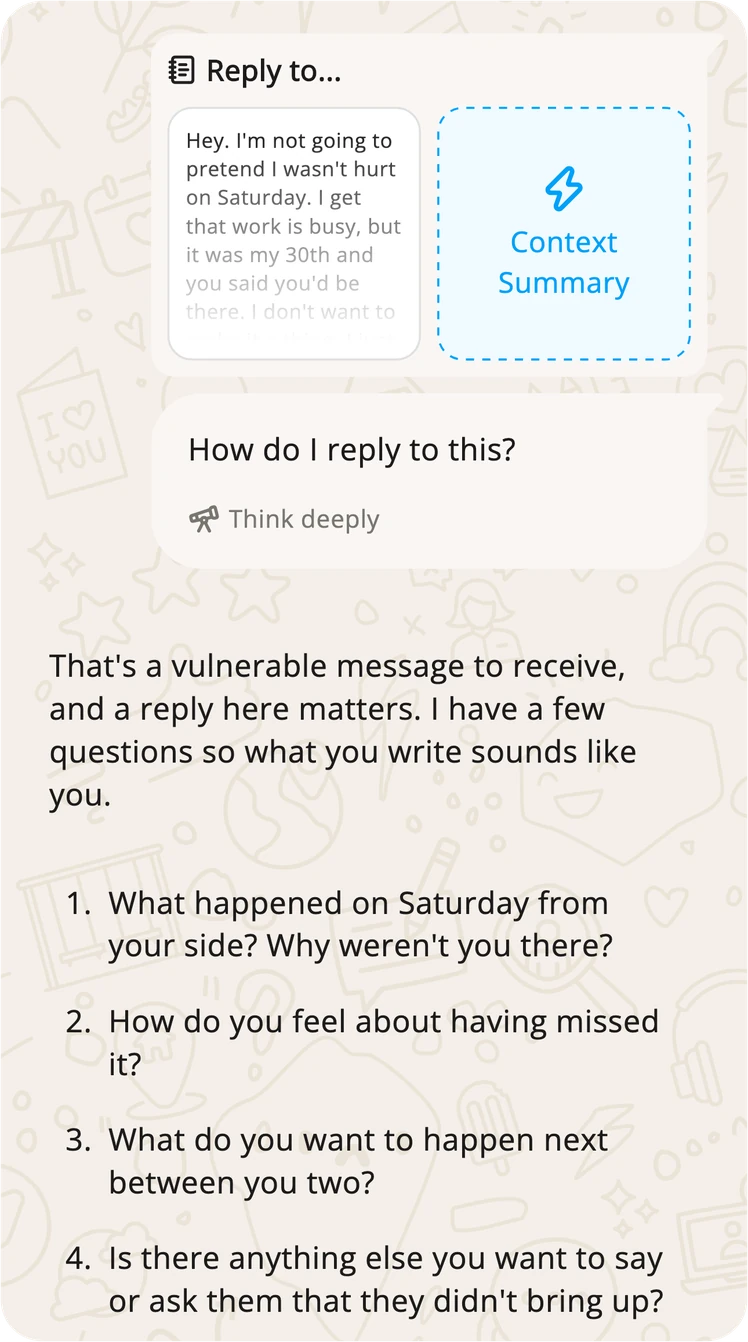
Often the other person writes first and says what it was like for them, which is the order Frantz and Bennigson found works better. When the apology is a reply and you have no draft at all, Subtext can ask before it writes. One exchange from 13 October 2026 shows it, with a made-up message and the app’s real answers. The message received was “Hey. I’m not going to pretend I wasn’t hurt on Saturday. I get that work is busy, but it was my 30th and you said you’d be there. I don’t want to make it a thing, I just needed to say it.” It went in as the message to reply to, with the request “How do I reply to this?” and with deeper thinking switched on. Before writing anything, Subtext asked four questions: what happened on Saturday from your side, how you feel about having missed it, what you want to happen next, and whether there is anything else to say. The first three came with suggested answers.
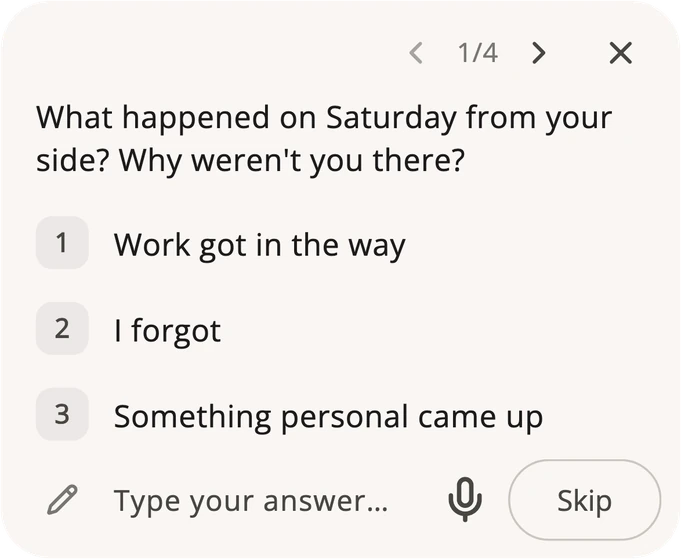
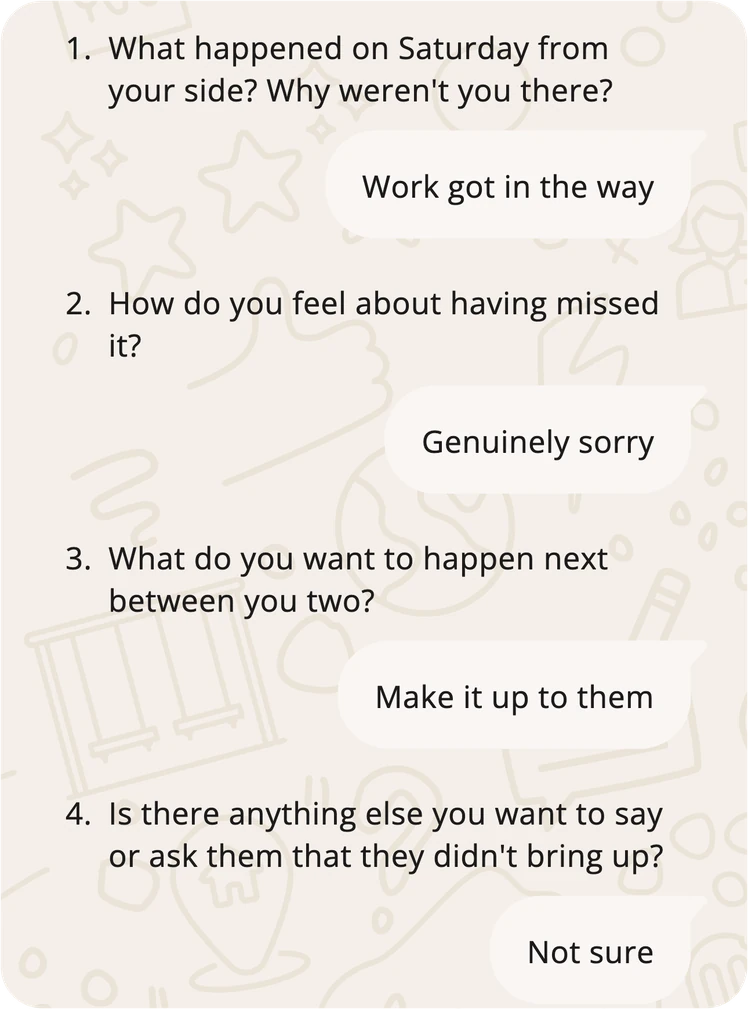
In this exchange the first suggested answer was chosen each time, “Work got in the way”, “Genuinely sorry” and “Make it up to them”, and the open question got “Not sure”. The first version, “Short and sincere”, reads “I’m really sorry I wasn’t there on Saturday. Work got in the way, but it was your 30th and I should have been there. Thank you for telling me. I’d love to make it up to you.” It is marked safe to send. Hold it against check 3 above. It gives the reason, “Work got in the way”, before “I should have been there”, and it does so because that was the answer given. Cut the reason if it reads as an excuse to you.
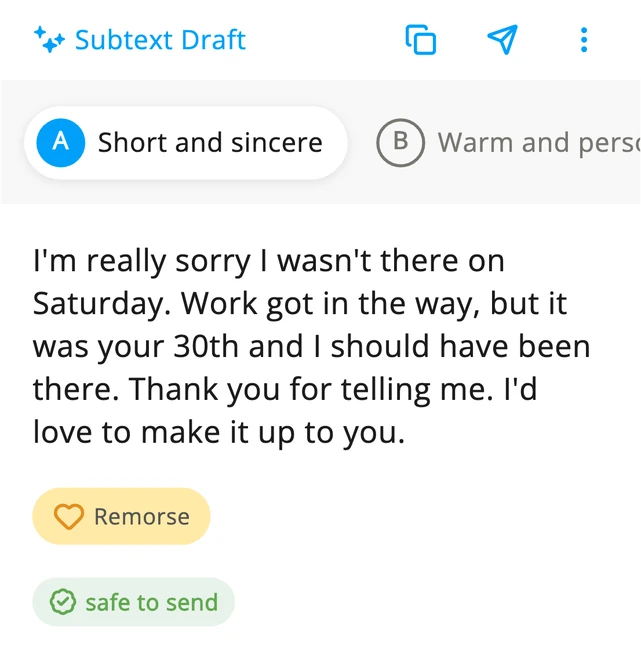
Two things about the other versions belong here. The second and third propose a dinner and a celebration nobody had mentioned, and Subtext said so itself. And the third gets a fact backwards. It says “You told me you’d be there for your 30th, and I wasn’t.”, where the friend wrote “you said you’d be there”. Read every version against the message you are answering before you send one.
Try Subtext in your browserDownload on the App StoreGet it on Google PlayScan it with your phone camera to install.
When you should not apologise
Everything above assumes a situation where trust was broken and both people want it repaired. Some situations are not that, and the research changes shape.
Demanded apologies repair less than volunteered ones. Langlinais and Tomlinson had working adults watch a colleague fail to complete a task, then either demand an apology or wait17. The forced apologies produced lower trust repair than the voluntary ones. The comparison rests on roughly 82 cases, and the study did not randomly assign whether to demand, so treat it as one study, not a settled result.
Coerced apologies are visible to everyone except the person receiving them. Risen and Gilovich found across five studies that observers reliably distinguish spontaneous apologies from coerced ones, while the targets often do not, and tend to accept questionable apologies under social pressure18. Children as young as seven make the same distinction that adults miss. Smith and colleagues found older children rated a coerced apology as less effective at communicating remorse and at mending the victim’s feelings19.
Sometimes the person apologising is the person who was harmed. DARVO describes a pattern where someone confronted about their behaviour denies it, attacks, and reverses the roles of victim and offender, so that the person who raised the concern ends up apologising. Harsey and Freyd showed in a vignette experiment with 230 undergraduates that this shifts perceived blame onto the victim20.
If “apologise” in practice means admitting your boundary was wrong, taking responsibility for someone else’s aggression, withdrawing a truthful account, or reassuring the person controlling you that their behaviour was justified, then this is not the trust-repair situation any of the studies above examined. Nothing in the psychology of effective apologies is an instruction to comply. An apology made to get safely through a moment is self-protection and admits nothing.
If this is where you are, the National Domestic Violence Hotline has a page specifically on what it means when an abusive partner apologises, and states plainly that you have the right to refuse one21. In the UK, SafeLives has guidance on coercive control and where to get support22. Talking to someone outside the situation is worth more than getting the wording right.
Think I have read a study wrong, or know research on this I have missed? Tell me on LinkedIn.
Samet Durgun is the co-founder of Subtext, an app that catches the emotional tone of your messages and rewrites them in your own voice. He’s based in Berlin.
Sources
Numbered in the order they appear above. Where a figure could not be verified against the primary source, the text says so. Checked 27 September 2026. The Subtext exchange under How I use this is from 13 October 2026. This piece touches apologising inside coercive or abusive relationships; if that is where you are, the two resources at source 21 and 22 are a better next step than an article.
- Lewicki, R. J., Polin, B., and Lount, R. B. Jr. (2016). An Exploration of the Structure of Effective Apologies. Negotiation and Conflict Management Research, 9(2), 177 to 196.
- Ohio State University News. The 6 elements of an effective apology, according to science. Source of the 755 participant total.
- De Cremer, D., Pillutla, M. M., and Reinders Folmer, C. (2011). How Important Is an Apology to You? Forecasting Errors in Evaluating the Value of Apologies. Psychological Science, 22(1), 45 to 48.
- Frantz, C. M., and Bennigson, C. (2005). Better late than early: The influence of timing on apology effectiveness. Journal of Experimental Social Psychology, 41(2), 201 to 207.
- Gao, S., and Yan, J. (2022). Verbal or Written? The Impact of Apology on the Repair of Trust. Frontiers in Psychology, 13:884867.
- Schumann, K. (2014). An affirmed self and a better apology. Journal of Experimental Social Psychology, 54, 89 to 96.
- Baumann, P. (2021). “Sorry If! On Conditional Apologies.” Ethical Theory and Moral Practice, 24(5), 1079 to 1090.
- Scott, M. B., and Lyman, S. M. (1968). Accounts. American Sociological Review, 33(1), 46 to 62.
- Schumann, K., Ritchie, E. G., and Forest, A. (2023). The Social Consequences of Frequent Versus Infrequent Apologizing. Personality and Social Psychology Bulletin, 49(3), 331 to 343.
- Brooks, A. W., Dai, H., and Schweitzer, M. E. (2014). “I’m Sorry About the Rain! Superfluous Apologies Demonstrate Empathic Concern and Increase Trust.” Social Psychological and Personality Science, 5(4), 467 to 474.
- British Psychological Society Research Digest, on the design of the Brooks field study.
- Schumann, K., and Ross, M. (2010). Why Women Apologize More Than Men. Psychological Science, 21(11), 1649 to 1655.
- Degenhardt, J., and Bernaisch, T. (2022). Apologies in South Asian Varieties of English: A Corpus-Based Study on Indian and Sri Lankan English. Corpus Pragmatics, 6(3), 201 to 223.
- Fehr, R., Gelfand, M. J., and Nag, M. (2010). The road to forgiveness: A meta-analytic synthesis. Psychological Bulletin, 136(5), 894 to 914.
- Correction to Fehr, Gelfand and Nag (2010). Psychological Bulletin, 137(2), 366.
- Freedman, G., Burgoon, E. M., Ferrell, J. D., Pennebaker, J. W., and Beer, J. S. (2017). When Saying Sorry May Not Help. Frontiers in Psychology, 8, 1375.
- Langlinais, L. A., and Tomlinson, E. C. (2025). Forced versus Voluntary Apologies. Negotiation and Conflict Management Research, 19(1), 30 to 45.
- Risen, J. L., and Gilovich, T. (2007). Target and observer differences in the acceptance of questionable apologies. Journal of Personality and Social Psychology, 92(3), 418 to 433.
- Smith, C. E., Anderson, D., and Straussberger, A. (2018). Say You’re Sorry: Children Distinguish Between Willingly Given and Coerced Expressions of Remorse. Merrill-Palmer Quarterly, 64(2).
- Harsey, S., and Freyd, J. J. (2023). The Influence of Deny, Attack, Reverse Victim and Offender and Insincere Apologies on Perceptions of Sexual Assault. Journal of Interpersonal Violence, 38(17 to 18), 9985 to 10008.
- National Domestic Violence Hotline. What If My Abusive Partner Apologizes?
- SafeLives. What Is Coercive Control?