
ArticlesMessages
How do you deal with passive aggressive people?
Passive aggressive personality disorder was removed from the diagnostic manual entirely, and no controlled experiment tests whether naming the behaviour reduces it. What is actually known.
By Samet Durgun · Co-founder of Subtext · 9 min read
· Updated October 14, 2026
Someone in your life keeps agreeing to things and not doing them, or saying “fine” in a way that is clearly not fine, and you cannot work out whether they are managing you or whether you are inventing it. I co-founded Subtext, and messages people cannot decide about are most of what I look at.
I’d start with how unstable the ground is. Passive aggression started as a wartime military description, spent decades as a formal psychiatric diagnosis, and was removed from the diagnostic manual altogether in 2013. And the confident advice you have read about how to handle it is almost entirely untested.
None of that means the behaviour is not real, but most of what people write about it is opinion wearing a lab coat.
It was a diagnosis, and then it wasn’t
The term came out of a US War Department bulletin drafted in 1943, describing soldiers who resisted authority indirectly through inefficiency, procrastination and passive obstruction, not open defiance1. That document was the direct ancestor of the first diagnostic manual.
It survived as a diagnosis for decades. In the 1980 edition it carried a feature unique among the personality disorders. Clinicians could only diagnose it if the patient met criteria for no other personality disorder. By 1994 the manual had renamed it negativistic personality disorder and moved it to an appendix for further study. By 2013 it was gone entirely, surviving only as an unspecified personality disorder or through trait facets.
Theodore Millon, who championed the renaming, gave five reasons for the move2: insufficient acceptance in the clinical literature, content too narrow and behavioural, behaviour too situational to reflect a syndrome, a term implying a motivation at a time when criteria were meant to be purely descriptive, and too much overlap with other disorders.
The empirical case was strong. In 1,158 psychiatric outpatients, internal consistency of the seven diagnostic items was low at alpha 0.50, only 3 per cent met criteria, and almost 90 per cent of those had at least one other personality disorder3. A separate study of 1,215 undergraduates found the correlation between the older passive-aggressive construct and the newer negativistic one was only .52, lower than the correlation between negativistic and borderline personality disorder2.
The fourth of Millon’s reasons is the one I think matters most for anyone trying to decide what is happening in their own life. Diagnostic criteria that omit motive cannot distinguish passive aggression from disorganisation or inattention, because the whole concept depends on the behaviour meaning something. Missing a deadline counts as passive aggression only if the person meant it to communicate. You cannot read that off the behaviour.
Which is exactly the position you are in when you look at the message. What the sender meant is not answerable from the words, and the diagnostic manual gave up on that question for the same reason.
What the research studies instead
Three replacement constructs, all self-report or peer-report, all measuring perceived behaviour, none of it verified.
Negativistic personality, from Millon’s model, describing conflict between dependency on others and the desire for self-assertion. Millon proposed subtypes; these are theoretical taxonomy, and nobody ever validated them as distinct types, so treat them as a framework.
Covert hostility, the internalised side of unexpressed anger and cynicism. I’ll note that the widely used Buss-Perry Aggression Questionnaire has no passive-aggression subscale. Its four factors are physical aggression, verbal aggression, anger and hostility.
Indirect aggression, meaning behaviour intended to harm while concealing intent, avoiding counterattack. Researchers measure it through several scales originally developed with Finnish schoolchildren using peer nomination.
Adult scales do exist, including a Passive Aggression Scale validated with 408 Korean adults in 20224, but none of them can tell you what one message meant. When you read a statistic about how many people are passive aggressive, ask what instrument produced it.
At work, one thing has been measured
Most of the workplace discourse rests on a vendor survey. One study measured the thing directly.
Yuan, Park and Sliter separated active email incivility, meaning put-downs and demeaning content, from passive email incivility, meaning tuning someone out, ignoring them, withholding replies5. A survey of roughly 233 working US employees supported the distinction empirically, and a diary study found passive incivility was positively associated with insomnia, which then predicted heightened negative affect at the start of the workday.
The finding that explains the whole phenomenon is that active incivility drove a stronger emotionality appraisal, while passive incivility was appraised as more ambiguous. Participants reported not knowing what it meant.
That ambiguity is the harm. Because uncivil acts of this kind are deniable, targets burn cognitive resources decoding whether the person was malicious or merely careless, and that decoding cost is what you take home. It is also why an openly rude email is easier to recover from than three words that might mean nothing, and why resolving the ambiguity quickly matters more than resolving it correctly.
Correlational and diary-based, so it does not establish that a terse email causes insomnia. It does establish which category of message people cannot put down.
The broader incivility literature is real. A survey of 1,180 US public-sector employees found 71 per cent reported experiencing incivility over five years, with instigators disproportionately people holding organisational power6. Be sceptical of the widely quoted 98 per cent figure, which comes from a practitioner magazine article that was not peer reviewed.
The markers will not settle it
Only one written marker has solid experimental backing, and it is the full stop on a one-word reply. Emoji have a documented problem with ambiguity, not hostility. Everything else people list, meaning “noted”, “per my last email”, “sure”, “K”, delayed replies, ellipses and the thumbs-up, has no direct peer-reviewed evidence as a marker of hostility.
I have written that up properly, with the studies and their limits, in what a full stop actually signals and is that email passive aggressive, or just short. For the purposes of this post, the markers will not settle the question for you, which is why the rest of this article is about the person, not the punctuation.
Are you over-reading it?
This is a live disagreement and I am not going to pretend otherwise.
The over-reading case. Kruger and colleagues found across five experiments that senders substantially overestimate their ability to convey tone in writing, because they hear their own intended prosody while composing and cannot decouple from it7. Sillars and Zorn found receivers rated emails more negatively than uninvolved observers did8. Hostile attribution bias and the illusion of transparency both predict over-attribution of hostile intent under ambiguity, the same pull behind are they mad at me, or am I overthinking it.
The counter-case, and it is strong. Pollmann and Roos asked both parties9. Participants uploaded a message they had actually received and rated its warmth; Pollmann and Roos then asked the person who wrote it what they had intended. Across 347 receivers with 171 matched senders for texts, and 361 receivers with 61 matched senders for work emails, sender and receiver ratings aligned well. Six moderators, including message length and emoji, changed nothing.
I have a plausible reconciliation, though it is only my reading. The over-reading studies mostly use lab settings, constructed stimuli, strangers, and tasks like detecting sarcasm in isolated items. Pollmann and Roos used real messages between people with existing relationships. Context and history may supply exactly the disambiguating information a lab strips out.
Two flags on the counter-case. The venue is a companion open-access title, not the parent journal, and the study is recent and not yet replicated.
What this means for you. In lab conditions and between strangers, tone travels unreliably and skews negative. Between people who know each other, in real exchanges, it travels better than the folklore suggests. So if this is a colleague you barely know, your uncertainty is well founded, so ask, or check your reply before you send it. If it is someone you have exchanged thousands of messages with, your reading is probably closer than you think, in either direction.
That gap is where a tone-checking tool is worth something, and where I would be careful about overclaiming. Subtext can tell you what a received message asks of you, and mark the words in your own reply that could land wrong. It cannot tell you what someone meant, and the research above is the reason I will not pretend otherwise.
Try Subtext in your browserDownload on the App StoreGet it on Google PlayScan it with your phone camera to install.
Does naming it help?
There is no controlled experiment testing whether calling someone’s behaviour passive aggressive reduces it. I made three separate research passes for this piece, and all three agree. Anyone giving you a confident script here is giving you clinical practice, which is not nothing, but it is not evidence.
What is testable, and what researchers have tested, is narrower.
Rogers, Howieson and Neame had participants read hypothetical conflict-opening statements varying on I-language against you-language, and on whether the speaker communicated awareness of the other person’s perspective10. Both I-language and communicating perspective reduced how defensively people expected the recipient to react.
I think the counterpoint matters. Korobov analysed young adult couples arguing in natural contexts and found arguments were often initiated with I-language feelings talk, which failed to defuse the conflict and drew deflection11. Only when the I-language demonstrated awareness of the other person’s feelings did it promote alignment.
Read together, I-statements reduce anticipated hostility when people rate hypothetical statements, and perform less impressively in observed real arguments unless they carry real perspective-taking. That is a lab-versus-field gap, and it suggests the perspective-taking half is the active ingredient rather than the grammatical construction.
So my defensible version of the advice is to describe the specific behaviour, not the trait, say what it did to you, make a concrete request, and show you have understood their side. No trial proved it, but the one thing that separated success from failure in real arguments was demonstrated awareness of the other person.
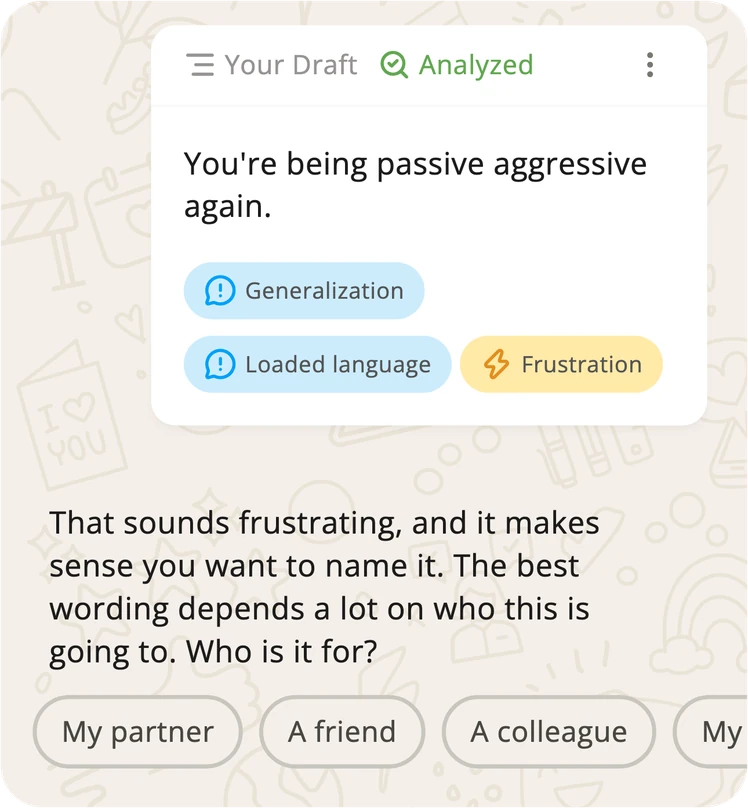
In one run, Subtext drew the same line between the behaviour and the trait. On the draft “You’re being passive aggressive again.”, made up for the run, it returned the tags Generalization and Loaded language and named the feeling as Frustration. The note on the second said that “passive aggressive” “is a label about who they are, which tends to trigger defensiveness rather than a real conversation”. That is the app’s estimate of how the line reads. The studies above support only the weaker point, that people expect a you-statement to be met defensively. The note on the first said that “again” frames this as a repeated pattern. It wrote no version. It replied “That sounds frustrating, and it makes sense you want to name it. The best wording depends a lot on who this is going to. Who is it for?” That is the app’s real output, unedited.
On assertiveness training generally, a review found a large but dated literature supporting it, mostly peaking in the 1970s and 80s, with modern high-quality research diminished drastically. I look at the wider question of whether setting boundaries is actually good for you separately.
Where this stops being about style
An irritating communication style, a chronic withdrawal pattern, and a course of controlling behaviour are three different things, and the third one is not a communication problem.
The distinction turns on pattern, transparency, power and effect. Silence and indirection used as punishment, in a repeating cycle where the only thing that ends it is your capitulation, and which produces hypervigilance and changed behaviour in you, is a different phenomenon from someone who is bad at saying what they want.
In England and Wales, controlling or coercive behaviour in an intimate or family relationship has been a criminal offence since the Serious Crime Act 2015, where the behaviour is repeated or continuous between people who are personally connected and has a substantial adverse effect on day-to-day activities.
Do not pathologise the first thing while naming the second. Most passive aggression is exactly what it looks like: someone who finds direct conflict harder than indirect resistance. If what you are living with is the other thing, the wording of your next message is not the problem to solve, and someone outside the situation is worth talking to.
Sources
Numbered in the order they appear above. Where a figure could not be verified against the primary source, the text says so.
- War Department Technical Bulletin, Medical 203 (drafted 1943, issued 1945). The direct ancestor of the first Diagnostic and Statistical Manual. Described here via the secondary account in source 2; primary text not directly consulted.
- Hopwood, C. J., and Wright, A. G. C. (2012). A comparison of passive-aggressive and negativistic personality disorders. Journal of Personality Assessment, 94(3), 296 to 303. 1,453 undergraduates sampled, 1,215 retained. Funded in part by NIMH grant F31MH087053.
- Rotenstein, O. H., and colleagues (2007). A cross-sectional evaluation of the DSM-IV criteria for passive-aggressive personality disorder. Journal of Psychiatric Research. 1,158 psychiatric outpatients. Funder not stated in the accessible record.
- Lim, Y.-O., and Suh, K.-H. (2022). Development and Validation of a Measure of Passive Aggression Traits: The Passive Aggression Scale (PAS). Behavioral Sciences, 12(8), 273. Item analysis with 123 Korean adults, reliability and validity with 408.
- Yuan, Z., Park, Y., and Sliter, M. T. (2020). Put you down versus tune you out: Further understanding active and passive email incivility. Journal of Occupational Health Psychology, 25(5), 330 to 344. Support acknowledged in connection with CDC and NIOSH; exact grant line needs confirming.
- Cortina, L. M., Magley, V. J., Williams, J. H., and Langhout, R. D. (2001). Incivility in the workplace. Journal of Occupational Health Psychology, 6(1), 64 to 80. 1,180 US public-sector employees. The description of the exact population conflicts across secondary sources and needs verifying against the paper.
- Kruger, J., Epley, N., Parker, J., and Ng, Z.-W. (2005). Egocentrism Over E-Mail. Journal of Personality and Social Psychology, 89(6), 925 to 936. The specific accuracy percentages differ by study within the paper and conflict across secondary sources; none are quoted here.
- Sillars, A., and Zorn, T. E. (2021). Hypernegative Interpretation of Negatively Perceived Email at Work. Management Communication Quarterly, 35(2), 171 to 200.
- Pollmann, M. M. H., and Roos, C. A. (2025). “I get u”. People correctly interpret the tone of text messages and emails. Computers in Human Behavior Reports, 18, article 100689. A companion open-access title; recent and not yet replicated.
- Rogers, S. L., Howieson, J., and Neame, C. (2018). I understand you feel that way, but I feel this way: the benefits of I-language and communicating perspective during conflict. PeerJ, 6, e4831. Vignette study, 253 students, Edith Cowan University. No external funding.
- Korobov, N. (2020). Failure of I-statements for Mitigating Interpersonal Conflict in Arguments Between Young Adult Couples. Studies in Media and Communication, 8(2), 49 to 60. Qualitative, 20 couples, roughly 140 hours of home recordings; the 61 per cent figure is a descriptive count without inferential statistics. Author-fee open-access venue.