ArticlesMessages
How do you tell someone they hurt you over text?
The pronoun is doing less work than the perspective-taking. Name the hurt rather than the anger, because anger gets noticed and hurt gets missed. And delete any sentence that starts with I feel that you.
By Samet Durgun · Co-founder of Subtext · 9 min read
· Updated October 14, 2026
You have the draft open. It has been open for an hour. Every version either sounds like an accusation or hedges until it no longer says anything happened. I co-founded Subtext, and this is the message people revise the most and send the least. If the fight has already happened and you are past the raising-it stage, what to text after an argument covers the repair. And if the person you are writing to frightens you, skip to the last section, because the advice in between does not apply.
The advice you have already read says use I-statements. That advice has real experimental support, from studies where people rate hypothetical sentences. When researchers recorded real couples arguing at home, the picture changed. What survives both the lab and the field is narrower and more useful. The pronoun matters less than showing you have understood the other person’s side, and naming hurt rather than anger changes what comes back.
I-statements, in the lab and in the kitchen
The lab evidence is consistent and favourable. Rogers, Howieson and Neame had 253 students read possible opening lines to a conflict, varying “I” against “you” language and whether the speaker showed awareness of the other person’s perspective, and rate how defensively the recipient would react1. Both I-language and communicated perspective reduced expected hostility. The best-rated statement combined the two, acknowledging the other person’s view before stating one’s own. The authors’ own emphasis is that perspective mattered regardless of pronoun.
Nobody in that study was in a conflict, which is its structural limit. Participants predicted how a hypothetical third party would react to a sentence on a page.
The field evidence points the other way. Korobov gave 20 couples an audio recorder to take home for two weeks, producing roughly 140 hours of ordinary conversation2. In the arguments, over 61 per cent contained a moment where one partner opened with an “I feel” statement and the other deflected it straight back, answering the subjective claim with an objective rejoinder that relocated the blame.
That is a descriptive count from a small corpus, in a low-tier venue, with no inferential statistics. Hold it lightly. But it was not the paper’s whole finding, and the half that people leave out inverts the advice. When the I-language showed awareness of the partner’s feelings or of the dynamic between them, it did promote alignment. Korobov’s closing recommendation is to add that awareness, not to abandon the form.
A separate experiment found no difference in how “I feel hurt” and “you hurt me” landed for negative emotions in general, non-romantic contexts3. And in a small qualitative study of 23 experienced female engineers, a third explicitly advised against “I feel” language at work, describing it as ceding authority4. Eight people, asked what they would advise, not observed doing it.
My reconciliation is that a vignette experiment and a naturalistic corpus study, using entirely different methods, both land on perspective-taking as the active ingredient. The pronoun alone does little, and possibly nothing outside close relationships. Owning your feeling and signalling that you have understood theirs does help.
Which gives you the one editing rule with support from both directions. Delete any sentence beginning “I feel that you”. It is a you-statement in disguise, the concept explicitly excludes it, and the field recordings show recipients hearing the accusation underneath and answering that.
This is the failure people cannot see in their own writing. “I feel that you never listen” reads as an I-statement from the inside and as a charge from the outside, and the difference is three words.
Hurt, not anger
This is the practical crux and it has better evidence than the pronoun question.
Sanford studied 83 married couples in conflict conversations and found that anger overshadows sadness to the point where a partner is likely to miss the sadness entirely5. In his own summary, anger trumps sadness in partner perception. Earlier work across three samples found hard emotion, meaning anger and aggravation, predicted increases in negative communication, while soft emotion, meaning sadness and hurt, predicted more benign responses and an appraisal that the conflict mattered and should be resolved6.
Lemay, Overall and Clark ran five studies on what follows from hurt against anger7. Both arose in response to feeling devalued. They diverged in consequences. Hurt was associated with the other person feeling guilt and empathy and responding constructively. Anger was not.
One design note from me, because it matters. None of the five Lemay studies manipulated whether someone expressed hurt or anger. These are associations. The claim that switching from anger to hurt will produce a better response is a reasonable extrapolation, not the thing the studies tested.
So soft emotion invites a better response, and it is simultaneously the thing most likely to go unnoticed. That’s why I’d name the hurt explicitly and not leave the other person to infer it from the tone, since a message written from hurt and sent as anger loses the one advantage the research gives it.
Two more findings that point the same way. Messages perceived as intentionally hurtful produce more distancing than those seen as unintentional, so if your message reads as accusing them of hurting you on purpose, expect more defence8. And people who wrote accounts of the same kind of event as both victim and perpetrator systematically downplayed the harm when writing as the perpetrator and saw the other’s reaction as excessive9. The person you are writing to is likely to remember this as smaller than you do, and that comes from the positions you each hold, not from malice.
Complaint, not criticism
Gottman’s descriptive vocabulary is clinically useful and the operational part is the distinction between a complaint, which names a specific behaviour and states a need, and a criticism, which attaches a global trait, usually with “always” or “never”.
Be sceptical of the predictive claims that travel with Gottman’s vocabulary. The famous divorce-prediction accuracies come from models that researchers fitted to data after the outcomes were known, which is explanation rather than prospective prediction10. More seriously, an independent team tested Gottman’s affective process models on 85 couples from a different population and found only 2 of 22 processes predicted whether the relationship survived11. Women’s negative start-up, the single finding people most often turn into advice about softening, did not predict separation. One of the two processes that did predict ran opposite to the gendered recommendation.
What survived is the broad sense that negativity corrodes and positivity helps. The specific sequential models and the gender-specific advice built on them did not.
I’d also note that softening is not always right, and the blanket advice to soften everything is not what the evidence shows. Direct opposition helps when a serious problem needs to change and the other person is capable of responding to it12. Validating, cooperative communication can help with minor or unchangeable problems and can fail to fix serious ones.
Written, or spoken?
No study directly compares telling someone they hurt you in writing against telling them in person. That is an open gap, and the adjacent evidence cuts both ways.
Writing gives you time and a record. It also strips the tone out while leaving you convinced the tone is obvious, which is the best-documented hazard in this whole area13. I have written about that separately in does this text sound rude. Its main point is that you are overconfident about irony and firmness and roughly accurate about plain warmth. A message about being hurt sits on the firmness side.
Asynchrony cuts both ways too. It lets you cool down and edit. It also lets you reread, ruminate, and assemble an exhaustive list of everything that has ever gone wrong. If what you keep rereading is a message they sent, why that text got to you is worth a look before you reply. No clean experiment settles which effect dominates.
And there is a real argument for the phone, from the same research programme. Voice reduces misinterpretation and increases felt connection relative to text, and a large set of randomised experiments on disagreement found spoken conversation produced more understanding and less conflict than written, even though 84 per cent of people preferred to write14. If you have the option, the call goes better than you expect.
The ways it goes wrong
The accusation in disguise. Covered above, and the most common failure.
Stacking the hedges. “Maybe I’m being too sensitive, it’s probably nothing, but”. The recipient can reasonably conclude that nothing needs to change, because that is what the preamble said. People have seen it in clinical practice, but experiments have not quantified it, and the evidence on tentative language is double-edged. It can raise influence with some audiences and lower it with others15.
Kitchen-sinking. Piling every past grievance into one message raises the odds of a defensive reply, and answering negativity with negativity is one of the more reliable markers of distressed relationships. One thing per message.
Sarcasm. Combined with the tone problem, sarcasm in a message about being hurt is close to guaranteed to be read at its most hostile plausible reading. Readers are poor at telling whether a text is sarcastic from the words alone.
Threatening the whole person. People defend a global sense of their own integrity, and a message that attacks it triggers defence16. One that affirms the relationship and targets a specific behaviour lowers it.
Subtext reads a draft like yours for which emotion is on the surface, because hurt that arrives sounding like anger is the version that gets missed. On a made-up draft, “Why didn’t you tell me earlier?”, Subtext named the feeling underneath as Hurt and tagged the wording as loaded language, because the question “can feel like an accusation and put the other person on the defensive”. That is the app’s real output, unedited.
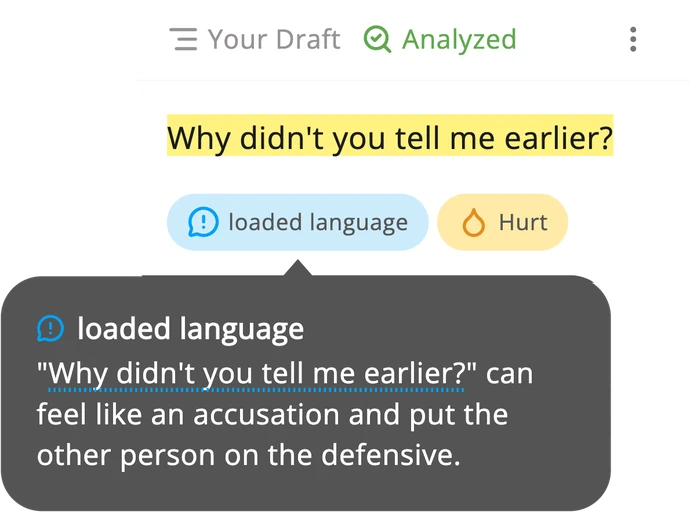
Subtext will tell you when the version you have is fine, which is more often than the hour you spent on it suggests.
Try Subtext in your browserDownload on the App StoreGet it on Google PlayScan it with your phone camera to install.
When none of this applies
Everything above assumes two people of roughly equal power, both acting in good faith. When the other person is abusive or coercively controlling, the advice inverts, and I’ll be explicit about why.
Coercive control is an ongoing pattern of domination, intimidation, isolation and control, not a series of incidents, and it is a criminal offence in England and Wales, in Scotland, and in some Australian states, New South Wales among them since July 202417. Laws differ by country and change, so check where you live. In that context, telling someone what hurts you tells a controlling person exactly where to apply pressure.
There is a documented response pattern to watch for. In a survey of undergraduates who had confronted someone over a wrongdoing, a large majority reported the person simultaneously denied it, attacked them, and tried to reverse who was the victim18. Higher exposure to that pattern predicted more self-blame in the person who raised it. A follow-up experiment found that seeing a perpetrator do this made observers rate the victim as less believable. I’d treat this as emerging evidence, from one lab, mostly student vignettes. The pattern is real enough to name.
Here the advice inverts. With someone abusive or coercively controlling, do not disclose vulnerability, because it arms them. Do not negotiate, because there is no good-faith exchange to be had. Do document. Written communication flips from an emotional tool to an evidence tool, and dated, factual, unemotional records can support protective orders. Keep copies somewhere the person cannot reach. If they can see your phone or your accounts, keeping records there can itself be risky, since abusers use tracking apps and shared accounts to monitor a partner19. A helpline can help you plan how to keep records safely.
I’d also keep couples counselling out of it where coercive control is present, because framing abuse as a mutual communication problem is both false and dangerous. A meta-analysis of six studies on couples therapy for partner violence concluded it can be a viable treatment in select situations, and its authors note that professionals are cautious because of the risk of violent retaliation20.
If any of this describes what you are living with, the wording of your next message is not the problem to solve. In the UK, Refuge runs a free 24-hour helpline on 0808 2000 247. In the US, the National Domestic Violence Hotline is 1-800-799-7233, or text START to 88788. For other countries, hotpeachpages.net lists lines by country. Talking to someone outside the situation is worth more than any draft.
Sources
Numbered in the order they appear above. Where a figure could not be verified against the primary source, the text says so.
- Rogers, S. L., Howieson, J., and Neame, C. (2018). I understand you feel that way, but I feel this way. PeerJ, 6, e4831. 253 students, Edith Cowan University, mean age 28, 77 per cent female. No funding declared.
- Korobov, N. (2020). Failure of I-statements for Mitigating Interpersonal Conflict in Arguments Between Young Adult Couples. Studies in Media and Communication, 8(2), 49 to 60. Twenty couples, roughly 140 hours of home recordings. Qualitative; the 61 per cent is a descriptive count without inferential statistics. Author-fee open-access venue.
- Bippus, A. M., and Young, S. L. (2005). Owning your emotions: Reactions to expressions of self- versus other-attributed positive and negative emotions. Journal of Applied Communication Research, 33(1), 26 to 45. Sample size could not be verified.
- Wolfe, J. (2018). IEEE Professional Communication Conference, Toronto. Twenty-three female engineers with five or more years’ experience; discourse completion interviews. Conference paper, measures stated strategy.
- Sanford, K. (2010). Perceived sadness in couples’ conflict conversations. Journal of Family Psychology, 24(2). Eighty-three married couples.
- Sanford, K. (2007). Hard and soft emotion during conflict. Personal Relationships, 14, 65 to 90. Three studies: 236 married people, 140 students, 77 couples observed. Correlational.
- Lemay, E. P., Overall, N. C., and Clark, M. S. (2012). Experiences and interpersonal consequences of hurt feelings and anger. Journal of Personality and Social Psychology, 103(6), 982 to 1006. Five studies, all correlational; per-study samples not retrieved.
- Vangelisti, A. L., and Young, S. L. (2000). When words hurt: The effects of perceived intentionality on interpersonal relationships. Journal of Social and Personal Relationships, 17(3), 393 to 424.
- Baumeister, R. F., Stillwell, A., and Wotman, S. R. (1990). Victim and perpetrator accounts of interpersonal conflict. Journal of Personality and Social Psychology, 59(5), 994 to 1005.
- Heyman, R. E., and Slep, A. M. S. (2001). The hazards of predicting divorce without cross-validation. Journal of Marriage and Family, 63(2), 473 to 479.
- Kim, H. K., Capaldi, D. M., and Crosby, L. (2007). Generalizability of Gottman and Colleagues’ Affective Process Models of Couples’ Relationship Outcomes. Journal of Marriage and Family, 69(1), 55 to 72. Eighty-five couples from the Oregon Youth Study; only 2 of 22 processes predicted relationship survival. NIH-funded.
- Overall, N. C., and McNulty, J. K. (2017). What type of communication during conflict is beneficial for intimate relationships? Current Opinion in Psychology, 13, 1 to 5.
- Kruger, J., Epley, N., Parker, J., and Ng, Z.-W. (2005). Egocentrism over e-mail. Journal of Personality and Social Psychology, 89(6), 925 to 936. Every figure from this paper must be attributed to a specific study; none is quoted here.
- Bevis, B., Schroeder, J., and Yeomans, M. (2026). Spoken disagreement is more constructive than written disagreement. Nature Communications, 17, 5792. See also Kumar and Epley (2021), Journal of Experimental Psychology: General, 150(3), on voice and felt connection; sample details not verified.
- Carli, L. L. (1990). Gender, language, and influence. Journal of Personality and Social Psychology, 59(5), 941 to 951. With Leaper and Robnett (2011) finding a small gender difference in tentative language, d = .23.
- Sherman, D. K., and Cohen, G. L. (2006). The psychology of self-defense: Self-affirmation theory. Advances in Experimental Social Psychology, 38, 183 to 242.
- Legislation. Serious Crime Act 2015, section 76, Controlling or coercive behaviour in an intimate or family relationship (England and Wales). · Domestic Abuse (Scotland) Act 2018, section 1, Abusive behaviour towards partner or ex-partner. https://www.legislation.gov.uk/asp/2018/5/contents · NSW Government. Coercive control and the law. Criminal offence in New South Wales from 1 July 2024, for current or former intimate partners. https://www.nsw.gov.au/family-and-relationships/coercive-control/law
- Harsey, S. J., Zurbriggen, E. L., and Freyd, J. J. (2017). Perpetrator responses to victim confrontation: DARVO and victim self-blame. Journal of Aggression, Maltreatment and Trauma, 26(6), 644 to 663. Reported sample of 138; a conflicting figure of 267 circulates and is unresolved. With Harsey and Freyd (2020), Experiment 1, 316 students.
- Refuge. Refuge Tech Safety, guidance on technology-facilitated abuse, including tracking apps and shared financial accounts.
- Karakurt, G., Whiting, K., van Esch, C., Bolen, S. D., and Calabrese, J. R. (2016). Couples Therapy for Intimate Partner Violence: A Systematic Review and Meta-Analysis. Journal of Marital and Family Therapy, 42(4), 567 to 583. Six studies, 470 participants. Concludes couples therapy is a viable treatment in select situations.