
ArticlesMessages
What is dry texting?
Dry texting means short, flat, low-effort replies that make a conversation feel like hard work. Short replies are reliably read as disinterest. Whether they actually are disinterest is a question almost nobody has tested.
By Samet Durgun · Co-founder of Subtext · 11 min read
· Updated October 14, 2026
Dry texting is the thing where someone replies “yeah”, then “haha”, then “cool”, and the conversation dies without anyone deciding to end it. You are carrying all of it. Every message you send costs you something and every reply you get back costs them nothing. I built Subtext around messages people cannot read, and this is the pattern people ask about most after being left on read.
My short answer is that dry texting is a real perception with weak evidence behind the interpretation. People read short, slow, low-effort replies as disinterest, and that part is well established. Whether a short reply actually means disinterest is a different question, and almost nobody has studied it. Every article about this merges those two things, and separating them changes what you should do.
Is dry texting a real thing, or just a word?
Mostly a word. “Dry texting” is vernacular and it does not appear as a construct in psychology research, with one qualified exception.
Zullaicha and colleagues published a qualitative study in 2025 treating “dry text” as digital body language on WhatsApp, using Stuart Hall’s encoding and decoding model1. Their conclusion is that reading a dry message is highly subjective and depends on how close you are, what your history is, and what mood you are in. Useful framing, but I would not lean on it. The journal is not indexed in the major databases, I could not retrieve the full text to establish the sample size, and the paper’s own reference list cites a Vogue article alongside its academic sources. That tells you how thin the scholarly base is.
The strongest peer-reviewed anchor is Fang, Zhang and Maglio2. Eight preregistered studies, 5,306 participants, including an archival analysis of real Tinder conversation histories across 37 countries. Abbreviated messages made senders look less sincere and lower effort, and reduced the likelihood of getting a reply at all. That last part matters because it is measured behaviour rather than a rating of a hypothetical message.
It studies abbreviations, not one-word replies, so I’m applying it to dry texting as an inference. A close one, but an inference.
The two questions everyone merges
Are short replies read as disinterest? Yes, and the evidence is decent.
Response latency carries social information in a measurable way. Kalman and colleagues analysed more than 150,000 responses across email, discussion groups and an online market, and found reply times follow a power law, where most come fast and a few come very late3. Kalman and Rafaeli then showed that unusually long silences violate expectations and shift how people perceive the sender4.
Punctuation does something similar. Gunraj and colleagues found a full stop on a one-word reply made it read as less sincere, and the same manipulation did nothing in handwritten notes5. I have written about that study and its limits separately in what a full stop actually signals.
Do short replies actually indicate disinterest? Almost nobody has tested this, and what evidence exists points away from your instinct.
Kruger, Epley, Parker and Ng ran five experiments on how well people communicate tone in writing, and the headline is that senders are badly overconfident about being understood6. It is why you can’t tell from the inside whether a text sounds rude. Boothby and colleagues documented the liking gap: people systematically underestimate how much their conversation partners liked them, in the lab, among first-year students living together across a year, and at a workshop7.
So the reading runs negative and the reading is often wrong. What does not exist, as far as I can establish, is a study that measures a sender’s actual interest level alongside the recipient’s inference from their message length. That is the study that would settle this, and nobody has done it. Anyone telling you what a dry text means is filling that gap with confidence rather than data.
Why the negative read wins
Not because everyone defaults to the worst interpretation. I think that claim is too strong, and the paper people usually cite for it says something narrower.
Kingsbury and Coplan showed participants ambiguous texts, things like “I heard about last night”, and asked how likely a benign reading was against a negative one8. Across 215 and then 353 undergraduates, the finding was that high social anxiety predicted the negative reading. Participants also rated messages attributed to female senders more negatively. That is a moderator result. It says the negative reading is strong in some people and some configurations, and it does not say everyone defaults there.
The general tendency is real. Baumeister and colleagues’ review of negativity bias is well supported9. But one of the tidiest folk explanations has fallen apart. Malle meta-analysed the actor-observer asymmetry, the idea that we excuse ourselves and blame others, across 173 studies and found average effects near zero, holding only in specific conditions and reversing for positive events10.
Where the negative default does hold is inside relationships that are already strained. Bradbury and Fincham showed distressed couples make more distress-maintaining attributions11. If you are already unhappy with someone, the short reply confirms it. If you are not, it usually does not register. Whether that applies to the message you are looking at right now is a judgement only you can make, because you know the relationship.
The boring reasons someone texts dry
I’ll go through them, because the popular version treats brevity as a deliberately encoded message and most of the research treats it as a byproduct.
They are a short texter. Personality does show up in language. Yarkoni analysed over 100,000 words from 694 bloggers, and Schwartz and colleagues analysed roughly 700 million words from about 75,000 Facebook volunteers, finding extraversion associated with more social and positive words1213. Nobody has established the specific claim that introverts send shorter texts. I looked. It is a plausible mechanism, not a documented finding, and most articles state it as fact.
They are autistic, and you are not. Milton’s double empathy problem argues that communication breakdown between autistic and non-autistic people is mutual rather than an autistic deficit14. Crompton and colleagues tested it with 72 participants in nine diffusion chains and found information degraded significantly faster in mixed autistic and non-autistic chains, while all-autistic chains performed as well as all-non-autistic ones15. Howard and Sedgewick surveyed 245 autistic adults and found text and email ranked highly as preferred modes while phone calls ranked worst16.
Note the limit, because people misuse it constantly. That last study establishes mode preference. It says nothing about message length. Autistic adults preferring text does not mean autistic adults text shorter.
They punctuate like someone older. A full stop reads as marked to someone raised in punctuation-free group chats and completely neutral to someone who learned to write before texting existed. Same message, two readings, no intent involved.
They are distracted. The intuition is strong and the science is weak. Ophir, Nass and Wagner reported worse cognitive control in heavy media multitaskers, but Parry and le Roux meta-analysed 118 assessments and found a pooled effect near zero1718. Being distracted is a perfectly good explanation for a short reply. The research on multitasking deficits is not the evidence for it.
None of these four explanations are visible from a single short reply.
What “dry” means, precisely
There is a better definition available than “short”, and it comes from conversation analysis.
In speech, minimal responses are engagement markers. Yngve coined “back channel” for the short noises a listener makes without taking the turn, and Schegloff reframed the main function as a continuer: “uh huh” signals that you understand the other person has not finished and you are passing up your chance to speak1920. Minimal responses generally keep the other person talking.
McLaughlin and Cody identified the condition where they stop working21. They recorded 90 pairs of strangers in 30-minute conversations and looked at lapses, defined as interactive silences of three or more seconds at the end of a turn. Sequences leading into a lapse were full of minimal responses from one participant: acknowledgements, laughter, reflections.
So the distinction is not between short and long replies. It is between a short reply that hands the topic back and a short reply that does not advance it and lets the conversation stall. “Yeah” after a question is a continuer. “Yeah” as the whole contribution is a lapse waiting to happen. That is the most precise account of dry texting I have found anywhere, and it comes from a paper about spoken conversation in 1982. A reply that stalls a conversation and a reply that hands it back are not visible in isolation.
What the research supports doing about it
Widen the reading before you do anything. The liking gap and the overconfidence findings both point the same way. Your interpretation is probably more negative than the situation warrants. This costs nothing and it is the best-evidenced move available.
Ask a specific question, don’t test them with silence. Huang and colleagues found across three studies of live conversations that asking more questions, particularly follow-up questions, increased liking, mediated by perceived responsiveness22. My caveat is methodological, and it is not the one people usually repeat alongside this citation. Kluger and Malloy reanalysed the paper’s speed-dating study and argued the effect disappears once you account for who was doing the asking, and the original authors published a reply arguing the reanalysis used the wrong measure and an unsuitable model23. The paper also carries a published correction from March 2025, with no expression of concern and no retraction attached to it. A co-author has separately been the subject of research misconduct findings on other papers since 2023, which is a fact about that person and not about this study, and nothing here links the two.
Match register, not effort. This is where the popular advice goes wrong in an interesting way. Riordan, Markman and Stewart found instant-messaging partners naturally converge on the length and duration of their contributions24. Ireland and colleagues found language style matching across 40 speed dates predicted mutual interest, with an odds ratio of 3.0525. So “match their energy” half-aligns with real findings.
Then it inverts them. Convergence happening naturally is a description. Deliberately withholding effort to punish someone for withholding effort is a strategy, and Fang, Zhang and Maglio found low-effort messaging reduces the likelihood of a reply2. You would be applying the exact behaviour that ends conversations, on purpose, to a conversation you want to continue. The worry underneath is usually whether a longer reply will sound desperate, and warmth tends to land better than people expect.
Here are the two next to each other, on the same reply.
Punishing “k.”
The same low-effort move that reduces the odds of a reply, aimed on purpose at someone you actually want to keep talking to.
Genuine “Not gonna lie, that felt a little flat. Everything okay?”
Both match the other person’s length. Only one of them is trying to hurt them. From the word alone Subtext cannot tell which of the two you meant. Given a lone “k” as a draft, it tagged the message with the note that it “can come across as curt or detached, and it’s unclear what you’re replying to”. Then, before it wrote anything, it asked “Who are you replying to, and what did they say?” That is the app’s real output, unedited.
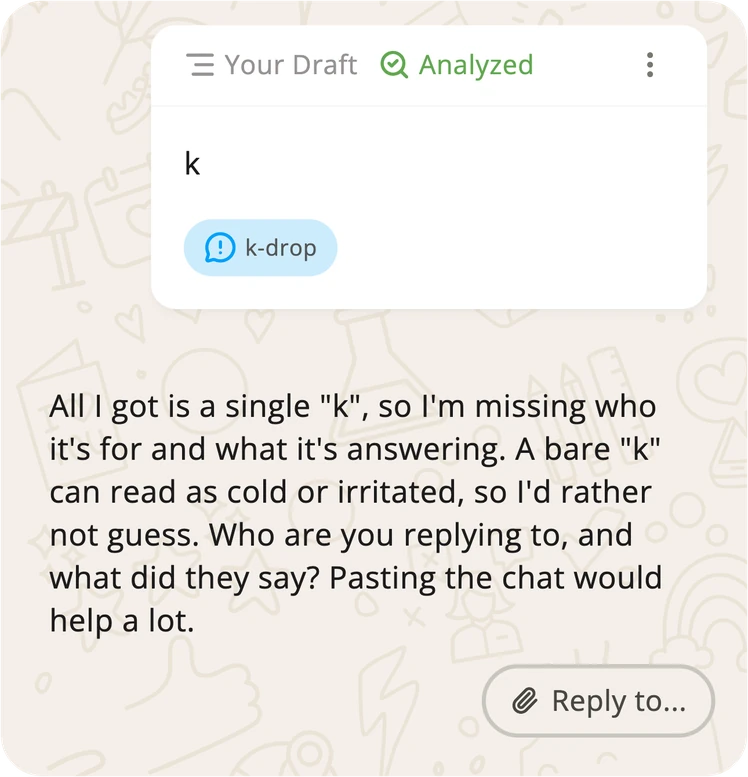
Which of the two goes out is still your choice, and only the second hands them something to answer.
Do not withdraw. Schrodt, Witt and Shimkowski meta-analysed 74 studies with a combined 14,255 participants and found a moderate negative association between the demand-withdraw pattern and relational outcomes, at r = .36026. Correlational, but consistent, and it is the clearest evidence of harm in this whole area.
Subtext also catches the opposite mistake, where you reread a message that is actually fine and find problems that were never there. That is the more common case by far. Subtext cannot tell you what someone feels. What it can do is tell you what a received message asks of you.
Try Subtext in your browserDownload on the App StoreGet it on Google PlayScan it with your phone camera to install.
Rules that have nothing behind them
Fixed reply-time thresholds. No research supports any specific number. The chronemics work shows expectations exist and people can violate them. It sets no clock. The one real base rate available says people answer roughly 70 per cent of WhatsApp messages and 44 per cent of Instagram messages within five minutes, from an analysis of 3.4 million messages across 889 chats, and it comes from a preprint that has not been peer reviewed and a volunteer sample that is not representative27.
The three-day rule. Lore. I couldn’t find a study.
Fast replies prove attraction. There is a real paper behind this and people are misapplying it badly. Templeton and colleagues found faster response times predicted felt connection in conversation, published in PNAS28. It is face-to-face spoken conversation, and the effects operate below 250 milliseconds, a timescale the authors specifically argue precludes conscious control. Stretching that to whether someone answers a text in four minutes or forty is a category error, not a finding.
Predicting a breakup from texting patterns. The famous over-90-per-cent divorce prediction figure is not credible as stated. Heyman and Slep showed accuracy collapses without cross-validation, and Kim, Capaldi and Crosby failed to replicate29. The underlying observations remain a useful clinical heuristic. The percentages do not survive contact with the method.
Subtext does not use any of these thresholds either, for the same reason none of them survive contact with the evidence.
When a short reply does mean something
The threshold that should change your conclusion is a stable pattern across time, topics and channels. One flat reply on a Tuesday is noise. Someone who has been short with you about everything for a month, including things they used to be interested in, and who is also short with you in person, is a pattern. That judgement covers weeks. Subtext works on the message or thread in front of you. What it keeps over time is Memory, short notes on how you write to one person, which you can read, edit or delete. It does not watch a pattern across weeks.
That is also where the evidence supports the negative reading, since distress-maintaining attribution and demand-withdraw both apply inside relationships that are already strained, and not to strangers exchanging four messages.
And if you get there, the move is to say it plainly, not to withdraw and see what happens. Withdrawing is the one thing with a measured association with things getting worse.
Think I have read a study wrong, or know research on this I have missed? Tell me on LinkedIn.
Samet Durgun is the co-founder of Subtext, an app that catches the emotional tone of your messages and rewrites them in your own voice. He’s based in Berlin.
Sources
Numbered in the order they appear above. Where a figure could not be verified against the primary source, the text says so. Checked 28 August 2026.
- Zullaicha, S., Ronda, M., Lusianawati, H., and Santoso, P. Y. (2025). Dry Text Reception as Digital Body Language on WhatsApp. The Eastasouth Journal of Social Science and Humanities, 2(3), 445 to 455. Sample size not retrievable; journal not indexed in the major databases.
- Fang, D., Zhang, Y., and Maglio, S. J. (2024). Shortcuts to Insincerity: Texting Abbreviations Seem Insincere and Not Worth Answering. Journal of Experimental Psychology: General, 154(1), 39 to 57.
- Kalman, Y. M., Ravid, G., Raban, D. R., and Rafaeli, S. (2006). Pauses and Response Latencies: A Chronemic Analysis of Asynchronous CMC. Journal of Computer-Mediated Communication, 12(1), 1 to 23.
- Kalman, Y. M., and Rafaeli, S. (2011). Online Pauses and Silence: Chronemic Expectancy Violations in Written Computer-Mediated Communication. Communication Research, 38(1), 54 to 69.
- Gunraj, D. N., Drumm-Hewitt, A. M., Dashow, E. M., Upadhyay, S. S. N., and Klin, C. M. (2016). Texting insincerely: The role of the period in text messaging. Computers in Human Behavior, 55, 1067 to 1075.
- Kruger, J., Epley, N., Parker, J., and Ng, Z.-W. (2005). Egocentrism Over E-Mail: Can We Communicate as Well as We Think? Journal of Personality and Social Psychology, 89(6), 925 to 936.
- Boothby, E. J., Cooney, G., Sandstrom, G. M., and Clark, M. S. (2018). The Liking Gap in Conversations: Do People Like Us More Than We Think? Psychological Science, 29(11), 1742 to 1756.
- Kingsbury, M., and Coplan, R. J. (2016). RU mad @ me? Social anxiety and interpretation of ambiguous text messages. Computers in Human Behavior, 54, 368 to 379.
- Baumeister, R. F., Bratslavsky, E., Finkenauer, C., and Vohs, K. D. (2001). Bad Is Stronger Than Good. Review of General Psychology, 5(4), 323 to 370.
- Malle, B. F. (2006). The actor-observer asymmetry in attribution: A (surprising) meta-analysis. Psychological Bulletin, 132(6), 895 to 919.
- Bradbury, T. N., and Fincham, F. D. (1990). Attributions in marriage: Review and critique. Psychological Bulletin, 107(1), 3 to 33.
- Yarkoni, T. (2010). Personality in 100,000 Words. Journal of Research in Personality, 44(3), 363 to 373.
- Schwartz, H. A., Eichstaedt, J. C., Kern, M. L., and colleagues (2013). Personality, Gender, and Age in the Language of Social Media. PLOS ONE, 8(9), e73791.
- Milton, D. E. M. (2012). On the ontological status of autism: the double empathy problem. Disability and Society, 27(6), 883 to 887.
- Crompton, C. J., Ropar, D., Evans-Williams, C. V. M., Flynn, E. G., and Fletcher-Watson, S. (2020). Autistic peer-to-peer information transfer is highly effective. Autism, 24(7), 1704 to 1712. Spoken story-retelling task, not texting.
- Howard, P. L., and Sedgewick, F. (2021). “Anything but the phone!”: Communication mode preferences in the autism community. Autism, 25(8), 2265 to 2278. Establishes mode preference only.
- Ophir, E., Nass, C., and Wagner, A. D. (2009). Cognitive control in media multitaskers. Proceedings of the National Academy of Sciences, 106(37), 15583 to 15587.
- Parry, D. A., and le Roux, D. B. (2021). “Cognitive control in media multitaskers” ten years on: A meta-analysis. Cyberpsychology, 15(2). Pooled effect near zero across 118 assessments.
- Yngve, V. H. (1970). On getting a word in edgewise. Papers from the Sixth Regional Meeting, Chicago Linguistic Society, 567 to 578.
- Schegloff, E. A. (1982). Discourse as an interactional achievement: Some uses of “uh huh” and other things that come between sentences. In Tannen (ed.), Georgetown University Round Table on Languages and Linguistics.
- McLaughlin, M. L., and Cody, M. J. (1982). Awkward Silences: Behavioral Antecedents and Consequences of the Conversational Lapse. Human Communication Research, 8(4), 299 to 316.
- Huang, K., Yeomans, M., Brooks, A. W., Minson, J., and Gino, F. (2017). It Doesn’t Hurt to Ask: Question-Asking Increases Liking. Journal of Personality and Social Psychology, 113(3), 430 to 452. Carries a published correction from March 2025; no expression of concern and no retraction.
- Kluger, A. N., and Malloy, T. E. (2019). Journal of Personality and Social Psychology, 117(6), 1132 to 1138, with the original authors’ reply at Yeomans, Brooks, Huang, Minson and Gino (2019), 117(6), 1139 to 1144.
- Riordan, M. A., Markman, K. M., and Stewart, C. O. (2013). Communication Accommodation in Instant Messaging. Journal of Language and Social Psychology, 32(1), 84 to 95. Sample sizes not confirmed.
- Ireland, M. E., Slatcher, R. B., Eastwick, P. W., Scissors, L. E., Finkel, E. J., and Pennebaker, J. W. (2011). Language Style Matching Predicts Relationship Initiation and Stability. Psychological Science, 22(1), 39 to 44. Correlational; the authors note matching may reflect attention rather than cause liking.
- Schrodt, P., Witt, P. L., and Shimkowski, J. R. (2014). A meta-analytical review of the demand/withdraw pattern of interaction. Communication Monographs, 81(1), 28 to 58.
- Sorry for the late reply: Response times and reciprocity in WhatsApp and Instagram chats. arXiv preprint 2605.03687, 2026. Not peer reviewed; volunteer donated data, not a representative sample.
- Templeton, E. M., Chang, L. J., Reynolds, E. A., Cone LeBeaumont, M. D., and Wheatley, T. (2022). Fast response times signal social connection in conversation. Proceedings of the National Academy of Sciences, 119(4), e2116915119. Face-to-face spoken conversation at sub-250-millisecond resolution.
- Heyman, R. E., and Slep, A. M. S. (2001). The hazards of predicting divorce without cross-validation. Journal of Marriage and Family, 63(2), 473 to 479.