
ArticlesMessages
What do you say when you don't know what to say?
Saying nothing after bad news often goes worse than saying something clumsy, though a 2025 study found it depends on what happened. A plain, sincere message did about as well as an eloquent one. The danger is the floor, not the ceiling.
By Samet Durgun · Co-founder of Subtext · 9 min read
· Updated October 14, 2026
Someone you know has had bad news. You have opened the thread four times and closed it, because everything you draft sounds either hollow or presumptuous. I co-founded Subtext, and this is the message people most often abandon halfway through writing. If that happens with messages well beyond this one, why you can’t reply to messages you actually want to answer covers the avoidance side.
Two findings should change what you do. Researchers have now tested silence head to head against a bad message, and the answer depended on the situation. After an injury, silence did worse. After a job loss, the dismissive message did more damage to the relationship. And a moderate message did about as well as a beautifully crafted one in the study that compared them, so the effort you pour into perfect words buys you little. What causes damage sits at the bottom of the range, not the top.
The comparison everyone assumed, now tested
Until recently, every article on this topic argued from analogy. Ray and Floyd tested it directly1.
They ran a survey experiment with 886 US adults, census-matched on age, sex and ethnicity, using two situations, someone who had been injured and someone who had lost their job. They compared nonsupport, meaning saying nothing when support was expected, against a low person-centred support message, meaning the worst category of message, not a merely awkward one.
After the injury, silence produced less emotional improvement and more damage to the relationship than the bad message did. After the job loss it flipped, and the bad message did more damage to the relationship than silence. The authors conclude that saying nothing is not always worse than saying the wrong thing, and that it may depend on the kind of stress the person is under.
So the popular line, that any message beats silence, is too strong. Silence is not the safe choice people assume, and a dismissive message can be worse than nothing, which makes the floor of what you send the part to get right.
I’d flag two caveats. It is a survey experiment built on scenarios, so the researchers observed no real bereavement, and neither scenario involves a death. But it is a direct test, and it replaces a decade of reasonable guessing.
Silence is also not rare. A study of 205 young adult cancer patients across 22 countries found roughly three in five had experienced nonsupport, meaning support they expected from someone in their network that never came2. People read it as abandonment, not as respectful restraint. The same pattern sits behind why people ghost, and what to send instead.
The ceiling is lower than you think
This is the finding that relieved me most.
Researchers code supportive messages on a nine-level scale of person-centredness, which is the degree to which a message acknowledges, elaborates and legitimises the other person’s feelings rather than challenging or diverting from them. Low messages deny or criticise the feeling. Moderate messages acknowledge it and then move attention away. High messages validate and elaborate.
Tian and Solomon ran two experiments, one lab and one online, on messages about the death of a parent3. Moderately person-centred messages produced less resistance and better support quality than low ones, and participants perceived them to be as effective as highly person-centred ones.
So “I am so sorry you are going through this” appears to do the work. The eloquent, elaborated message is not measurably better than the plain sincere one. What you are agonising over is the difference between a seven and a nine, and that difference does not show up in the data. The difference between a three and a seven does. That’s the only thing I’d check before you send.
High and Dillard’s meta-analysis of 23 studies confirms that person-centredness relates to effectiveness overall, with a stronger relationship to perceived effectiveness than actual4. One detail I’d flag is that the advantage shrinks in studies using live interaction instead of written vignettes. In live interaction, tone, presence and relationship history carry weight that a rated message strips out. I would report the direction of that finding and not a number, because the effect sizes conflict across the sources I worked from and I couldn’t verify any of them without the paywalled full text.
Why the bad message is bad
A dismissive message fails to comfort, and it also provokes resistance.
Tian, Solomon and St.Cyr Brisini had 325 married adults evaluate a hypothetical support message after a marital disagreement5. Participants perceived low person-centred messages as conveying dominance and as having weak argument quality, and that predicted psychological reactance through a perceived threat to the recipient’s freedom. In the summary of this work, participants reported feeling angry and mentally arguing back as they read.
That reframed the problem for me. I had thought the choice was between helping and not helping. It is between helping and generating an argument the other person has silently, with you, while reading.
The four things that reliably go wrong
Positive reframing, for some people. Marigold, Cavallo, Holmes and Wood ran six studies including a confederate interaction6. People with low self-esteem were less receptive than others to support that positively reframed their experience, meaning cheering up, optimistic spin, minimising. They were equally receptive to support that validated their negative feelings.
I think that trap is worth the whole paper. In real interactions, friends offered positive reframing to everyone equally, and offered validation less to the people with low self-esteem. So the people who needed validation most got it least. And when recipients rejected the reframing, the providers felt worse about the interaction, about themselves and about the friendship.
Note the moderator. This is specifically about low-self-esteem recipients, and I wouldn’t inflate it into a universal law about silver linings.
Advice given first. Two literatures converge. People rate unasked-for support as unpleasant, and the mechanism is the recipient inferring that the giver sees them as incompetent7. Advice Response Theory holds that advice threatens both the desire to be approved of and the desire for autonomy8. Advice offered before emotional validation generates that threat, and recipients reject it. The same advice after validation lands completely differently.
So the actionable rule is narrower than “never advise”. It is “never advise first.”
Minimising. Researchers document it mainly through its consequences and through the reactance mechanism above. It invalidates the severity of the experience and signals distance.
Social comparison. The weakest evidence base of the four. What exists traces to an unpublished thesis, not a peer-reviewed article, so treat it as suggestive. Conceptually it violates person-centredness by moving the focus off the person.
And one piece of folk wisdom that does not hold up. Rimé’s programme established that people overwhelmingly do share emotional experiences, and that the review evidence was generally not consistent with the view that sharing alleviates the memory of what was shared. Venting reliably happens and meets social needs. It does not by itself reduce distress, which is the premise I check in the best apps for venting.
This is roughly the shape of what Subtext checks in a draft: whether the message validates before it advises, whether it reframes something the person has not yet finished feeling, and whether the version you wrote at speed sits at the bottom of that scale without your noticing. Subtext marks the words and offers versions, and what you send, silver lining included, stays your choice.
Try Subtext in your browserDownload on the App StoreGet it on Google PlayScan it with your phone camera to install.
What bereaved people actually say helps
Lehman, Ellard and Wortman interviewed 94 people who had lost a spouse or a child in a road accident four to seven years earlier, alongside 100 controls describing what they would say9.
Bereaved people most often named contact with someone who had been through something similar, and the opportunity to express feelings, as helpful. They most often named giving advice, and encouraging recovery, as unhelpful.
The paper’s sharpest conclusion takes aim at the excuse this article is named after. The authors judged the “people don’t know what to say” explanation implausible, because the control respondents, who had never faced the situation, produced perfectly sensible answers about what would help. Bystanders describe in the abstract exactly what works. They just do not do it when it is real.
A separate study of 55 cancer patients found what counts as helpful is source-specific10. Patients valued emotional and esteem support most from close ties, information from medical experts, and similar-other contact from fellow patients. The patients cited friends and acquaintances disproportionately for social avoidance, meaning reduced contact and redirected conversation.
The one rule worth knowing
“Comfort in, dump out” comes from a 2013 newspaper op-ed by a clinical psychologist and a mediator11. Draw concentric circles with the person in crisis at the centre and each wider ring holding less-close people. Comfort flows inward. Venting flows outward, to rings wider than your own.
It came from the psychologist’s own experience as a breast cancer patient, when peripheral colleagues expressed their distress to her and she ended up comforting them about her own illness.
It has never been empirically tested. No trial, no peer-reviewed evaluation. It circulates in hospice and grief education because it is intuitive and memorable. Untested does not mean wrong, and this is a hypothesis with unusually good face validity. And it is one of very few pieces of popular advice designed to discipline the sender rather than optimise the message.
Does “I don’t know what to say” work?
There is no direct study of the phrase. I looked, and the sources that assert it is received well cite a handbook chapter that does not test it.
What I can say defensibly is that bereaved people rate acknowledgement of the loss and permission to express feelings as helpful9, and that a moderate message performs as well as an elaborate one3. So an honest, unelaborate message is not a compromise.
The phrase works as honesty paired with acknowledgement and presence. “I don’t know what to say, but I’m thinking of you and I’m not going anywhere.” It does not work as a substitute for engaging, and the Lehman finding specifically undercuts using it as an excuse. Engaging with the specific message is also what makes any reply land well.
It helps to work out first whether you are missing the words or missing a decision about what you can offer, which I cover in why replying to a simple message feels like so much work.
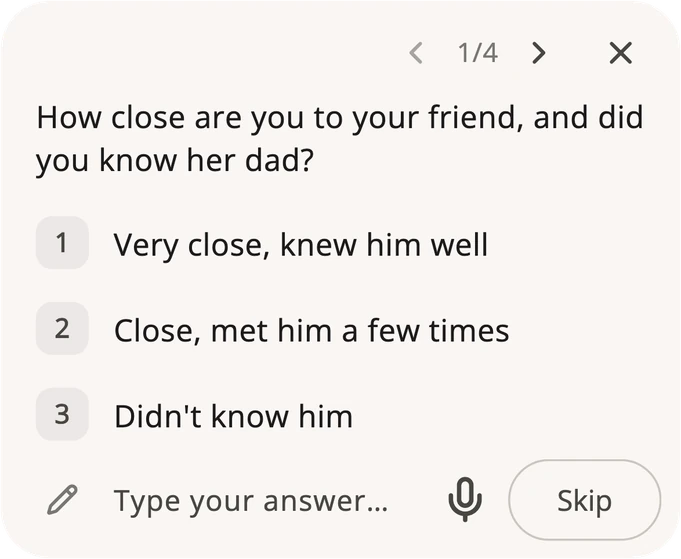
Subtext can ask for that decision before it writes. Given the request “My friend’s dad died last week and I still haven’t written to her. I don’t know what to say”, which was made up for the run, it wrote no message at first. It asked four short questions, among them “How close are you to your friend, and did you know her dad?”, “Do you want to acknowledge that you’re writing late?” and “What can you offer her right now?” With the answers “Very close, knew him well”, “Yes, briefly” and “Just being there” chosen and the open last question answered “Not sure”, the first of its three versions, labelled Short and simple, read “I’m so sorry about your dad. I should have written sooner, I just didn’t know what to say. I’m here for you, however you need me to be. No need to reply.” That is real output, as the app returned it.
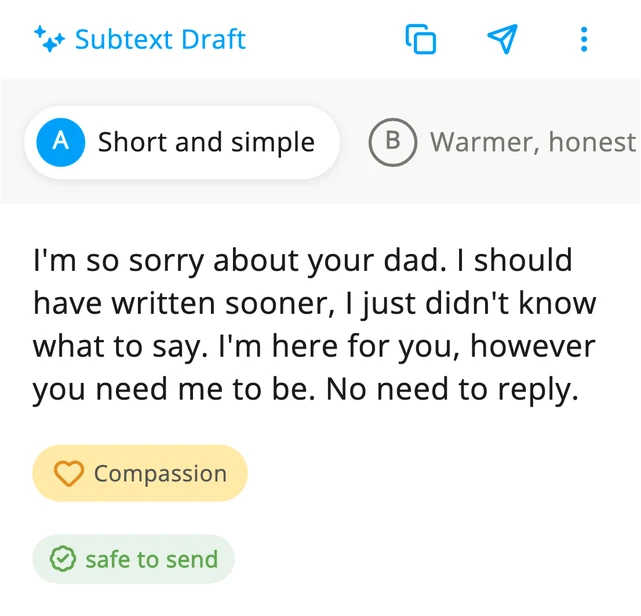
Two things in that first version sit badly with this article. “I just didn’t know what to say” is given as the reason for the delay, which is the use the Lehman finding undercuts. And “however you need me to be” is not the concrete, small offer the next section asks for. It followed the answer “Just being there”, and “A call or visit” was among the answers on offer.
So, practically
Send something, and make sure it does not dismiss what happened. Silence is not the safe choice it feels like, and a careless message can do more harm than nothing, so the floor is the part worth checking.
Say you are sorry, name the specific thing, and stop. Do not reframe it as a blessing in disguise. Do not offer advice before you have acknowledged the feeling. Do not compare it to something that happened to you.
Say what you will actually do, and make it concrete and small. And then do the unglamorous thing that the research on nonsupport keeps pointing at, which is send another one next week, when everyone else has stopped.
Sources
Numbered in the order they appear above. Where a figure could not be verified against the primary source, the text says so.
- Ray, C. D., and Floyd, K. (2025). Saying the Wrong Thing or Saying Nothing at All: Comparing Outcomes of Nonsupport Versus Low Person-Centered Emotional Support Messages. Communication Studies, 77(5), 692 to 716. Published online July 2025, print issue 2026. N = 886 US adults, census-matched on age, sex and ethnicity. Survey experiment using injury and job loss scenarios.
- Ray, C. D. (2024). Nonsupport Experiences of Young Adult Cancer Patients: Prevalence, Acceptability, and Comparisons to Supportive Experiences. Health Communication, 39(6), 1127 to 1139. N = 205 young adult cancer patients across 22 countries. Cross-sectional.
- Tian, X., and Solomon, D. H. (2025). The Role of Person-Centered Messages, Parallel Disclosures, and Reactance When Communicating Support for Parental Death. Communication Research, 52(8), 1116 to 1144. Two experiments on messages about the death of a parent.
- High, A. C., and Dillard, J. P. (2012). A review and meta-analysis of person-centered messages and social support outcomes. Communication Studies, 63(1), 99 to 118. Twenty-three studies. Effect sizes conflict across secondary sources and are not reported here.
- Tian, X., Solomon, D. H., and St.Cyr Brisini, K. (2020). How the Comforting Process Fails. Journal of Communication, 70(1), 13 to 34. N = 325 married adults. Experimental vignette study.
- Marigold, D. C., Cavallo, J. V., Holmes, J. G., and Wood, J. V. (2014). You can’t always give what you want. Journal of Personality and Social Psychology, 107(1), 56 to 80. Six studies including a confederate interaction.
- Smith, J., and Goodnow, J. J. (1999). Unasked-for support and unsolicited advice. Psychology and Aging, 14(1), 108 to 121.
- Feng, B., and MacGeorge, E. L. (2010). The influences of message and source factors on advice outcomes. Communication Research, 37(4), 553 to 575. See also MacGeorge, Feng, Butler and Budarz (2004), Human Communication Research, N = 280.
- Lehman, D. R., Ellard, J. H., and Wortman, C. B. (1986). Social support for the bereaved. Journal of Consulting and Clinical Psychology, 54(4), 438 to 446. N = 94 bereaved (40 spouse, 54 child) plus 100 controls. Retrospective structured interviews. Percentage figures circulating for this study could not be verified and are not used.
- Dakof, G. A., and Taylor, S. E. (1990). Victims’ perceptions of social support. Journal of Personality and Social Psychology, 58(1), 80 to 89. N = 55 cancer patients.
- Silk, S., and Goldman, B. (2013). How not to say the wrong thing. Los Angeles Times, 7 April 2013. An op-ed, never empirically tested.