
ArticlesMessages
How do you say no to extra work?
Saying yes raises your performance ratings and barely moves your actual rewards. Women are asked more, agree more, and are penalised for declining while men are not. What the evidence supports, and where the advice stops applying.
By Samet Durgun · Co-founder of Subtext · 10 min read
· Updated October 14, 2026
The message is sitting there. Someone wants you to run the thing, join the committee, take the extra account. You have drafted a no three times and each version reads either curt or so hedged that it invites a negotiation. I co-founded Subtext, and this is the workplace message people rewrite more than any other.
The useful thing I can tell you is that the strongest research here is about who gets asked, who agrees, and who is punished for refusing, and none of it is about wording. The tactical advice, the scripts and the magic words, rests on much thinner ground than the advice industry implies, and one famous study behind it says the opposite of what people cite it for.
The finding that matters most is not about you
Babcock, Recalde, Vesterlund and Weingart studied non-promotable tasks, meaning work that benefits the organisation and does little for your advancement1. Committee service, note-taking, event organising, routine upkeep.
The field data. Across email requests to 3,271 faculty at a large public university, 3.7 per cent volunteered, 4.3 per cent declined by reply, and 92 per cent ignored the email. Female faculty volunteered at 7.0 per cent against 2.6 per cent for men. Women were 24.7 per cent of faculty and 37.5 per cent of faculty-senate committee members.
People report that gap as women being 2.7 times more likely to volunteer. I’d call that arithmetically true and misleading, because it is the same fact as a 4.4 percentage point difference in a population where nearly everyone ignored the request. Both framings are accurate. One sounds enormous.
The lab experiments are where it got interesting for me. In mixed-sex groups playing a volunteering game, women volunteered almost 50 per cent more often than men. In single-sex groups, running the identical design, men and women volunteered at equal rates.
That is the causal linchpin. Willingness to take on this work is not a fixed gendered preference. It responds to who else is in the room, which implicates shared expectations rather than personality. A third experiment added a requester, who asked female members more often, and women agreed more often than men when asked.
A follow-up paper found that letting requesters penalise refusers did not widen the gender gap in acceptance, but that the penalties men imposed on refusers were larger than those imposed by women2.
A few limits I’d flag. The lab paradigm is an abstract volunteering game, not literal office housework. The field data are from one university, in academia. And critically, the design never tests whether individual women benefit from declining. It documents the allocation problem, not the effectiveness of the remedy.
Does saying yes actually help your career?
The literature is split and I am not going to resolve it for you.
The case that it helps. A meta-analysis of 168 samples covering 51,235 people found organisational citizenship behaviour correlated with managerial performance ratings at a corrected .60 and with reward recommendations at .773.
Then look at the third number. Correlation with actual rewards: .26. The authors note explicitly that reward recommendations do not always translate into rewards that organisations administer. There is also a method-bias caveat, because the ratings link is much stronger when the citizenship behaviour and the rating come from the same source, .62, than from different sources, .32.
The case that it hurts. Bergeron, Shipp, Rosen and Furst used archival data from 3,680 employees at a professional services firm and found time spent on task performance mattered more than time spent on citizenship for all four career outcomes: performance evaluation, salary increase, advancement speed and promotion4. The authors’ own abstract says the results lend some support, so I’d say the finding that holds up is the relative one, not a clean claim that helping hurt anyone.
And the asymmetry that makes this personal. Heilman and Chen ran three studies5. Men who helped received significantly higher performance ratings and reward recommendations. Women performing the identical behaviour received no premium. Participants rated women who withheld help significantly lower. Men who withheld suffered no penalty.
Their third study established the mechanism, showing that participants rated the same altruistic behaviours as significantly more required and less optional when the person was female. So it never counted as a favour. I’d hold on to that when you are rewriting a no for the fourth time, because the thing making it hard may not be your wording.
I’d flag one caveat the popular versions drop. In the second study, the interaction on reward recommendations did not reach conventional significance, at p = .07. The performance-evaluation result was significant in both. And this is “paper people” methodology, where participants evaluate written profiles, not real colleagues, which the authors themselves flag.
So I’d call “say yes to get ahead” conditionally and weakly supported at best, since it carries measurable strain costs and pays out unevenly by gender. Whether setting boundaries is actually good for you outside work is a question I have looked at separately.
What about the script?
The advice industry has a problem here.
The most-cited study behind “always give a reason” is the copier study6. Someone asks to skip a photocopier queue, either with no reason, a real reason (“because I’m in a rush”), or a meaningless one (“because I have to make copies”). For a small favour of five pages, compliance went from 60 per cent with no reason to 93 per cent with the meaningless one. Hence the copywriting maxim.
The same table reports the boundary condition directly beneath, and people almost never quote it. For a large favour of twenty pages: 24 per cent with no reason, 24 per cent with the meaningless reason, and 42 per cent with a real one. The placebic reason performed exactly like saying nothing.
| Favor size | No reason given | Meaningless reason | Real reason |
|---|---|---|---|
| Small favor (5 pages) | 60% | 93% | not stated |
| Large favor (20 pages) | 24% | 24% | 42% |
Per-cell numbers were roughly 15 to 25 people. A careful partial replication failed to reproduce the mindlessness interpretation and instead found that the content of the reason mattered, with controllable reasons drawing less compliance than uncontrollable ones even for small favours7.
The study also happened at the Graduate Center of the City University of New York, not Harvard, which is worth knowing because half the marketing decks citing it say Harvard.
Why this matters for your actual problem. Additional work requests are by definition not trivial. They carry real time and cognitive cost, which puts them firmly on the large-favour side of that boundary. So I don’t think the copier study supports the idea that any reason will do. At meaningful stakes the content of the reason carries the weight, and a circular or evasive justification reads as exactly that. Before sending, I’d check whether the reason you gave would survive being read back to you.
And no study directly tests whether refusals land better with reasons attached. The recommendation rests on the pragmatics literature, where a reason or excuse is the single most common formula across languages and cultures, plus the inference that concreteness signals good faith. That is reasonable, but it is not evidence.
What the pragmatics literature does establish
The dominant taxonomy of refusals sorts them into direct refusals, indirect ones (regret, excuse, statement of alternative, postponement) and adjuncts like gratitude that supplement a refusal without constituting one8. Studies applying it across many languages consistently find indirect strategies dominate, that reason or excuse is the most frequent formula, and that ordering shifts with the other person’s relative status.
Two things I’d hold on to. This literature collects data overwhelmingly through written responses to hypothetical prompts, which may not match real speech. And it describes what refusers do. There is very little experimental work on how each refusal form is received, which is the thing you want to know.
Structurally, refusing someone with power over you is more face-threatening than refusing a peer9. That is a theoretical claim, not a measurement of workplace outcomes. The voice and silence literature corroborates it. In an interview study of 40 employees, most had withheld concerns from a supervisor, with the most common reason being fear of being labelled negatively10.
No published experiment compares the outcomes of refusing a boss against refusing a peer. Anyone telling you otherwise is extrapolating.
The counter-offer, and why I would still use it
I think the reasoning behind proposing an alternative is good, and it is reasoning rather than a measured effect. A statement of alternative is a recognised indirect refusal formula that reduces the face threat while still declining. Integrative bargaining holds that proposing alternatives addressing underlying interests preserves relationships better than flat refusal.
A counterintuitive finding supports this. Negotiators feel less satisfied when the other side accepts their offer immediately, so some back-and-forth raises the counterpart’s satisfaction. By extension a thoughtful counter-offer may leave a requester more satisfied than either an instant yes or a bare no.
But a meta-analysis of first offers and anchoring across 90 studies and 16,334 participants shows ambitious first offers also produce fewer deals and lower subjective value for the recipient11. That evidence is about first offers, and the step to a counter-offer is my inference. The relationship-preserving version is a modest alternative, not a hard bargain.
No controlled trial compares counter-offers to flat refusals in a work setting. But I would use the one version that survives regardless of how the other person reacts, which is to structure it as a trade. “I can take A if we move B.” That protects you against role overload whether or not the counter-offer lands well, because it does not depend on the requester’s reaction at all.
For refusing upward, the framing that follows from all this is to avoid personal-preference claims and re-anchor on your manager’s own priorities. “If I take this, the other thing slips three days. Which do you want?” For refusing sideways, route the person to an existing resource or owner so the work does not land on you. Both are derived best practice, not tested formulas, and I would rather label them than sell them. The same upward framing works when the thing you want to push back on is a process, which is the hard part of saying the standup is broken.
This is the part Subtext is useful for, and it is narrower than the rest of this article. It can fix a message that reads colder than you meant. It cannot fix a request that was never optional in the first place, and it does not sort a draft refusal into the types the pragmatics literature uses. A no you have rewritten four times usually fails in one of two directions: it hedges so much that it reads as an opening bid, or it strips out so much that it reads as annoyed. The version in between is how you say no without over-explaining. Seeing which one you have written, before you send it, is most of the problem.
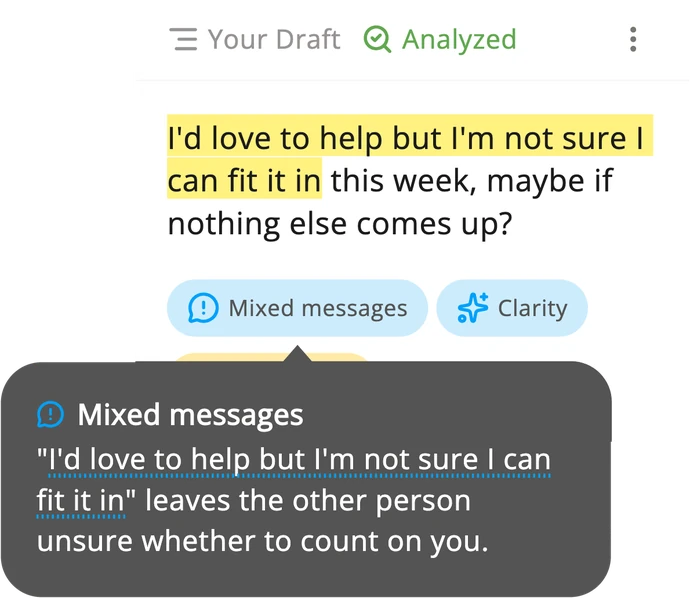
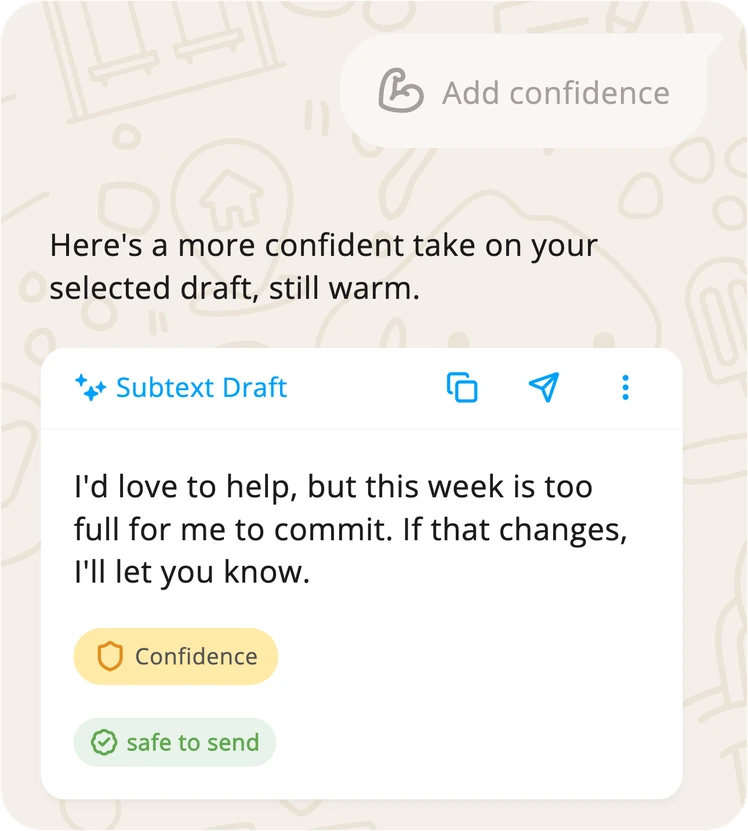
Here is a no, made up for the run, that fails in the first direction. On the draft “I’d love to help but I’m not sure I can fit it in this week, maybe if nothing else comes up?” Subtext returned the tags Mixed messages and Clarity and named the feeling as Uncertainty. It marked the opening and noted that it “leaves the other person unsure whether to count on you”. Its closest version read “I’d love to help, but this week is looking tight. If things clear up, I’ll let you know.” Asked for more confidence, it produced “I’d love to help, but this week is too full for me to commit. If that changes, I’ll let you know.” That is the app’s real output, unedited. Neither version is the trade described above, because the app cannot know what B is. The closest one keeps the maybe. The confident one makes it a no for this week and still leaves the door open.
Try Subtext in your browserDownload on the App StoreGet it on Google PlayScan it with your phone camera to install.
Where this advice stops applying
Everything above assumes a baseline of job security, an outside option, and the freedom to leave. For a lot of people that assumption does not hold, and blanket assertiveness advice can be actively harmful.
Workers on employer-tied visas are the clearest case. A visa petitioned by a specific employer means changing jobs requires a new employer to file fresh paperwork, which creates the friction people usually call job lock. The wage evidence tracks it. Newly hired accountants on H-1B visas at large firms received starting salaries around 10 per cent lower than citizen new hires matched on office, position and hiring date12. A separate analysis merging petition wage offers with survey data found H-1B workers earn substantially less than comparable native workers13.
The same logic applies to probation periods, at-will roles with no bargaining power, and anyone whose housing or healthcare is tied to the job.
What the literature establishes here is the reduced bargaining power. It does not supply a tested script for people in that position, and I am not going to invent one. If that is your situation, the trade framing above is still the safest of the options, because it makes the cost visible without making the refusal personal. But my answer is that the research on how to say no did not have you in mind.
Sources
Numbered in the order they appear above. Where a figure could not be verified against the primary source, the text says so.
- Babcock, L., Recalde, M. P., Vesterlund, L., and Weingart, L. (2017). Gender Differences in Accepting and Receiving Requests for Tasks with Low Promotability. American Economic Review, 107(3), 714 to 747. Field data on 3,271 faculty. Funded by the Carnegie Bosch Institute and NSF grant SES-1330470. Per-experiment lab sample sizes could not be verified and are not reported.
- Babcock, L., Recalde, M. P., and Vesterlund, L. (2017). Gender Differences in the Allocation of Low-Promotability Tasks: The Role of Backlash. AER Papers and Proceedings, 107(5), 131 to 135.
- Podsakoff, N. P., Whiting, S. W., Podsakoff, P. M., and Blume, B. D. (2009). Individual- and organizational-level consequences of organizational citizenship behaviors. Journal of Applied Psychology, 94(1), 122 to 141. 168 samples, 51,235 individuals. No external grant funding acknowledged.
- Bergeron, D. M., Shipp, A. J., Rosen, B., and Furst, S. A. (2013). Organizational Citizenship Behavior and Career Outcomes: The Cost of Being a Good Citizen. Journal of Management, 39(4), 958 to 984. Archival data, 3,680 employees. Correlational.
- Heilman, M. E., and Chen, J. J. (2005). Same Behavior, Different Consequences. Journal of Applied Psychology, 90(3), 431 to 441. Study 1 n = 135, Study 2 n = 99, Study 3 n = 41. The Study 2 reward-recommendation interaction reached p = .07 and is a trend rather than a significant result.
- Langer, E., Blank, A., and Chanowitz, B. (1978). The Mindlessness of Ostensibly Thoughtful Action. Journal of Personality and Social Psychology, 36(6), 635 to 642. N = 120, per-cell roughly 15 to 25. Conducted at the Graduate Center, City University of New York. Funding unverified.
- Folkes, V. S. (1985). Mindlessness or mindfulness: A partial replication and extension of Langer, Blank, and Chanowitz. Journal of Personality and Social Psychology, 48(3), 600 to 604. Sample sizes conflict across secondary sources and are not reported here.
- Beebe, L. M., Takahashi, T., and Uliss-Weltz, R. (1990). Pragmatic Transfer in ESL Refusals. In Scarcella, Andersen and Krashen (eds.), Developing Communicative Competence in a Second Language.
- Brown, P., and Levinson, S. C. (1987). Politeness: Some Universals in Language Usage. Cambridge University Press. A theoretical framework, criticised as Western-biased.
- Milliken, F. J., Morrison, E. W., and Hewlin, P. F. (2003). An Exploratory Study of Employee Silence. Journal of Management Studies, 40(6), 1453 to 1476. Forty employees, exploratory interviews.
- Petrowsky, H. M., Boecker, L., Escher, Y. A., Frech, M.-L., Friese, M., Galinsky, A. D., Gunia, B., Lee, A. J., Schaerer, M., Schweinsberg, M., Soliman, M., Swaab, R., Troll, E. S., Weber, M., and Loschelder, D. D. (2025). The power and peril of first offers in negotiations: a conceptual, meta-analytic, and experimental synthesis. Organizational Behavior and Human Decision Processes, 191, 104448. 374 effects from 90 studies, N = 16,334. Ambitious first offers went with fewer deals, g = -0.42, and lower subjective value for recipients, g = -0.40.
- Bourveau, T., Stice, D., Stice, H., and White, R. (2025). H-1B Visas and Wages in Accounting. Journal of Business Ethics, 199(2). Big-4 payroll data, matched-comparison design, correlational.
- Borjas, G. J. (2026). The H-1B Wage Gap, Visa Fees, and Employer Demand. NBER Working Paper 34793, revised March 2026. Not peer reviewed. The working paper and its abstract report slightly different gap figures.