ArticlesMessages
What does anxious attachment look like in texting?
Attachment anxiety is a position on a continuum with no clinical cut-off, and the texting behaviours most often used to diagnose it have no studies behind them. What the research supports, what it does not, and what actually reduces the distress.
By Samet Durgun · Co-founder of Subtext · 11 min read
· Updated October 14, 2026
You sent a message ninety minutes ago. It says delivered. You have picked up your phone eleven times since, and somewhere in there you started drafting the follow-up that says “sorry, ignore me”. People who describe themselves as anxiously attached are a large share of the people who use Subtext, and this is the moment they describe.
My short answer is more useful than the one you will find elsewhere. Attachment anxiety is a continuous dimension rather than a type, there is no validated cut-off that makes you “an anxious attacher”, and several of the texting behaviours that popular articles list as symptoms have never been studied at all. Double texting is the clearest example. I couldn’t find a single peer-reviewed study operationalising it and showing that an attachment measure predicts it.
I’d say what does hold up is worth knowing, because it points somewhere different from the advice.
It is a dimension, not a box
Researchers measure attachment with the Experiences in Close Relationships questionnaire, which came out of Brennan, Clark and Shaver factor-analysing a pool of 323 items from the existing adult attachment scales1. Two dimensions came out: anxiety and avoidance. Everyone sits somewhere on both.
The four-box model, secure and anxious and avoidant and fearful-avoidant, is a labelling convenience laid over those two continua. Fraley’s taxometric work is fairly clear that the underlying structure is dimensional, in adult self-report and in infant behaviour and across both general and relationship-specific attachment23.
There is a nice accidental confirmation of this. Mizrahi, Laufer and Zuckerman ran an EEG study that sorted participants into the four categories, and then found their own categories leaked. Anxious and avoidant participants overlapped substantially on the continuous composite, and the authors concluded attachment sits on a spectrum4, a categorical study conceding the dimensional point.
In practice, an ECR score is a position, not a diagnosis. There is no accepted clinical threshold. If a quiz told you that you are anxiously attached, it drew a line that the research does not support.
The one-in-five figure is from a newspaper quiz
You have probably seen a claim that around 20 per cent of people are anxiously attached. It does not match either nationally representative survey.
Mickelson, Kessler and Shaver analysed the US National Comorbidity Survey, 8,098 people, and reported 11.3 per cent anxious5. Meng, D’Arcy and Adams analysed the Replication survey, 5,645 people, and reported 5.5 per cent6.
The 19 per cent that the popular figure is closest to comes from Hazan and Shaver in 1987, where the sample was self-selected responses to a love quiz printed in a Denver newspaper7. It is not a population estimate.
| Study | Sample | Percent anxious |
|---|---|---|
| Mickelson, Kessler and Shaver, 1997 | US National Comorbidity Survey, 8,098 people | 11.3% |
| Meng, D’Arcy and Adams, 2015 | Replication survey, 5,645 people | 5.5% |
| Hazan and Shaver, 1987 | Self-selected responses to a Denver newspaper love quiz | About 19% (the popular figure, not a population estimate) |
Every one of those numbers comes from a categorical instrument, which means all of them are artefacts of where somebody drew a line on a continuum. Treat them as history. They do not tell you how many people are like you.
What the theory predicts
Mikulincer and Shaver’s model is the bridge between attachment and behaviour. People high in attachment anxiety rely on hyperactivating strategies: energetic persistence in seeking comfort and reassurance, vigilance for signs that a partner is unavailable, overdependence, and rumination8.
My editorial point, the one almost every article skips, is that a mechanism is not a symptom list. The theory predicts intensified proximity seeking. It does not license the inference that any particular texting behaviour diagnoses attachment anxiety, and most of the listicles work backwards from behaviour to diagnosis.
Where the digital mapping holds up. Several observational studies link attachment anxiety to social-media jealousy and partner surveillance910. The best of them is longitudinal. Métellus and colleagues followed 322 young adults over two years and found social media jealousy associated with more electronic partner surveillance and lower relationship satisfaction a year later11. It is observational, and everyone in it stayed with the same partner for the whole study, so it cannot say what caused what. The data did not support the mediation model the authors proposed, linking attachment anxiety to satisfaction through these behaviours.
I’d flag one detail that writers usually report the other way round. In that study, lower satisfaction later on went with the jealousy, and the study found no link between electronic surveillance itself and later satisfaction. Not finding a link is different from showing that checking is harmless, and it says nothing about whether going through a partner’s accounts is fair to them. That question belongs to the section on coercive control further down.
Where it does not hold up. Jin and Peña found associations between attachment and voice calling, and no significant association between text-message use and attachment style12. Raw message volume is not the signal.
And double texting has nothing. No study in any of the material I worked from operationalises it and shows an attachment measure predicts it. Popular content invented the construct and then attached a diagnosis to it. If you have been reading your own double texts as evidence of something, you have been reading them against a rule nobody established.
The best finding in this literature
Excessive reassurance seeking is the construct that does most of the work here. Joiner and colleagues defined it as the tendency to excessively and persistently seek assurance that one is lovable and worthy13.
It correlates with attachment anxiety strongly. Shaver, Schachner and Mikulincer found coefficients between .59 and .68 across two studies, and no relationship with avoidance14. Its association with depression is well replicated. Starr and Davila meta-analysed 38 studies covering 6,973 people and found r = .32, and a later meta-analysis of 102 studies found r = .331516.
In Shaver’s fourteen-day diary study, for women scoring one standard deviation above the mean on attachment anxiety, seeking reassurance on one day predicted worse mood the next day. For women one standard deviation below the mean, seeking reassurance predicted better mood the next day. Same behaviour, opposite outcome, depending on where the person sat on the dimension. I have not seen that finding in a single popular article, and it is the one that changes how you think about this.
The authors read that as a secure and an insecure version of the same act. It is the empirical line between asking a question and running a loop, and I trust it more than any rule about how many messages you are allowed to send. It is a diary association, so I would not write it up as proof that reassurance caused the mood.
Two more things about reassurance seeking that cut against the usual advice. The meta-analytic association with actual rejection is modest, at r = .1415. And in one daily-diary replication, the partners of avoidant men who sought reassurance reported higher next-day trust17. The research does not support the claim that reassurance seeking always pushes people away.
A message asking a real question and a message asking for the fourth time whether everything is fine look almost identical on the screen and do completely different things to the person reading them.
Waiting for a reply, and read receipts
Response latency has the better evidence, and it is thinner than you would guess. Huang and Yao had undergraduates in relationships recall a recent conflict and imagine texting about it while the partner failed to reply within the expected interval18. Higher attachment anxiety went with greater negative affect under that hypothetical violation.
The boundary matters. Huang and Yao measured attachment and did not manipulate it, and their participants imagined the delay. I’d read this as supporting “people higher in attachment anxiety report more anticipated negative emotion when picturing a late reply during a conflict”. I would not stretch it to “delayed texts cause distress in anxious people”.
Read receipts are worse. The one direct test I could find is a student research proceedings paper with 352 undergraduates, and the mediation model involving anxious attachment was not significant, while a corresponding neuroticism model was19. Low-tier source, so I would not build on it either way. But it is the only direct test, and it came out null, which is not what the internet will tell you. This is why Subtext has nothing to say about read receipts or reply timers. The evidence for either mattering is thinner than the anxiety they cause.
One correction that matters more than it looks. A lot of writing on this cites Kingsbury and Coplan to claim that attachment anxiety predicts negative interpretation of ambiguous texts. That paper is about social anxiety, which its title says plainly, and the two are not interchangeable20. My read is that attachment anxiety supports threat vigilance under uncertainty, and that nobody has run a clean experiment showing attachment-anxious adults assign different meanings to the same ambiguous message.
I have written about that paper properly in the piece on reading ambiguous messages, where it belongs. The wider research on social anxiety and messaging is in why texting gives you anxiety, and what helps.
Does it change?
Yes, moderately, and neither popular extreme is right.
Fraley’s meta-analysis of longitudinal data supports a prototype model, in which test-retest correlations decay and then flatten at a non-zero level rather than approaching zero21. So attachment is neither fixed nor freely rewritable.
Fraley, Gillath and Deboeck found life events often associated with immediate shifts, after which people commonly drift back towards the trajectory their earlier levels predicted22. Attachment anxiety tends to decline with age across long-running datasets23. And a systematic review of psychological therapy found attachment security generally increasing and anxiety generally decreasing over the course of treatment, though most of that literature measures change during therapy and does not randomise anyone to an attachment-change condition24.
Security priming has the cleanest causal evidence. A meta-analysis of 120 studies covering 18,949 participants found an overall effect of d = .51 across affective, cognitive and behavioural outcomes25. Two limits travel with it. Priming shifts a person’s state for a short time and does not produce durable trait change. Social priming as a field also has a documented replication problem, and this meta-analysis addresses it directly. A single well-written message will not do what months of therapy or a securely attached relationship does, and Subtext does not pretend otherwise. Its job is narrower. It is there to make sure today’s message is not the thing that sets you back.
What actually reduces the distress
A hierarchy, strongest evidence first:
- Short-term distress: experimentally activating a sense of security has the cleanest causal support25.
- Longer-term attachment: longitudinal studies document change, and anxiety declines during therapy2124.
- Partner context: perceived partner responsiveness is associated with greater relationship-specific security, correlationally.
- Texting rules: nothing. I couldn’t find any controlled evidence that waiting a set number of minutes, turning off read receipts, or refusing to send a second message reduces attachment-anxiety distress or builds security.
I want you to sit with that last line, because texting rules are what almost every article on this topic sells you.
Cognitive reappraisal and self-compassion both have direct trial support for reducing distress in general. Applying either specifically to texting is an extrapolation, and I would rather label it as one than dress it up.
In your position, phone in hand, I would write the message, then wait long enough to reread it once. If the second read shows a question you actually want answered, send it. If it shows the same question you asked yesterday in different words, you have found the loop, and the useful move is to name the loop rather than to send or not send.
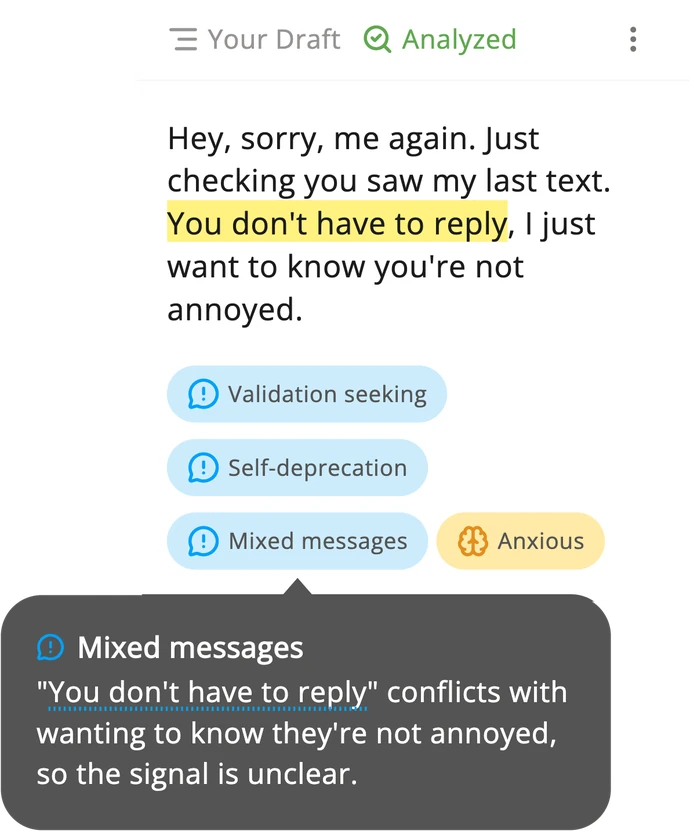
Loop “Hey, sorry, me again. Just checking you saw my last text. You don’t have to reply, I just want to know you’re not annoyed.”
The same check I already ran an hour ago, worded differently · “you don’t have to reply” cancels itself · nothing in it a reply could actually resolve
Question “No rush on this, but let me know today if you can. I’m trying to work out whether to wait on you or just make the call myself.”
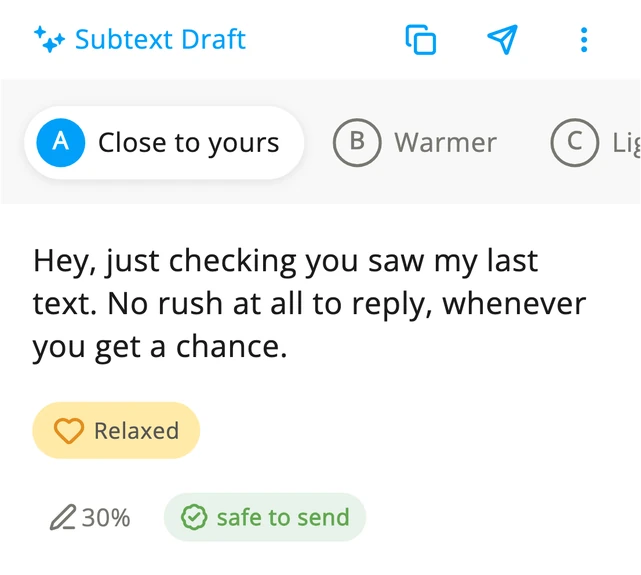
Subtext can point out the loop for you. Given the first of those two drafts, it tagged it Validation seeking, Self-deprecation and Mixed messages, and its reason for Mixed messages was the self-cancelling line, that “You don’t have to reply” sits against wanting to know they’re not annoyed. All three versions it offered left out the request for reassurance. The first, which it marked safe to send, was “Hey, just checking you saw my last text. No rush at all to reply, whenever you get a chance.” That is one real run, quoted as the app returned it. It is still a check on the same text, so the question worth asking is yours to write. Subtext also tells you when the message is fine, which it usually is. It does not ask where you sit on the attachment dimension or read anything into how many messages you send. It reads what the message says, which is the part the evidence supports.
Try Subtext in your browserDownload on the App StoreGet it on Google PlayScan it with your phone camera to install.
When this framing stops applying
Everything above assumes a relationship with a baseline of safety. Some relationships do not have that, and the framing changes completely.
If a partner withholds replies as punishment, demands continuous proof of where you are, or retaliates over a late message, then vigilance is an accurate reading of your environment, not a symptom of anything. Ordinary silence is a different question, which I look at in what it means when someone reads your message and doesn’t reply. Telling someone in that situation that the problem is their attachment style asks them to internalise responsibility for another person’s conduct.
The distinction runs both ways. Anxiety can explain the urge to check. It does not justify accessing someone’s accounts, demanding passwords, requiring constant availability, tracking location, or flooding someone with messages after they have withdrawn. The research literature on technology-facilitated coercive control treats those behaviours as part of abuse dynamics, not as failed self-regulation.
Technology-safety guidance adds one practical caution. Suddenly changing passwords, disabling location sharing or removing devices can alert an abusive partner, so you are better off getting advice on sequencing before changing settings26. The National Domestic Violence Hotline in the US and Refuge in the UK both have people who can talk it through.
Think I have read a study wrong, or know research on this I have missed? Tell me on LinkedIn.
Samet Durgun is the co-founder of Subtext, an app that catches the emotional tone of your messages and rewrites them in your own voice. He’s based in Berlin.
Sources
Numbered in the order they appear above. Where a figure could not be verified against the primary source, the text says so. Checked 28 August 2026. This piece touches technology-facilitated coercive control; if that is where you are, the two resources at source 26 are a better next step than an article.
- Brennan, K. A., Clark, C. L., and Shaver, P. R. (1998). Self-Report Measurement of Adult Attachment: An Integrative Overview. In Simpson and Rholes (eds.), Attachment Theory and Close Relationships. Guilford Press, 46 to 76.
- Fraley, R. C., and Waller, N. G. (1998). Adult Attachment Patterns: A Test of the Typological Model. In Simpson and Rholes (eds.), Attachment Theory and Close Relationships. Guilford Press, 77 to 114.
- Fraley, R. C., Hudson, N. W., Heffernan, M. E., and Segal, B. (2015). Are Adult Attachment Styles Categorical or Dimensional? Journal of Personality and Social Psychology, 109(2), 354 to 368.
- Mizrahi, M., Laufer, A., and Zuckerman, G. (2025). Behavioral Sciences, 15(4), 427. Twenty-seven EEG participants selected by attachment cluster from an initial pool of 96; nine in the anxious cell.
- Mickelson, K. D., Kessler, R. C., and Shaver, P. R. (1997). Adult Attachment in a Nationally Representative Sample. Journal of Personality and Social Psychology, 73(5), 1092 to 1106.
- Meng, X., D’Arcy, C., and Adams, G. C. (2015). Associations Between Adult Attachment Style and Mental Health Care Utilization. Psychiatry Research, 229(1 to 2), 454 to 461.
- Hazan, C., and Shaver, P. (1987). Romantic Love Conceptualized as an Attachment Process. Journal of Personality and Social Psychology, 52(3), 511 to 524. Self-selected responses to a newspaper love quiz.
- Mikulincer, M., and Shaver, P. R. (2003). The Attachment Behavioral System in Adulthood. Advances in Experimental Social Psychology, 35, 53 to 152.
- Marshall, T. C., Bejanyan, K., Di Castro, G., and Lee, R. A. (2013). Attachment styles as predictors of Facebook-related jealousy and surveillance. Personal Relationships, 20(1), 1 to 22.
- Reed, L. A., Tolman, R. M., and Ward, L. M. (2016). Snooping and sexting: Digital media as a context for dating aggression and abuse. Violence Against Women, 22(13), 1556 to 1576.
- Métellus, S., Vaillancourt-Morel, M.-P., Brassard, A., and Daspe, M.-È. (2025). Attachment Anxiety and Relationship Satisfaction in the Digital Era: The Contribution of Social Media Jealousy and Electronic Partner Surveillance. Journal of Marital and Family Therapy. 322 young adults followed over two years.
- Jin, B., and Peña, J. F. (2010). Mobile communication in romantic relationships. Communication Reports, 23(1), 39 to 51.
- Joiner, T. E., Metalsky, G. I., Katz, J., and Beach, S. R. H. (1999). Depression and Excessive Reassurance Seeking. Psychological Inquiry, 10(3), 269 to 278.
- Shaver, P. R., Schachner, D. A., and Mikulincer, M. (2005). Attachment Style, Excessive Reassurance Seeking, Relationship Processes, and Depression. Personality and Social Psychology Bulletin, 31(3), 343 to 359. Study 1: 72 couples. Study 2: 61 couples with a fourteen-day diary. No funding statement in the paper.
- Starr, L. R., and Davila, J. (2008). Excessive Reassurance Seeking, Depression, and Interpersonal Rejection: A Meta-Analytic Review. Journal of Abnormal Psychology, 117(4), 762 to 775.
- Negative Feedback Seeking and Excessive Reassurance Seeking Behavior and Depression: A Meta-Analytic Review (2020). Journal of Social and Clinical Psychology, 39(9), 788. 102 studies, 134 effects.
- Evraire, L. E., Dozois, D. J. A., and Wilde, J. L. (2022). The Contribution of Attachment Styles and Reassurance Seeking to Trust in Romantic Couples. Europe’s Journal of Psychology, 18(1), 19 to 39. Daily diary with 110 couples.
- Huang, S., and Yao, M. Z. (2024). Journal of Social and Personal Relationships. 200 participants recruited, 162 in the final structural model; no financial support reported. Hypothetical scenario.
- Schlosser, A. (2019). MacEwan University Student Research Day Proceedings. 352 undergraduates; the mediation model involving preoccupied-anxious attachment was not significant. Student proceedings paper, lowest-tier source used here.
- Kingsbury, M., and Coplan, R. J. (2016). RU mad @ me? Social anxiety and interpretation of ambiguous text messages. Computers in Human Behavior, 54, 368 to 379. A social anxiety finding, not an attachment finding.
- Fraley, R. C. (2002). Attachment stability from infancy to adulthood: Meta-analysis and dynamic modeling of developmental mechanisms. Personality and Social Psychology Review, 6(2), 123 to 151.
- Fraley, R. C., Gillath, O., and Deboeck, P. R. (2021). Do life events lead to enduring changes in adult attachment styles? Journal of Personality and Social Psychology.
- Chopik, W. J., Edelstein, R. S., and Grimm, K. J. (2019). Longitudinal changes in attachment orientation over a 59-year period. Journal of Personality and Social Psychology, 116(4), 598 to 611.
- Taylor, P., Rietzschel, J., Danquah, A., and Berry, K. (2015). Changes in attachment representations during psychological therapy. Psychotherapy Research, 25(2), 222 to 238.
- Gillath, O., Karantzas, G. C., Romano, D., and Karantzas, K. M. (2022). Attachment Security Priming: A Meta-Analysis. Personality and Social Psychology Review, 26(3), 183 to 241. 120 studies, 18,949 participants, d = .51.
- NNEDV Safety Net Project. Technology safety guidance on changing account, location and device settings.