
ArticlesMessages
What does this text mean?
A message carries less than the person writing it thinks. But in ordinary messages between people who know each other, readers get the tone about right. What the research supports, and where the misreads actually happen.
By Samet Durgun · Co-founder of Subtext · 9 min read
· Updated October 14, 2026
You have the message open and you have read it four times, and each read gives you a slightly different answer. I co-founded Subtext, which reads messages for tone, so this is the question I get asked most and it is also the one I am most careful about answering.
My answer has two halves that most articles never put together. The person who wrote it is worse at conveying tone than they think, which is well established. And you, reading it, are probably getting the basic direction right, which is also established and much less well known. Where things break is narrower than the internet suggests, and knowing where the breaks happen is more useful than any decoding chart.
The sender knows less than they think
Kruger, Epley, Parker and Ng ran five experiments on how well tone travels in writing, and the result is the anchor for this whole field1.
The one number worth knowing comes from their third study, with 154 pairs.
The gap Senders predicted their tone would be read correctly 88.8 per cent of the time. Readers actually managed 70.4 per cent.
In an earlier study the gap was narrower but still there, with senders predicting 97 per cent and readers achieving 84.
The explanation the authors give is egocentrism. When you write a message you hear it in your own head, in the tone you meant, which is why you cannot tell whether your own text sounds rude, and you cannot switch that off to check what it sounds like without the voice. Their own summary is that people believe they can communicate over email more effectively than they actually can.
I’d note what this does and does not show. It shows ambiguity plus sender overconfidence. It does not show that readers skew negative. That is a different claim and it needs different evidence.
You are probably reading it right
This is the finding that reframes the question, and it came out in 2025.
Pollmann and Roos asked both people, which nobody had done properly before2. Participants uploaded a real message thread where they had asked a friend to do something, and rated how positive the reply felt. Then Pollmann and Roos asked the friend who wrote it what they had meant.
Across 347 receivers with 171 matched senders, intended valence averaged 7.39 on a nine-point scale and perceived valence averaged 7.25. The difference was not significant, and an equivalence test ruled out any effect larger than half a point in either direction. They repeated it with work and school emails, 361 receivers and 61 matched senders, and got the same result.
They also tested six things people assume matter: message length, emoji, the reader’s gender, the reader’s age, how close the two people were, and the reader’s neuroticism. None of them predicted misreading.
There is a caveat neither the study’s coverage nor most summaries mention, and I think it matters. Mean-level agreement was excellent, but the correlation between individual senders and receivers was moderate, at .33 and .38. So on average people are not reading messages more negatively than intended, and individual readings still vary a good deal around what the sender meant.
The authors state the limits themselves. The messages sampled were mostly positive, the topics were benign, and everyone already knew each other.
I think that last limit is where the answer lives. A reply read against the twenty before it is a different object from a reply read on its own (the research on how far that goes is on the page about a tool that reads the whole message thread before suggesting a reply), and the research says the relationship is doing more work than any feature of the words.
So where do the misreads actually happen
Four places, and none of them is “all texts, all the time”. It is also the list I would keep in mind before trusting any reading of a message.
When the reader has context the message does not carry. Sillars and Zorn asked people to supply an email they had found upsetting, then had independent observers rate the same email3. Receivers rated them more negative than observers did. The authors explain it through missing context. Many of the emails had nothing overtly negative in them, and the receiver read them against a situation the observers knew nothing about. Their example is a message requiring staff to work two Sundays a month, which lands very differently on someone who goes to church.
Humour and sarcasm. This is the one place where readers fall apart. In the second Kruger experiment, email readers told sarcastic from serious lines at a rate indistinguishable from chance, while listeners hearing their partner’s lines read aloud got roughly three quarters of them right1.
When the message is ambiguous. Kingsbury and Coplan built vignettes deliberately constructed to be readable both ways, things like “I heard about last night”, and found higher social anxiety predicted the negative reading4. That is a moderator finding, not a universal one, and I’d separate it from the popular version. In Pollmann and Roos’s real messages, most of which were not ambiguous, no such bias appeared. If this specific worry, whether one particular person is upset with you, is what brought you here, I have written about it in more depth in are they mad at me, or am I overthinking it.
When you are close to the person. This is counterintuitive and well documented. Savitsky and colleagues found people are more egocentric with friends than with strangers, communicate no better and sometimes worse, and feel considerably more confident about it5.
There is even a finding in the opposite direction to the one everyone assumes. Holtgraves found receivers read face-threatening messages as more positive than the sender intended, because senders overcorrected while softening the blow.
Those four zones, missing context, humour, ambiguity and closeness, are the places the research I found points to. They can overlap, and a message can sit in none of them and still be misread, so treat them as a checklist for when to slow down.
What you are actually doing when you decide what it means
Steinebach, Stein and Schnell built a messenger app that prompted couples to rate their own feelings and their partner’s feelings during real conversations, and collected 960 jointly rated interactions from 51 couples over ten days6.
They found real tracking accuracy, meaning people did pick up something about their partner’s actual state. They also found a large assumed-similarity bias. What matters is how the two compare, and in both their models the influence of tracking accuracy was substantially lower than the influence of assumed similarity.
So when you decide what your partner’s message means, your own current mood predicts your answer more strongly than their actual mood does. That is much of why that text got to you.
I’d flag two things. The authors call the study underpowered, having planned 200 couples and recruited 51, with 57 per cent dropout. And the sample is culturally narrow. But they took their measurements in the medium this article is about, with real messages, which almost nothing else here can claim.
There is one more thing they found that runs against instinct. More messaging experience went with more projection, not less. Being a heavy texter does not make you a better reader. This is the case for having something outside your own head look at the message.
The single thing that works
Eyal, Steffel and Epley ran 25 experiments on this and the answer is unusually blunt7.
Across the first fifteen, with 1,476 participants, instructing people to take another person’s perspective increased their effort and reduced their egocentrism, and did not increase accurate insight. It made them less accurate, at around d = -0.26, while sometimes making them more confident.
What reliably worked was asking the other person.
Imagining your way into someone’s head is the move everyone reaches for and it does not work. Asking does, and the reason it feels expensive is a face problem rather than an accuracy problem, since asking implies either that they were unclear or that you were not listening.
Two things make asking cheaper. Giurge and Bohns showed across eight preregistered studies with 4,004 working adults that receivers systematically overestimate how fast senders expect replies to non-urgent out-of-hours emails, and that a single line from the sender saying there is no rush removed the bias8. Stating intent beats leaving people to infer it, in both directions. And other-initiated repair is a human universal. Across twelve languages from eight families, every one has a shared system for signalling you did not catch something, with an interjection like “huh” appearing in near-identical form9.
Far from being a social failure, asking what someone meant is the most standard move in conversation there is.
The decoding rules with nothing behind them
I’d go through these anyway, because they’re what most search results for this question will give you.
Specific delay windows mean specific things. No evidence. Reply latency is power-law distributed and driven by interruptions, task switching and notification settings10. Delay does carry information, but relative to what that specific person normally does rather than against a clock. Two hours from someone who always answers in five minutes is a different signal from two hours from someone who answers twice a day.
“K” versus “OK” versus “Okay”. I couldn’t find a direct study on these spellings. The nearest real finding is about a full stop on a one-word reply, which I have written about in what a full stop actually signals.
Message length ratios. Directly tested and null. Pollmann and Roos put message length into their regression and it came out at .05, not significant2.
Specific emoji mean specific things. Contradicted. Miller and colleagues found that when people rated the same emoji rendering, they disagreed on whether the sentiment was positive, neutral or negative a quarter of the time, and disagreement rose when the rendering differed across platforms11.
The 7-38-55 rule. I want to name this one specifically. The claim that communication is 7 per cent words, 38 per cent tone and 55 per cent body language, and therefore that text carries almost nothing, is a misapplication of Mehrabian’s 1967 work. He measured situations where a single spoken word conflicted with a facial expression about feelings, and he said himself that the ratio does not apply to written text or to messages that are not in conflict.
Leaving a message on read for a set number of hours. No evidence for any numeric claim. A read receipt marks that the message was displayed, which is not the same as reading it and certainly not intent.
None of these rules run inside Subtext either, for the same reason none of them survive contact with the evidence above.
What to do with the message in front of you
Start from the base rate, which is that you are probably reading it about right and the sender is more worried about being misread than you are about misreading. Then check whether you are in one of the four zones where things break: are you supplying context they did not have, is this humour, is the message readable both ways, and how close are you to this person.
If you are still stuck, the research says ask, and the research says asking is cheaper than it feels.
When you give Subtext a message you received, it sums up what the other person is asking for and what needs an answer, and with a screenshot it reads that against the thread. It will not tell you what someone privately feels, because nothing can do that from words on a screen. A 2025 study found that both human readers and language models matched writers’ own reports of their emotions only imperfectly12, and any tool claiming otherwise is selling you the thing this article is about.
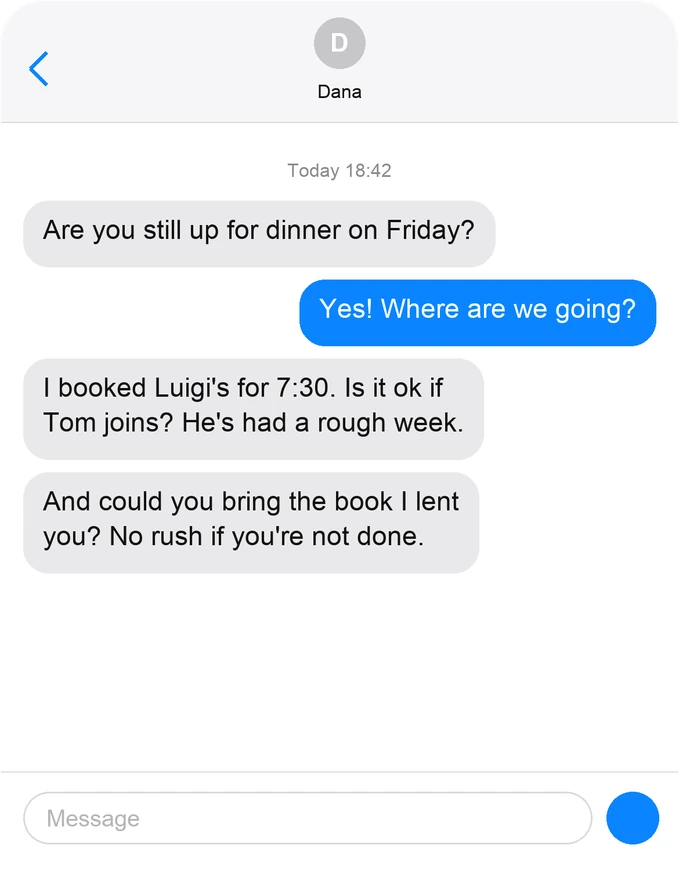
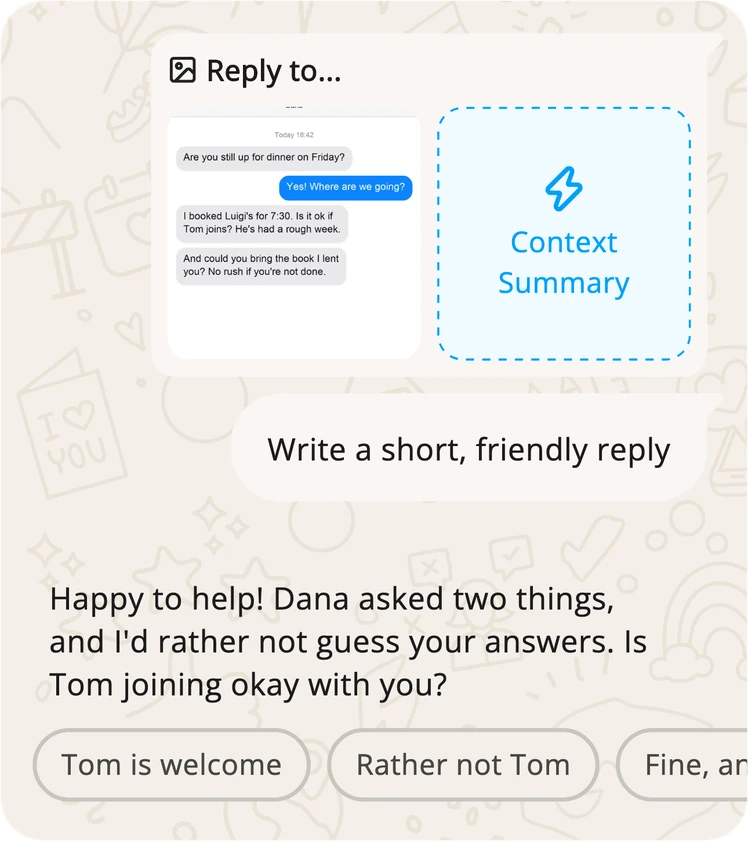
One run shows Subtext picking out what was asked without guessing at feelings. For it, a made-up chat with Dana was drawn as a screenshot; the reply to it is the app’s real output. Dana says she has booked Luigi’s for Friday, asks if Tom may join because “He’s had a rough week.”, and asks for her book back. Told to “Write a short, friendly reply”, Subtext asked the user first: “Happy to help! Dana asked two things, and I’d rather not guess your answers. Is Tom joining okay with you?” Four possible answers came with that question. Nothing in the answer guessed at what Dana or Tom felt, which is the line this article draws.
Try Subtext in your browserDownload on the App StoreGet it on Google PlayScan it with your phone camera to install.
Think I have read a study wrong, or know research on this I have missed? Tell me on LinkedIn.
Samet Durgun is the co-founder of Subtext, an app that catches the emotional tone of your messages and rewrites them in your own voice. He’s based in Berlin.
Sources
Numbered in the order they appear above. Where a figure could not be verified against the primary source, the text says so. Checked 28 August 2026.
- Kruger, J., Epley, N., Parker, J., and Ng, Z.-W. (2005). Egocentrism Over E-Mail: Can We Communicate as Well as We Think? Journal of Personality and Social Psychology, 89(6), 925 to 936. Funded by University of Illinois Board of Trustees Grant 1-2-69853 and NSF Grant SES-0241544. The 88.8 and 70.4 figures are Study 3, with 154 pairs; the 97 and 84 figures are Study 1, with six dyads.
- Pollmann, M. M. H., and Roos, C. A. (2025). “I get u”. People correctly interpret the tone of text messages and emails. Computers in Human Behavior Reports, 18, article 100689. A companion open-access title rather than the parent journal; recent and not yet replicated. Study 2 preregistered.
- Sillars, A., and Zorn, T. E. (2021). Hypernegative Interpretation of Negatively Perceived Email at Work. Management Communication Quarterly, 35(2), 171 to 200.
- Kingsbury, M., and Coplan, R. J. (2016). RU mad @ me? Social anxiety and interpretation of ambiguous text messages. Computers in Human Behavior, 54, 368 to 379.
- Savitsky, K., Keysar, B., Epley, N., Carter, T., and Swanson, A. (2011). The closeness-communication bias: Increased egocentrism among friends versus strangers. Journal of Experimental Social Psychology, 47(2), 269 to 273.
- Steinebach, P., Stein, M., and Schnell, K. (2025). Messenger-based assessment of empathic accuracy in couples’ smartphone communication. BMC Psychology, 13, article 147. Preregistered. Underpowered by the authors’ own account: 51 couples against a planned 200.
- Eyal, T., Steffel, M., and Epley, N. (2018). Perspective mistaking: Accurately understanding the mind of another requires getting perspective, not taking perspective. Journal of Personality and Social Psychology, 114(4), 547 to 571.
- Giurge, L. M., and Bohns, V. K. (2021). “You don’t need to answer right away!” Receivers overestimate how quickly senders expect responses to non-urgent work emails. Organizational Behavior and Human Decision Processes, 167, 114 to 128. Eight preregistered studies, 4,004 working adults.
- Dingemanse, M., Torreira, F., and Enfield, N. J. (2013). Is “Huh?” a universal word? PLOS ONE, 8(11), e78273.
- Kalman, Y. M., Ravid, G., Raban, D. R., and Rafaeli, S. (2006). Pauses and Response Latencies: A Chronemic Analysis of Asynchronous CMC. Journal of Computer-Mediated Communication, 12(1), 1 to 23.
- Miller, H., Thebault-Spieker, J., Chang, S., Johnson, I., Terveen, L., and Hecht, B. (2016). “Blissfully happy” or “ready to fight”: Varying interpretations of emoji. Proceedings of ICWSM 2016, 259 to 268.
- Li, J., Zhou, Y., Venkit, P. N., Islam, H. B., Arya, S., Wilson, S., and Rajtmajer, S. (2025). Can Third Parties Read Our Emotions? Proceedings of ACL 2025 (Long Papers), 21478 to 21499.