ArticlesMessages
Does this text sound rude?
You hear your own intended tone while you write and cannot switch it off. That makes you reliably overconfident about irony, teasing and the line between firm and cold, and reasonably accurate about plain warmth. What actually helps, ranked by evidence.
By Samet Durgun · Co-founder of Subtext · 9 min read
· Updated October 14, 2026
You have read it back six times and it sounds fine. It also sounded fine the first time, which is the problem, because reading it back straight away is a test your message will almost always pass. I co-founded Subtext because this question, asked of a message the person has already reread, is the most common thing anyone brings to it.
My answer is that you cannot tell from the inside, and the reason is well characterised. You silently hear your own intended tone while you write, and you cannot subtract it when predicting how someone else will read the words without it. But the popular version overstates the damage. You are bad at conveying irony, teasing, and the difference between firm and cold. You are not demonstrably bad at conveying ordinary warmth to people who already know you. Both halves matter, and so does knowing which half your message falls into.
The study behind everything, with the numbers labelled
Kruger, Epley, Parker and Ng ran five experiments on this and people cite the paper everywhere, usually with figures that do not say which study they came from1. I’ve labelled them here, because the unlabelled versions have caused real confusion.
In the first study, twelve students in six pairs wrote serious and sarcastic statements and emailed them. Senders predicted readers would decode 97 per cent correctly. Actual accuracy was 84. Reliable overconfidence on a tiny sample, and note that actual accuracy was still high. The finding is “worse than they thought”, not “bad”.
In the third and largest study, Kruger’s team tested 154 pairs on sarcasm, seriousness, anger and sadness. Pooled across email, voice-only and face-to-face, senders predicted 88.8 per cent accuracy and readers achieved 70.4. By email alone, senders predicted 88.0 per cent and readers achieved 62.8 (the paper’s Figure 2). Friends were no better than strangers. And face-to-face was no better than voice-only, which points at missing intonation, not missing gesture, as the operative loss.
In the second study, email readers detected sarcasm at a rate the authors describe as indistinguishable from chance, while people hearing their partner’s lines read aloud got roughly three quarters right. You will see that study quoted as 78 per cent predicted against 56 achieved. The paper’s Figure 1 prints both numbers, but they come from this one study of sarcastic and serious statements, with 29 pairs analysed, so they are not a general rate for reading tone.
The mechanism test is the fourth study, and it is the one that justifies everything practical in this article. Participants read their own statements aloud either in the intended tone or deliberately in the wrong one. Reading them the wrong way erased the overconfidence entirely. Your own inner voice is the culprit, and this is the experiment that shows it.
Two things to carry. No one has directly replicated the paper at high power. It fell outside the sampling frame of the big replication projects and appears in none of them. It is famous, theoretically coherent and internally consistent, and it rests on small mid-2000s undergraduate samples. And the mechanism, egocentric anchoring, has theoretical parents in the curse of knowledge and the illusion of transparency, neither of which has a gold-standard direct replication either.
This table sets out three of the five Kruger, Epley, Parker and Ng (2005) experiments, study by study1.
| Study | Participants | What was judged | Senders predicted | Readers achieved |
|---|---|---|---|---|
| 1 | Twelve students in six pairs | Serious or sarcastic, by email | 97 per cent | 84 per cent |
| 2 | 29 pairs analysed | Serious or sarcastic, by email or by voice | 78 per cent, as quoted | 56 per cent, as quoted |
| 3 | 154 pairs | Sarcasm, seriousness, anger or sadness, pooled across email, voice-only and face-to-face | 88.8 per cent | 70.4 per cent |
Study 2’s 78 and 56 are the figures you will see quoted, and they are not a general rate for reading tone. In that study the authors describe email readers’ sarcasm detection as indistinguishable from chance, while people hearing the lines read aloud got roughly three quarters right. The paper rests on small mid-2000s undergraduate samples, and no one has directly replicated it at high power.
The finding that narrows the thesis
Pollmann and Roos tested the popular assumption directly, using real messages and asking both people2. Receivers rated the warmth of a message they had actually received; the sender then rated what they had intended. Across 171 matched pairs for text messages and 61 for work emails, the ratings aligned closely, and the moderators they tested, emoji among them, changed nothing. Message length made no difference for the text messages, and for the emails they had too few complete cases to test it.
Read the scope carefully, because it’s what makes the two findings compatible.
| Kruger and colleagues | Pollmann and Roos | |
|---|---|---|
| Materials | Sentences written on assigned topics, or picked from a supplied list | Real messages people actually sent |
| Relationship | Strangers, plus friends in the third study | Existing relationships |
| What was judged | Which specific tone was intended | Warm to cold, one dimension |
| Difficulty | Irony-heavy, with senders often picking the lines they thought easiest | Whatever people naturally write |
My synthesis is that people are good at conveying whether they feel good or bad, and bad at conveying irony, teasing, and the line between firm and cold, especially with people who do not know them well.
Pollmann and Roos measured valence, a single dimension. “Was this warm or cold” is a different question from “did you catch that I was joking” or “did this read as passive-aggressive”, and their null result does not licence a general claim that people understand written tone. The reader’s side of the same research is in what a text means when you are the one receiving it. It is also a single study in a companion open-access journal, and no one has independently replicated it yet.
So when you ask whether your message sounds rude, the first thing to check is which kind of message it is. If it is plain and warm and going to someone who knows you, it is probably fine. If it is dry, ironic or firm and going to someone who does not, that is where the gap lives.
Why your intent feels audible
Most people hear a voice when they read. In a general-population survey of 570 people, 80.7 per cent reported sometimes or always hearing an inner voice during silent reading, and most described it as having gender, accent, pitch and emotional tone3. The 19.3 per cent who reported no inner reading voice is a useful complication, since it means this mechanism is probably not universal.
Linguists call the related phenomenon implicit prosody: silent reading projects a default melody onto text, and that melody influences how you parse it4. Brain measures back it up, with commas and implicit phrase boundaries producing responses that resemble the response to spoken boundaries. It is part of why people ask whether a full stop makes a text sound angry.
The limit of this evidence is that I found no single study that measures inner-voice prosody and then links it to a specific misjudgement of your own written tone. What exists is two well-supported literatures meeting at a plausible junction, plus Kruger’s fourth study, which manipulates the sender’s vocalisation and gets the predicted result.
This is also the precise gap Subtext sits in. It reads the message with no inner voice at all, which is the one thing you cannot do to your own draft, and it reports which readings the words support rather than the one you meant.
Why rereading straight away misses things, and typos survive
The same mechanism explains the typo you missed five times.
Daneman and Stainton had people write an essay and then proofread it after either twenty minutes or two weeks, alongside a familiar and an unfamiliar essay by someone else5. They caught fewer errors in their own writing than in unfamiliar writing. And the two-week delay reduced the disadvantage, which pins the problem on extreme familiarity and not on authorship as such.
One correction I’d make, because the wrong explanation circulates widely. Burgoyne and colleagues tested directly whether the generation effect, meaning better memory for things you produced yourself, is why you miss your own typos, and they did not confirm it. Two eye-tracking experiments found no self-generation effect in proofreading6. The account that holds up is familiarity and predictability. You know what the text is meant to say, so you see that rather than what is there.
Your expertise with your own message actively hurts. That is why the copy editor with no idea what you meant does better.
What actually helps, ranked
Read it aloud in the wrong tone. Kruger’s fourth study is the evidence1. Deliberately not performing your intended tone dissolves the overconfidence. Reading it aloud in the tone you meant may do little, because that reinforces your own phenomenology. Read it flat, or read it as if you were annoyed, and see what survives.
Wait. The easiest fix to try. Daneman and Stainton found that a two week delay helped people catch errors in their own writing5. I know of no test of an overnight wait for tone, but the familiarity problem is the same, and overnight is usually possible for a text.
Read it aloud for errors. Cushing and Bodner’s experiments now support this directly. They compared proofreading aloud, silently, and in a deliberately hard-to-read font7. Aloud improved error detection. The disfluent font either impaired it or did nothing. Participants did not predict the aloud benefit, so this is useful advice people will not adopt on intuition. I couldn’t verify the sample sizes for both experiments from the accessible materials, so no numbers.
Get an outside reader. The proofreading studies support this well for clarity and errors, since a fresh reader lacks your privileged knowledge. One caveat for tone specifically is that any negativity bias belongs to the actual recipient, so a neutral third party may not reproduce the reaction of one specific anxious or subordinate reader.
Change the format. Pilotti and colleagues found that changing the typescript restores error salience8. This is not the same as using a hard-to-read font, which the Cushing and Bodner work found unhelpful.
Say the thing explicitly. Giurge and Bohns tested this directly, and it addresses the best-evidenced asymmetry in this literature, which is about urgency, not rudeness. They ran eight preregistered experiments with 4,004 working adults and found receivers overestimate how fast senders expect replies to non-urgent out-of-hours email, and pay for it in stress9. A brief note from the sender saying there is no rush reduced the bias. Your convenient Sunday-night email reads as a demand, and the fix is four words long.
Text-to-speech. Principled, but not proven. It supplies an external voice with none of your intended prosody, which is what the fourth Kruger study suggests should help. I found no direct experiment isolating it for tone.
What Subtext does with this
Subtext is the outside reader, minus the inner voice, plus the specific check for the messages where the gap lives. It flags irony that will not travel, since figuring out whether a message is sarcastic from the words alone has its own research and its own limits, a firm sentence that reads cold. When a draft is fine, it says so.
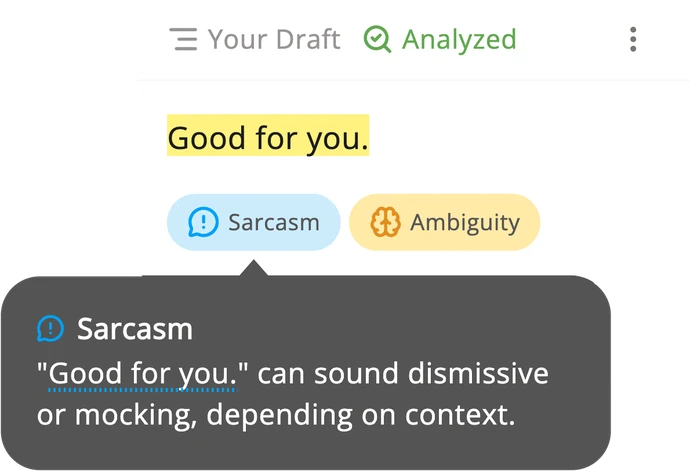
Here is that reader on a made-up dry line, as an illustration and not as evidence for the studies above. Read with no inner voice at all, “Good for you.” came back with the tag Sarcasm, the feeling word Ambiguity and a note that the line “can sound dismissive or mocking, depending on context”. That is the app’s real output, unedited. If you meant it warmly, the warmth was in your inner voice, and the words on their own do not carry it.
I cover the same gap from the product side in what AI can and can’t tell about the tone of your message. Subtext is the outside reader without an inner voice. Try Subtext in your browserDownload on the App StoreGet it on Google PlayScan it with your phone camera to install.
Sources
Numbered in the order they appear above. Where a figure could not be verified against the primary source, the text says so.
- Kruger, J., Epley, N., Parker, J., and Ng, Z.-W. (2005). Egocentrism over e-mail: Can we communicate as well as we think? Journal of Personality and Social Psychology, 89(6), 925 to 936. Funded by a University of Illinois Board of Trustees research grant and NSF grant SES-0241544. Study 1: 12 students, six dyads, 97 against 84. Study 3: 154 pairs, 88.8 against 70.4 pooled across email, voice-only and face-to-face; by email alone, 88.0 against 62.8 (Figure 2). Study 4: 54 students. Never directly replicated at high power.
- Pollmann, M. M. H., and Roos, C. A. (2025). “I get u”. People correctly interpret the tone of text messages and emails. Computers in Human Behavior Reports, 18, article 100689. Measures valence only. Companion open-access title; not yet independently replicated. Funding unverified.
- Vilhauer, R. P. (2017). Characteristics of inner reading voices. Scandinavian Journal of Psychology, 58(4), 269 to 274. General-population survey, n = 570. Self-report about reading in general. Funding unverified.
- Alderson-Day, B., and Fernyhough, C. (2015). Inner speech: Development, cognitive functions, phenomenology, and neurobiology. Psychological Bulletin, 141(5), 931 to 965. The major review of inner speech.
- Daneman, M., and Stainton, M. (1993). The generation effect in reading and proofreading: Is it easier or harder to detect errors in one’s own writing? Reading and Writing, 5(3), 297 to 313.
- Burgoyne, A. P., Saba-Sadiya, S., Harris, L. J., Becker, M. W., Brascamp, J. W., and Hambrick, D. Z. (2023). Revisiting the self-generation effect in proofreading. Psychological Research, 87, 800 to 815. Two eye-tracking experiments; no self-generation effect found.
- Cushing, C., and Bodner, G. E. (2022). Reading aloud improves proofreading (but using Sans Forgetica font does not). Journal of Applied Research in Memory and Cognition, 11(3), 427 to 436. Data at OSF. Sample sizes not verifiable from accessible materials. Funded by Flinders University seed and thesis awards.
- Pilotti, M., and colleagues (2004, 2009, 2012). Series on familiarity and proofreading, in Journal of General Psychology, Reading and Writing, and Journal of Research in Reading. Changing the typescript restores error salience.
- Giurge, L. M., and Bohns, V. K. (2021). “You don’t need to answer right away!” Receivers overestimate how quickly senders expect responses to non-urgent work emails. Organizational Behavior and Human Decision Processes, 167, 114 to 128. Eight preregistered experiments, 4,004 working adults. Funding unverified.