ArticlesMessages
Why does a two-line reply take me an hour?
Masking is real, very common in the samples studied, and consistently linked to exhaustion. The hour itself has never been measured. And the best evidence points at the reader as much as the writer.
By Samet Durgun · Co-founder of Subtext · 11 min read
· Updated October 14, 2026
The reply is two lines. You wrote it in thirty seconds. Then you read it back and it sounded blunt, so you added a greeting, and that sounded fake, so you took it out, and you have now been doing this for fifty minutes with a message that says you can make Thursday. I co-founded Subtext, and a lot of the people who use it describe this exact loop, and a lot of them are autistic.
This is a different problem from the one where you cannot start the reply at all, which I have written about in why can’t I reply to messages. This is the one where you started fine and cannot stop editing. The research has a name for the mechanism behind it, and most articles get its shape wrong. The masking is well documented, the hour is not, and the strongest single finding is about how non-autistic readers react, not about anything you are doing. The jobs inside any reply, reading, deciding, wording and judging how it lands, are in why replying to a simple message feels like so much work.
What masking is, and how it is measured
Hull and colleagues mapped camouflaging, which is what the research calls it, through thematic analysis of autistic adults’ own accounts, and it sorts into motivations, behaviours and consequences1. The behaviours are scripts, copying, monitoring and suppression. The consequences people describe are exhaustion and a loss of the sense of who they are underneath.
The instrument is the Camouflaging Autistic Traits Questionnaire, 25 items on three subscales: compensation, meaning learned strategies and scripts; masking, meaning suppressing autistic characteristics; and assimilation, meaning performing fit in places you feel out of place2. The validation sample was 832 UK adults, 354 of them autistic, and the reliability numbers are strong.
Two things the CAT-Q does not measure, and both matter for this article. It does not measure effort or time, so the hour-long reply is invisible to it. And a Dutch replication with 674 adults found the three-factor structure held but measurement invariance between autistic and non-autistic groups did not, and the CAT-Q correlated only weakly with a different way of measuring masking3. Whether you measure masking by asking people or by comparing how they present with how they test is a live argument in the field, and each side thinks the other’s method is contaminated.
How common it is
The one clean number comes from a 2021 online sample of 346 autistic adults, where 300 of the 334 who reached the camouflaging questions said they had done it at some point, which is 89.8 per cent4.
That is a self-selected online sample, disproportionately female, without intellectual disability, often diagnosed as adults, recruited for a study advertised as being about mental health. I read that as support for “very common in the online adult samples studied”, not for “nine in ten autistic people mask”, and I would not give a population figure because the evidence does not have one. The 94 per cent that circulates traces to nothing.
The cost, and what the causal evidence says
Every widely cited study here is cross-sectional. They establish that masking and poorer mental health go together. They do not establish direction.
Cage and Troxell-Whitman surveyed 262 autistic adults and found heavy camouflaging across many contexts, and a lot of switching between masked and unmasked settings, both went with worse anxiety, depression and stress5. Hull and colleagues found the same associations in 305 formally diagnosed adults, but camouflaging added only a small amount of explanatory power once they controlled for autistic traits and age6. Cassidy and colleagues found camouflaging remained associated with lifetime suicidality in 164 autistic adults after adjustment, which is a concerning association with a screening cut-off and not a prospective outcome7.
Then comes a correction I rarely see carried. The first substantial two-wave longitudinal study, 332 autistic adults assessed twice about two years apart, found that higher baseline camouflaging did not predict worsening mental health8. The observed relationship ran weakly the other way. The authors do not conclude masking is fine. Two waves cannot resolve pathways, the sample was older and highly educated, and data collection overlapped the pandemic. But the simple story, that masking leads to breakdown, is not what the only longitudinal data show.
Pointing back the other way, a co-twin study of 70 same-sex pairs found that within pairs, including identical twins, the twin who reported more camouflaging reported worse quality of life9. That removes genetic and shared-environment confounds and is more compatible with a real cost than an ordinary correlation. It is still cross-sectional, and only 22 of the 140 twins were autistic.
What I’d stand behind is that masking is repeatedly associated with poorer mental health, that many autistic people describe it as exhausting, and that whether it independently causes later difficulties is unsettled. No intervention trial of reducing masking exists.
Raymaker and colleagues mapped autistic burnout, the thing the hour-long reply feeds into, through interviews with 19 autistic adults plus public accounts, and described it as chronic exhaustion, loss of skills and reduced tolerance for stimulus, arising from cumulative demands without relief10. Masking was one of the demands people named. That is evidence for experienced cumulative cost, not a quantified model.
Has anyone studied this in writing?
Yes, twice, so the claim that the masking literature is face-to-face only is now wrong.
Jedrzejewska and Dewey compared 40 autistic and 158 non-autistic adolescents on camouflaging offline and online, and found autistic adolescents reported less camouflaging online than in person11. Adolescents, so a further step to adults.
Of everything I’ve read, Koteyko and colleagues come closest to the hour-long reply12. They combined observation, interviews and corpus analysis with 34 UK autistic adult social media users. Among those who limited disclosure of their autism, the written strategies were tentative language, managing a positive presentation, choosing what and where to post, and adjusting language to the expected audience. Participants described uncertainty about how readers would take their messages, and adapting to reduce the perceived social risk.
That study did not measure drafting time, deletions, rereads, cognitive effort, how much warmer a revised message became, or whether the revisions changed anything for the reader. So “digital masking is directly evidenced” is true. “The hour has been measured” is not. The specific thing this article is about remains unquantified, and I looked.
The word people use for it, translation labour, is a name for work autistic people describe. Nobody has measured it as a construct. And it can turn into a deficit story by accident, as if autistic writing were defective and had to be laboriously fixed. The digital evidence supports a different reading, in which people modify their language because of prior misunderstanding, stigma and anticipated judgement, not because the original phrasing was wrong.
Does text help, or does it just move the problem?
Three propositions, and the evidence cannot pick between the first two.
Text may reduce the need to mask, by removing gaze, prosody and real-time timing demands. The adolescent finding above points that way. Text may instead provide better tools for masking, meaning editing, hedging and controlling disclosure, so the masking relocates to a private editing stage and can expand to fill it. The Koteyko findings point that way, and it is the mechanism behind the hour.
The third proposition, that autistic adults use written channels more, is the only one established. A passive-monitoring study of 60 adults over up to four months found autistic participants spent 2.3 times more foreground time in written-communication apps and 2.6 times less in verbal ones13. Small, exploratory, and app time includes reading. The study did not measure masking.
So avoid both “autistic people prefer text because they can stop masking” and “because it makes masking easier”. The data do not adjudicate, and I would rather say that than pick the version that suits me.
This is where Subtext sits, and I want to be exact about it. The loop you are in is a prediction loop. You are trying to guess how a non-autistic reader will take the words, with no feedback. What Subtext does is replace the guess with a reading, once, so the editing stage has an end. It does not tell you to add warmth you do not mean. If the first draft reads fine, and it often does, it says so. The longer version is on the page about an AI tone checker for neurodivergent adults.
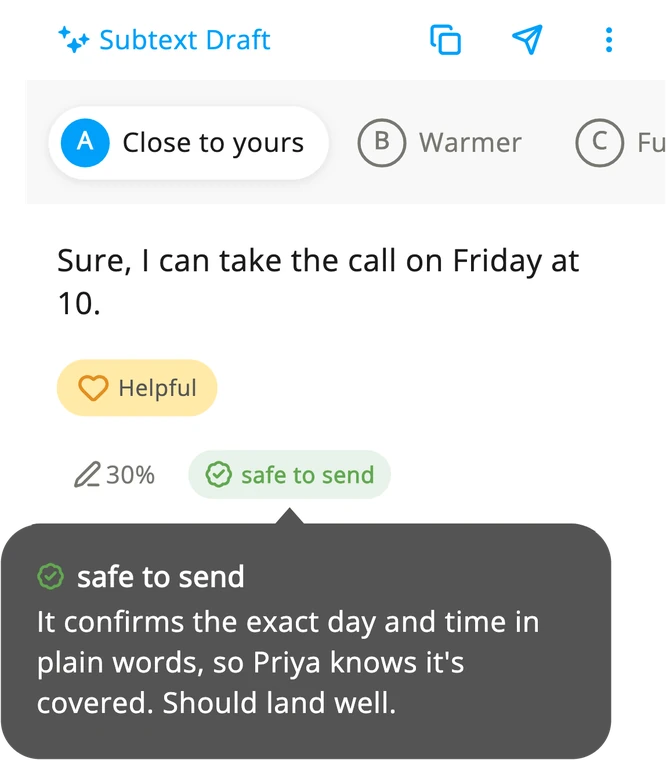
Here is one case, with a request and a reply both made up for the run. Priya, a colleague, asks “Could you take the client call on Friday at 10? I’m out that morning.” and the reply drafted to her says “Sure, I can do that.” No tag came back, and Subtext’s first line was “Happy to help a colleague out, and your reply already does that.” Three versions followed anyway, one of them warmer. The first, marked safe to send, read “Sure, I can take the call on Friday at 10.” The note behind the badge gave the reason, “It confirms the exact day and time in plain words, so Priya knows it’s covered. Should land well.” That is the app’s real output, unedited. Spelling out the day and time is the only change. The warmer version is an offer, and this draft did not need it.
The finding that moves the problem off your desk
Sasson and colleagues had 214 raters form first impressions of 20 autistic and 20 non-autistic adults across several formats: audio-visual, audio only, visual only, a still image, and a speech transcript14. Autistic adults got less favourable impressions on several dimensions when raters saw or heard them. When raters had the transcript alone, the group difference disappeared.
Strip the presentation and raters judged the words the same. A social outcome that people easily label an autistic deficit arose in large part from how non-autistic observers reacted to how someone looked and sounded.
Two caveats. It is a lab thin-slice task with strangers. And transcripts of speech are not the same stimulus as a message someone composed for a reader; nobody has tested first impressions from autistic-authored written text specifically. But for this article it is the bridge. The writer spending an hour may be anticipating a real interpretive penalty, not repairing anything internal.
Disclosure changes the reading too. In a follow-up, 215 observers judged the same adults under no label, a correct autism label, or an incorrect one15. Correct disclosure improved impressions relative to no label, and observers who knew more about autism rated autistic adults more positively. Lab judgement, not a workplace or a friendship, and none of it makes disclosure safe everywhere. It does make it a strategy with trade-offs, not a risk with none.
The framework, and its critics
Researchers usually organise the interactional reading above under the double empathy problem, which holds that misunderstanding between autistic and non-autistic people runs both ways. Its best known experiment passed information along chains of autistic, non-autistic and mixed participants and found more loss in the mixed chains, which I cover in AuDHD and communication: what holds up, and what does not. A larger registered replication with 311 participants, published in 2025, did not find that loss in mixed chains. Rapport showed a different pattern, and rapport and accuracy are separate outcomes16.
Methodologists contest the framework. Livingston, Hargitai and Shah argue in Psychological Review that people use “double empathy” for too many different things, that studies get cited as support without measuring empathy, and that applying it to diagnosis or policy is premature17. A reply argues that demanding that precision risks discarding a needed alternative to one-sided deficit models18. A separate methodological review of 20 empirical papers concluded most did not adequately measure empathy, while stating that this does not establish any autistic empathy deficit either19.
My read is that there is good evidence for recipient effects, mixed evidence for information loss between neurotypes, and much weaker evidence for the broad claim that the difficulties are symmetrical. There is no consensus, and this article does not need one. The transcript finding stands on its own.
Gender, and late diagnosis
Autistic women report higher total CAT-Q scores than autistic men, driven by masking and assimilation rather than compensation, in a sample of 306 autistic and 472 non-autistic adults20. A US sample of 502 found the same, with gender-diverse adults higher on compensation specifically21.
Three things must survive any summary of that. It is a group average on self-report, it is smaller on discrepancy methods, and Bradley and colleagues warn explicitly against treating masking as female-specific, because masked autistic men get missed4.
Adult-diagnosed autistic adults report more assimilation and compensation than those diagnosed as children, in a matched comparison of 251 against 25121. Because McQuaid and colleagues measured masking after diagnosis, that cannot show that people masked more before their delayed diagnosis. “Masking can hide autism from diagnosticians” is strongly supported by personal accounts. “Masking has been shown to cause late diagnosis” is not supported.
Unmasking, and why “just stop” is bad advice
Cook, Crane and Mandy surveyed 133 autistic people about when they could interact authentically, and as their title says, it takes two22. Dropping the mask depended on feeling safe, accepted and understood by the other person. It was relational, not a technique. Unmasking is also one of the two opposite things people now mean by autismmaxxing.
A 2026 mixed-methods study of autistic US college students found that students described unmasking as relieving stress while raising fear of rejection, with cross-sectional links between unmasking in some contexts and better mental health23. People with better mental health may find it safer to unmask, and no trial exists.
So my advice is not “just unmask”. The social penalties that motivate masking are real, and the transcript study shows they are real in the reader. The better-supported lever is on the environment: asynchronous channels, explicit expectations, readers who take direct wording without assigning hostility, no demand for performative warmth, and real choice about disclosure.
For the scene this article started with, the evidence-based accommodation is a relationship in which a concise, literal first draft does not need an hour of defensive editing. Until you have that, the second-best thing is a way to end the loop, and I collected the ones with evidence behind them in a guide for anxious texters who overthink every message.
Try Subtext in your browserDownload on the App StoreGet it on Google PlayScan it with your phone camera to install.
Sources
Numbered in the order they appear above. Where a figure could not be verified against the primary source, the text says so.
- Hull, L., Petrides, K. V., Allison, C., Smith, P., Baron-Cohen, S., Lai, M.-C., and Mandy, W. (2017). “Putting on My Best Normal”: Social Camouflaging in Adults with Autism Spectrum Conditions. Journal of Autism and Developmental Disorders, 47(8), 2519 to 2534. Sample size reported as 92 in one source only; funder not stated.
- Hull, L., Mandy, W., Lai, M.-C., Baron-Cohen, S., Allison, C., Smith, P., and Petrides, K. V. (2019). Development and Validation of the Camouflaging Autistic Traits Questionnaire. Journal of Autism and Developmental Disorders, 49(3), 819 to 833. 832 UK adults, 354 autistic. Funders reported variously as Wellcome Trust and MRC.
- van der Putten, W. J., and colleagues (2023). Conceptual replication of the CAT-Q in Dutch adults. Research in Autism Spectrum Disorders. 674 adults aged 30 to 92, 356 autistic. Funded by NWO VICI grant 453-16-006.
- Bradley, L., Shaw, R., Baron-Cohen, S., and Cassidy, S. (2021). Autistic Adults’ Experiences of Camouflaging and Its Perceived Impact on Mental Health. Autism in Adulthood, 3(4), 320 to 329. 346 recruited; 300 of 334 endorsed camouflaging. Funded by Coventry University, ESRC ES/N000501/2, and Autistica 7247, with additional support to Baron-Cohen.
- Cage, E., and Troxell-Whitman, Z. (2019). Understanding the Reasons, Contexts and Costs of Camouflaging for Autistic Adults. Journal of Autism and Developmental Disorders, 49(5), 1899 to 1911. 262 autistic adults.
- Hull, L., Levy, L., Lai, M.-C., Petrides, K. V., Baron-Cohen, S., Allison, C., Smith, P., and Mandy, W. (2021). Is social camouflaging associated with anxiety and depression in autistic adults? Molecular Autism, 12, 13. 305 formally diagnosed adults.
- Cassidy, S., Bradley, L., Shaw, R., and Baron-Cohen, S. (2018). Risk markers for suicidality in autistic adults. Molecular Autism, 9, 42. 164 autistic and 169 comparison adults; camouflaging measured with an early four-item index. Funded by ESRC ES/N000501/2 and Coventry University.
- van der Putten, W. J., and colleagues (2025). Two-wave longitudinal study of camouflaging and mental health. Autism. 332 autistic adults aged 30 to 84, assessed about two years apart. Funded by NWO VICI grant 453-16-006.
- Lundin Remnélius, K., Neufeld, J., Isaksson, J., and Bölte, S. (2024, in print 2026). Co-twin control study of camouflaging and quality of life. Journal of Autism and Developmental Disorders. 140 twins in 70 same-sex pairs, 22 autistic. The publisher page carries an “article has been updated” notice whose content has not been retrieved.
- Raymaker, D. M., and colleagues (2020). “Having All of Your Internal Resources Exhausted Beyond Measure and Being Left with No Clean-Up Crew”: Defining Autistic Burnout. Autism in Adulthood, 2(2), 132 to 143. 19 interviews plus 19 public sources. Funded by NIMH 1R21MH112038.
- Jedrzejewska, A., and Dewey, J. (2022). Camouflaging in Autistic and Non-autistic Adolescents in the Modern Context of Social Media. Journal of Autism and Developmental Disorders, 52(2), 630 to 646. 40 autistic and 158 non-autistic adolescents. Funder not recoverable.
- Koteyko, N., Van Driel, M., Billan, S., Barros Pena, B., and Vines, J. (2025). Stigma Management Strategies of Autistic Social Media Users. Autism in Adulthood. 34 UK autistic adults. Funded by ESRC ES/T016507/1.
- Turna, M., and colleagues (2025). Real world evidence for altered communication patterns in individuals with autism spectrum disorder. npj Digital Medicine, 8, article 155. 27 autistic and 33 typically developing adults over a four-month period. Funded by the Ministry of Culture and Science of North Rhine-Westphalia, ABCD-J grant KP22-106A.
- Sasson, N. J., Faso, D. J., Nugent, J., Lovell, M., Kennedy, D. P., and Grossman, R. B. (2017). Neurotypical Peers are Less Willing to Interact with Those with Autism based on Thin Slice Judgments. Scientific Reports, 7, 40700. Study 1: 40 targets, 214 raters. Rater counts conflict across secondary sources; these are the figures with the better provenance.
- Sasson, N. J., and Morrison, K. E. (2019). First impressions of adults with autism improve with diagnostic disclosure and increased autism knowledge of peers. Autism, 23(1), 50 to 59. 40 targets, 215 observers per the better-sourced account; a figure of 269 also circulates. Funder not identifiable.
- Crompton, C. J., Foster, S. J., Wilks, C. E. H., Dodd, M., Efthimiou, T. N., Ropar, D., Sasson, N. J., Lages, M., and Fletcher-Watson, S. (2025). Information transfer within and between autistic and non-autistic people. Nature Human Behaviour, 9, 1488 to 1500. Registered report, 311 participants.
- Livingston, L. A., Hargitai, L. D., and Shah, P. (2025). The Double Empathy Problem: A Derivation Chain Analysis and Cautionary Note. Psychological Review, 132(3), 744 to 757. Theoretical review, no sample.
- Bollen, C., and van Grunsven, J. (2026). Reply to Livingston, Hargitai and Shah. Psychological Review, 133(2), 507 to 514. Theoretical reply.
- Fellowes, S. (2026). Critical methodology review of double empathy studies. Journal of Autism and Developmental Disorders. Twenty empirical papers; search dated 21 July 2025. No organisational funding.
- Hull, L., Lai, M.-C., Baron-Cohen, S., Allison, C., Smith, P., Petrides, K. V., and Mandy, W. (2020). Gender differences in self-reported camouflaging in autistic and non-autistic adults. Autism, 24(2), 352 to 363. 306 autistic and 472 non-autistic adults.
- McQuaid, G. A., Lee, N. R., and Wallace, G. L. (2022). Camouflaging in autism spectrum disorder: Examining the roles of sex, gender identity, and diagnostic timing. Autism, 26(2), 552 to 559. 502 autistic adults; 251 adult-diagnosed matched to 251 child-diagnosed. Funded by Autism Speaks fellowship 11808 and George Washington University.
- Cook, J., Crane, L., and Mandy, W. (2024). Dropping the mask: It takes two. Autism, 28(4), 831 to 842. 133 autistic people surveyed. Cook funded by a UCL doctoral scholarship.
- Durben (2026). Unmasking among autistic US college students. Journal of Autism and Developmental Disorders. 14 interviewed, 214 surveyed. Single author; funded by a Casstevens Research Scholar award at Hamilton College.