ArticlesWriting tools
What is the Subtext app, who it's for, and when to use it
Subtext reads the tone of a message before you send it, then rewrites it in your own voice. What it does, who it's for, and when to use it.
By Samet Durgun · Co-founder of Subtext · 7 min read
· Updated September 26, 2026
Subtext is an app that reads the emotional tone of a message before you send it, then helps you say the same thing in your own voice. That’s the whole product in one sentence. The rest of this post is the longer, honest version, covering what it does, who it’s for, and when it earns a place on your phone.
I’m one of the two people who make it, so I’m biased by definition. To keep myself honest, every claim below links to a source, the review quotes are real ones you can find in the stores, and I’ll tell you plainly where Subtext is the wrong tool.
What Subtext is
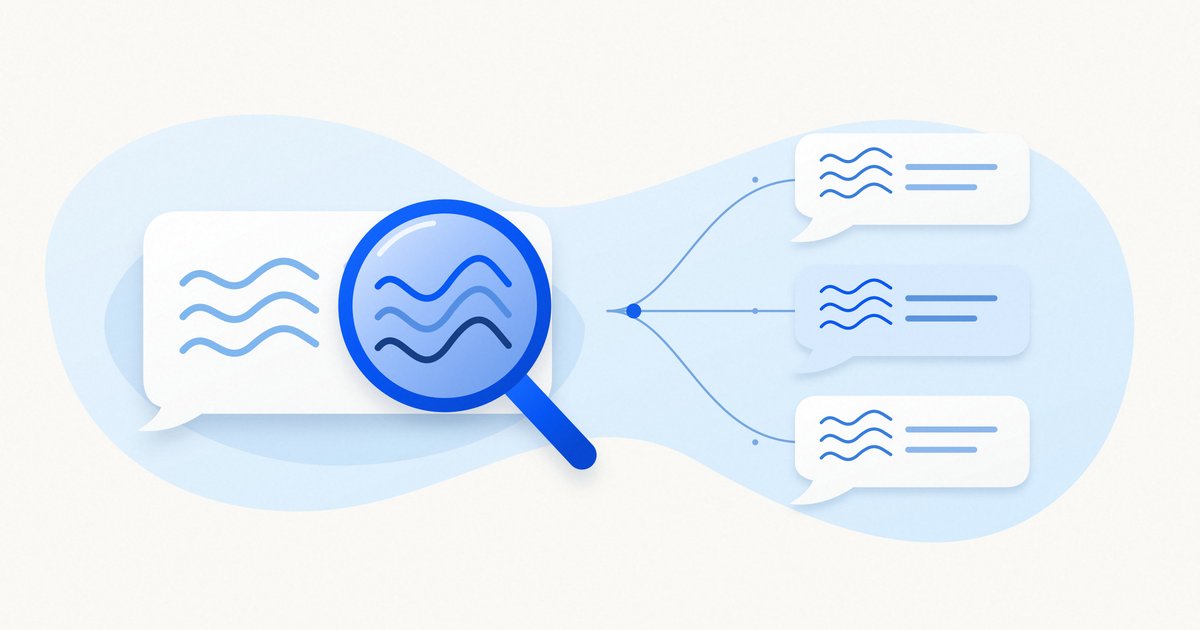
You bring a message. A draft you keep rewriting, a screenshot of the whole conversation, or a voice note where you just talk it out. Subtext reads it before it changes anything. It watches for the emotional triggers hiding in what you’ve written, then tags what it finds in your draft, including the parts you didn’t notice you put in there. The defensive edge, say, or the three apologies in a two-line text.
Then it rewrites. You get up to three versions to switch between, each tagged with how it comes across, and you can nudge any of them with a tap to make it warmer, shorter, or more casual. You pick one, or you steal the good parts and fix the draft yourself. On the Subtext website we call it a therapist for messages1. That line describes the feeling. The fine print2 is simpler, and I want to say it plainly. Subtext is a writing tool, it does not provide therapy, diagnosis, or medical advice, and it will never know your relationship better than you do.
The order of operations matters more than it sounds. Most AI tools skip straight to rewriting. We put analysis first because naming what’s inside a message changes how you handle it. Brené Brown’s team surveyed 7,000 people over five years3, asking them to name what they were feeling in the moment.
The finding On average, people can identify only three emotions while they’re actually feeling them: happiness, sadness, and anger.
A hard message usually carries more than three.
And the naming step does real work on its own. People who can tell their emotions apart in finer detail7 handle them better, a pattern researchers call emotion differentiation, and putting a feeling into words8 measurably reduces the brain’s alarm response to what’s being felt. Once you can see the guilt or the quiet panic sitting in your draft, the rewrite is the easy part.
How it’s different from ChatGPT, Grammarly, and Apple Intelligence
Subtext takes a different approach than the tone tools already built into your phone. Every phone now has a button that makes text friendlier or more professional, and those buttons work, in the sense that the output is polite. The problem is that the output is polite in exactly the same way for everyone. The most common theme in our reviews, by a wide margin, is some version of “it still sounds like me.” One App Store reviewer4 described finally being able to write in a way that feels like “me”, just warmer, clearer and more thoughtful, right after calling general chatbot output robotic.
There’s a structural reason the big assistants make poor editors for feelings, too. Models tuned on human approval learn to agree9 with you rather than level with you, a pull strong enough that OpenAI shipped and then rolled back10 a model update over it. Flattery is the default setting, which is why we built the unflattering analysis step on purpose.
The concrete differences. ChatGPT writes a competent message for a generic person, and you have to leave your conversation to go prompt it. Grammarly reads tone as well5, but it grew up correcting grammar and lives mostly in professional writing. Apple Intelligence and Gboard rewrite in one tap and hand everyone the same smooth paste. Subtext reads the actual thread, names the emotional content first, and rewrites inside your own phrasing and rhythm. And if all you need today is a comma fixed, you don’t need us. Your keyboard has that covered.
Who it’s for
Our store listing says it without much poetry. It’s for people who rewrite the same message five times before sending2. If you’ve ever drafted a text in your Notes app first, you’re who we built this for. Past the overthinkers, a few groups keep showing up in the reviews.
People setting boundaries. Saying no without attaching four paragraphs of justification. This turned out to be the strongest theme in our reviews across the US, UK, and Germany, and it surprised us. We thought we were building for texting anxiety. We were also building for everyone who cancels plans and then spirals about how they worded it.
People with texting anxiety. The read-it-eleven-times, send-it-never crowd. Seeing tags on your own draft turns a vague dread into a short list of fixable things, and that alone is most of the relief.
Neurodivergent communicators. One reviewer called Subtext a game changer for their ADHD brain after colleagues mentioned their Slack messages had become easier to follow4. Another wrote that it’s great for them since they’re neurodivergent2. There’s research behind this beyond our own reviews. Researchers at Tufts6 built an AI texting prototype for autistic adults and documented the exact problem we keep hearing about. Conveying and interpreting emotional tone in text takes real effort, and many autistic people mask their natural style to avoid being misread, at a real cost in time and energy. It is one reason a two-line reply can take an hour. The studies each Subtext feature answers to are listed on the research behind Subtext.
People whose work happens in writing. Slack messages and client emails, especially the ones that have to be firm without turning cold. These come up often in the reviews.
It’s less for you if you want an app that flirts on your behalf. That category exists and we’re not in it. Our store copy mentions dating. Our reviews are mostly about bosses and mums.
When to use it
When you’ve rewritten it five times. Paste the draft, look at the tags, and find out what your gut was reacting to. Usually it’s one sentence, and usually it’s fixable in a minute. If you’d rather run the check yourself, here’s what an AI message checker can check, and how to do it yourself.
When the apology keeps sounding fake. Most broken apologies smuggle in a defence. Subtext flags the spot where “I’m sorry” turns into “I’m sorry you took it that way,” and gives you versions that stay an apology all the way through.
When a family text pushes the guilt button. You can answer your mum without taking the bait. Paste her message and you get one line on what she is asking for, set apart from everything wrapped around it, and that separation does most of the work. Then it reads your reply and names the defensiveness that crept into it. That’s Rosenberg’s old distinction made practical: what others say is the stimulus of our feelings, never the cause11.
When the reply is just “ok.” Screenshot the thread and get a read on what the tone suggests, plus reply options that fit the situation instead of escalating it. Sometimes the read is that “ok” just means ok. That’s useful too.
When you have to say no. Cancelling plans, or pushing back on your boss without the anxiety spiral. The store lists this as setting boundaries without overexplaining2, which is the entire genre in five words.
When the message you received is a wall of text. Subtext summarises long threads and drafts so you can respond to what the person is actually asking instead of skimming and hoping2. You can also talk your reply out loud and let it shape the rambling into something sendable.
A small example of the whole loop:
Context: They asked whether you’d rather get the early train or the late one.
Draft: It’s fine. Do whatever you want.
What it flags: the gap between “fine” and a message that does not sound fine
Rewrite: I do have a preference, and it’s the earlier train. But if the late one matters to you, let’s take that.
What happens to your messages
A fair question, since using Subtext means pasting personal conversations into an app. The AI processing runs on providers we name in the open: Anthropic for text and screenshots, Deepgram for voice, OpenAI for read-aloud, and, when web search is on, a search provider for the terms Subtext looks up1. Your messages are not used to train any models, conversations delete themselves after five days, and you can wipe everything on request1. Before you share a word, the app asks you to agree to the privacy policy that names these providers, because you should get to decide with the facts in front of you.
Where to get it
Subtext runs on iOS, Android, and on the web at web.subtext.it, with one account across all of them once you sign in. It works in 17+ languages, written natively rather than translated. It’s free to start. As of August 2026 it has passed 100,000 downloads and holds a 4.9 rating on the App Store1. Those numbers come from our own site, so weigh them accordingly.
Two of us build it from Berlin. Anton writes the code. I do everything that involves words, including this post.
If you’re holding a draft right now, the fastest way to understand Subtext is to paste that draft in and watch the tags appear.  Try Subtext in your browserScan it with your phone camera to install.Try Subtext in your browser
If you think software has no business anywhere near your apologies, I want to hear that argument. Find me on LinkedIn.
Samet Durgun is the co-founder of Subtext, an app that catches the emotional tone of your messages and rewrites them in your own voice. He’s based in Berlin.
Sources
Every link above goes to the primary source where one exists.
- Subtext, official website.
- Subtext: Writing Assistant, Google Play listing, description and user reviews.
- Belinda Luscombe, “Brené Brown Thinks You Should Talk About These 87 Emotions,” TIME, November 2021.
- Subtext: AI Writing Assistant, Apple App Store listing and user reviews.
- Grammarly Tone Detector, product page.
- Rukhshan Haroon and Fahad Dogar, “TwIPS: A Large Language Model Powered Texting Application to Simplify Conversational Nuances for Autistic Users,” ACM ASSETS 2024.
- Todd Kashdan, Lisa Feldman Barrett, and Patrick McKnight, “Unpacking Emotion Differentiation,” Current Directions in Psychological Science, 2015.
- Matthew Lieberman and colleagues, “Putting Feelings Into Words: Affect Labeling Disrupts Amygdala Activity in Response to Affective Stimuli,” Psychological Science, 2007.
- Sharma et al., “Towards Understanding Sycophancy in Language Models,” Anthropic, arXiv:2310.13548, October 2023.
- OpenAI, “Sycophancy in GPT-4o: what happened and what we’re doing about it,” 29 April 2025.
- Marshall Rosenberg, Nonviolent Communication: A Language of Life, PuddleDancer Press, Chapter 10, “Distinguishing Stimulus From Cause.”