ArticlesMessages
Why can't I reply to messages I actually want to answer?
Avoiding a reply is emotion regulation rather than time management. The evidence for that is good. The evidence that a message gets harder the longer you leave it is an inference, and worth saying so.
By Samet Durgun · Co-founder of Subtext · 10 min read
· Updated October 14, 2026
There is a message in your inbox from someone you like. Answering it would take ninety seconds. It has been there eleven days. I co-founded Subtext, and this is the thing people describe to me with the most embarrassment, usually opening with the phrase “this is going to sound stupid”. If you are the person waiting instead, the question from that chair is what it means when someone reads your message and doesn’t reply.
Usually it is not a time problem. My read of this whole area is that avoiding a task is a way of managing how you feel right now, and the ninety seconds are rarely the real obstacle. What makes this worth reading rather than reassuring is that the popular version of it overreaches in several places, and one of the places it overreaches is the part you probably find most convincing.
It is mood repair, not laziness
Sirois and Pychyl’s account is the spine here1. Faced with a task that provokes anxiety, dread, boredom or confusion, you avoid it and the bad feeling goes away. The relief is immediate and completely real. The cost transfers to a future version of you who now has to answer the message and explain the delay.
Steel’s meta-analysis pooled 691 correlations across 216 samples and found the strongest predictors of procrastination were task aversiveness, task delay, self-efficacy, impulsiveness and conscientiousness2. Note what is high on that list. How unpleasant the task feels beats almost everything.
Tice and Baumeister supply the cost side, and the detail is better than the reputation3. In their first study, with 44 students, procrastinators reported less stress and fewer symptoms early in term while getting worse grades. By the end of term the pattern reversed, with more symptoms, more stress and more visits to the health centre. The authors are explicit that without random assignment they cannot claim procrastination caused any of it, and these are small self-selected samples for a finding this widely quoted.
I’d flag that the mood-repair model borrows the vocabulary of self-control research, and the ego-depletion effect from that tradition came out near zero in a large preregistered multi-lab replication. Sirois and Pychyl’s model does not need depletion to work, but if you have read that the failure is your willpower running out, that specific mechanism is on thin ice.
Motivation theory adds a point that matters for correspondence specifically. Motivation rises steeply as a deadline approaches, which predicts that a message with no deadline may never build up enough pull to make you answer it at all.
Not every delay is avoidance. In Sarrafzadeh and colleagues’ interviews, some people deferred an email on purpose, until they knew the answer or had time to think about how to respond4. Waiting for missing information is triage. The mood-repair account fits the other kind of delay, where you know what you want to say and still do not send it. I take that difference apart in why replying to a simple message feels like so much work.
If you have ADHD
Task initiation is a recognised executive function and ADHD disproportionately affects it. The best single number comes from Oguchi and colleagues, who split 490 Japanese adults by a standard ADHD screening cutoff and found the higher-symptom group scored substantially higher on procrastination, at d = 0.835.
Four caveats I’d add, because they almost never travel with that number, and they matter:
- These are people above a screening cutoff, not people with a diagnosis.
- The study is cross-sectional and entirely self-report.
- Part of the association is definitional. One of the six items on that screener is itself a procrastination question, asking how often you avoid or delay starting a task that requires a lot of thought. Measuring ADHD partly by measuring procrastination will inflate the correlation between them.
- The study’s actual hypothesis failed. ADHD symptoms did not moderate the relationship the study set out to test. The finding everyone cites was incidental.
And there is a gap. I could find no peer-reviewed study isolating ADHD and email, messaging or replying as an outcome. Everything connecting task-initiation research to your inbox is inference. Reasonable inference, but say the word.
If you are autistic
Monotropism proposes that autistic attention pools deeply into a small number of channels6. Pulling attention out of a current focus to compose a reply is therefore expensive, and the expense is completely invisible to the person waiting. Garau and colleagues developed a measure for the theory with autistic involvement, and autistic and AuDHD respondents score higher on it7. I’d call that early validation, not settled psychometrics.
Buckle and colleagues documented autistic inertia in a focus group study of 32 autistic adults aged 23 to 64, who reported pervasive non-volitional difficulty starting, stopping and switching tasks8. Qualitative and self-selected, so rich but not generalisable.
There is a cost specific to replying that neither the procrastination nor the ADHD literature captures, which is the translation labour of composing something that will read as appropriately warm to a non-autistic recipient. A two-line reply becomes a drafting exercise. The autistic community articulated that mechanism, with theoretical grounding but no measurement, and the closest thing to direct evidence now comes from Koteyko and colleagues, who combined observation, interviews and corpus analysis with 34 UK autistic adult social media users and documented the actual written strategies, tentative language, managing a positive presentation, choosing what and where to post, adjusting language to the expected audience9. I have written that study up properly, along with what it does and does not measure, in why a short reply takes an hour, which is the companion piece to this one. That one is about not being able to stop editing, and this one is about not being able to start.
The most on-topic source in this entire area is a Letter to the Editor10. Livingston and colleagues noticed while scheduling lab studies that autistic participants’ emails differed systematically: minimal preamble, formal address, high attention to detail, precise arrival times. They add that many autistic students are more unresponsive than non-autistic students, and attribute it to fatigue from filtering high-volume inboxes. No sample, no analysis, and the authors describe their own observations as largely anecdotal. They wrote a letter rather than a paper because studying private emails would need consent that would itself change the behaviour. Use it for what it is.
The perfectionism reversal
The field changed its mind here and the reversal is the useful bit.
Steel’s 2007 meta-analysis concluded perfectionism was not a meaningful cause of procrastination. Sirois, Molnar and Hirsch found the earlier null had collapsed two opposite things into one11. Split them and the picture flips. Perfectionistic concerns, meaning fear of mistakes and worry about being judged, predicted procrastination at r = .23 across 43 studies. Perfectionistic strivings, meaning high standards, predicted less procrastination at r = -.22.
The practical implication is sharp. Telling someone to lower their standards targets the wrong variable. What stalls people is fear of writing a bad reply, not the wish to write a good one, the same freeze behind what to say when you don’t know what to say. Subtext aims at that specific fear, which is why it shows you the draft rather than sending for you. It does not make you start.
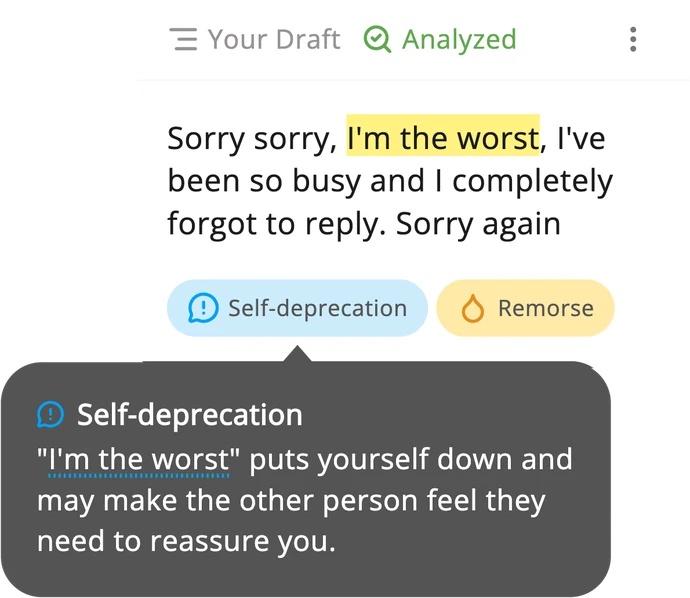
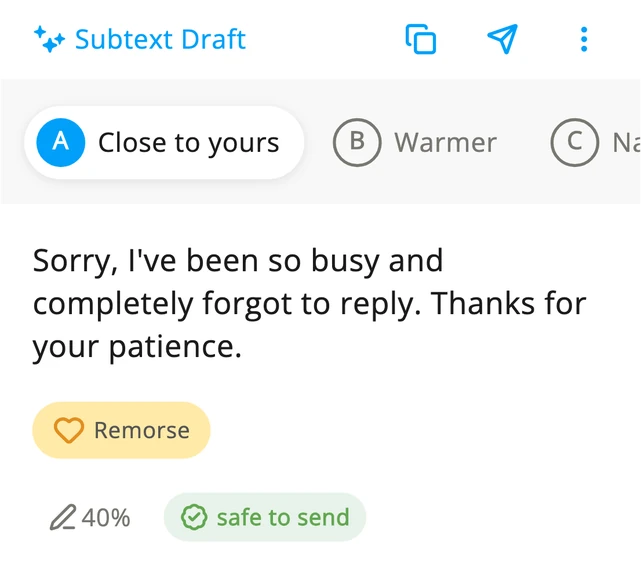
Here is what that fear tends to write once the reply is late. On the draft “Sorry sorry, I’m the worst, I’ve been so busy and I completely forgot to reply. Sorry again”, made up for the run, Subtext returned the tag Self-deprecation and named the feeling as Remorse. Its note said that “I’m the worst” “puts yourself down and may make the other person feel they need to reassure you”. Its closest version read “Sorry, I’ve been so busy and completely forgot to reply. Thanks for your patience.” It dropped “I’m the worst” and the repeated sorry “so it reads as one sincere apology”. The thanks at the end was the app’s addition, and it did not say so. That is the app’s real output, unedited.
Does it get harder the longer you leave it?
This is the part everyone finds most convincing and it has the least behind it. I found no peer-reviewed study measuring whether a specific unanswered message becomes more aversive as time passes.
The vivid version, where relief turns into guilt and the message looms larger and you avoid it more, comes from journalism and clinical writing. The most developed version is the Wall of Awful, a metaphor from an ADHD coach describing bricks of failure and shame accumulating around a delayed task until looking at it hurts. I think it’s a good frame, with real explanatory appeal and no empirical testing at all. If you have seen a claim that the emotional cost grows exponentially, that traces to the same place.
What I can assemble is an argument from three literatures, each supporting one link:
Aversiveness drives delay. Steel puts task aversiveness among the top predictors2.
Delay carries a real social cost, and late repliers know it. Kalman and colleagues analysed over 150,000 responses across corporate email, discussion groups and an online market, and found reply latencies follow a power law, with at least 70 per cent of responses arriving within the responder’s own average and no more than about 4 per cent arriving after ten times that12. Past that point a pause reads as silence. The behavioural detail that makes the argument is that late replies disproportionately contain apologies and explanations. People feel the lateness, and it shows in the logs.
Effortful messages are the ones deferred. Sarrafzadeh and colleagues found people defer emails requiring careful reading or composing, particularly under high workload4.
Chain those and you get a loop in which a small initial barrier closes the response window, the delay crosses a normative threshold, the message stops being a question and becomes a debt to explain, and a thirty-second reply is now a relational repair task. Every link has support. I couldn’t find a study that tested the compound claim, and the article you read that stated it as fact was overreaching.
The person waiting is making a mistake too
People rarely take silence as neutral, and the harm is real. Ostracism research is one of the better-replicated areas in social psychology. A meta-analysis of 120 studies covering 11,869 participants found the average effect of being excluded is large, exceeding d = 1.4, and generalises across gender, age, country and measure13.
But the recipient is also making a systematic inferential error about you, and that reframes the whole thing.
Vignovic and Thompson showed email recipients form unfavourable dispositional judgements of senders whose messages are terse or error-laden, and that signalling a situational constraint corrects the inference14. Your actual reason is overload, executive-function cost, anxiety or monotropic focus. Their inferred reason is indifference or disrespect. Those diverge systematically, and the divergence is documented.
Malle’s meta-analysis found the actor-observer asymmetry is smaller and more conditional than textbooks claim, though it holds best for negative or intentional behaviour, which is exactly the case of a non-reply15. So this one cuts in your favour.
Subtext exists partly because of that gap. The reply you cannot write and the meaning the other person reads into your silence are two different problems, and only one of them is about the words.
Try Subtext in your browserDownload on the App StoreGet it on Google PlayScan it with your phone camera to install.
What helps
Implementation intentions. The strongest tool here by some distance. Gollwitzer and Sheeran meta-analysed 94 independent tests with over 8,000 participants and found a medium-to-large effect, d = .65, on goal attainment, specifically effective at initiating goal striving16. The format is: if [specific trigger], then I will [specific action]. It targets exactly the thing that is broken.
Self-compassion, moderately. Sirois found across four samples that procrastination was associated with lower self-compassion and higher stress, with self-compassion mediating17. The mechanism is plausible, since shame about the delay is itself an aversive state you can avoid by avoiding the message. Correlational, and not demonstrated causally for correspondence.
A holding message, probably. I couldn’t find a study that tested it. In its favour, Vignovic and Thompson showed signalling a situational constraint corrects dispositional attribution, which is the mechanism14. Service-waiting research consistently identifies uncertainty as the thing that does the damage. And on the chronemics account, an acknowledgement resets the expectancy baseline before the delay crosses the threshold.
I could not find support for the claim that acknowledging reduces your own burden. That appears only in productivity writing. It is plausible and unevidenced, and they are different claims.
Where the sympathetic explanation stops
The sympathetic framing is mostly right and it is not entirely right, and the version that skips this part is the version nobody sceptical will believe.
Conscientiousness is a stable trait and one of the strongest predictors in Steel’s meta-analysis, so there is a durable dispositional component here. The harm to the person waiting is among the largest effects in this whole area. And by the model’s own definition, this is a self-regulation failure, meaning voluntary postponement despite expecting to be worse off. Tice and Baumeister’s data show the cumulative cost lands on the procrastinator as well.
The position I’ll defend is that non-reply has real mechanistic causes and consequences you can reasonably take steps to mitigate. Understanding why someone went quiet is not the same as concluding nothing was owed.
Sources
Numbered in the order they appear above. Where a figure could not be verified against the primary source, the text says so.
- Sirois, F., and Pychyl, T. (2013). Procrastination and the priority of short-term mood regulation. Social and Personality Psychology Compass, 7(2), 115 to 127.
- Steel, P. (2007). The nature of procrastination: A meta-analytic and theoretical review. Psychological Bulletin, 133(1), 65 to 94. 691 correlations across 216 samples.
- Tice, D. M., and Baumeister, R. F. (1997). Longitudinal study of procrastination, performance, stress, and health. Psychological Science, 8(6), 454 to 458. Study 1 n = 44; Study 2 60 recruited, 57 analysed. Funding unverified.
- Sarrafzadeh, B., and colleagues (2019). Characterizing and predicting email deferral behavior. WSDM 2019. Fifteen interviews plus enterprise log analysis.
- Oguchi, M., and colleagues (2021). Longitudinal relationship between procrastination and distress among ADHD symptom groups. 490 participants in Methods and tables, 470 in the abstract, an inconsistency in the published paper. Funded by the Ibuka fund and JSPS KAKENHI 202023103.
- Murray, D., Lesser, M., and Lawson, W. (2005). Attention, monotropism and the diagnostic criteria for autism. Autism, 9(2), 139 to 156.
- Garau, V., and colleagues (2023). The Monotropism Questionnaire. 47 items, autistic-led, released via OSF. Early validation.
- Buckle, K. L., Leadbitter, K., Poliakoff, E., and Gowen, E. (2021). “No way out except from external intervention”: First-hand accounts of autistic inertia. Frontiers in Psychology, 12, 631596. Six focus groups, 32 autistic adults.
- Koteyko, N., Van Driel, M., Billan, S., Barros Pena, B., and Vines, J. (2025). Stigma Management Strategies of Autistic Social Media Users. Autism in Adulthood. 34 UK autistic adults. Funded by ESRC ES/T016507/1.
- Livingston, L. A., Ashwin, C., and Shah, P. (2020). Letter to the Editor on autistic students’ email communication. A letter, not a study; the authors describe their observations as largely anecdotal. Livingston funded by the Medical Research Council.
- Sirois, F. M., Molnar, D. S., and Hirsch, J. K. (2017). A meta-analytic and conceptual update on the associations between procrastination and multidimensional perfectionism. European Journal of Personality, 31(2), 137 to 159. Concerns r = .23 across 43 studies; strivings r = -.22 across 38.
- Kalman, Y. M., Ravid, G., Raban, D. R., and Rafaeli, S. (2006). Pauses and Response Latencies: A Chronemic Analysis of Asynchronous CMC. Journal of Computer-Mediated Communication, 12(1), 1 to 23.
- Hartgerink, C. H. J., van Beest, I., Wicherts, J. M., and Williams, K. D. (2015). The ordinal effects of ostracism: A meta-analysis of 120 Cyberball studies. PLOS ONE, 10(5), e0127002. N = 11,869. Funded in part by NSF grant BCS-1339160 and NWO grant 016-125-385.
- Vignovic, J. A., and Thompson, L. F. (2010). Computer-mediated cross-cultural collaboration: Attributing communication errors to the person versus the situation. Journal of Applied Psychology, 95(2), 265 to 276. Venue confirmed against the Crossref record. Sample size unverified.
- Malle, B. F. (2006). The actor-observer asymmetry in attribution: A (surprising) meta-analysis. Psychological Bulletin, 132(6), 895 to 919.
- Gollwitzer, P. M., and Sheeran, P. (2006). Implementation intentions and goal achievement: A meta-analysis of effects and processes. Advances in Experimental Social Psychology, 38, 69 to 119. 94 independent tests, over 8,000 participants, d = .65.
- Sirois, F. M. (2014). Procrastination and stress: Exploring the role of self-compassion. Self and Identity, 13(2), 128 to 145. Four samples of 145, 339, 190 undergraduates and 94 community adults.