ArticlesMessages
Why that text got to you
Three people can read the same message and have three different afternoons. What the research says about why, and what to do with it before you reply.
By Samet Durgun · Co-founder of Subtext · 13 min read
· Updated September 26, 2026
Someone sends you “we need to talk.”
You know what happens next. You read it four times. You check when they were last online. You start a reply, delete it, write a shorter one, delete that too. Forty minutes later you have done no work and sent no message.
Meanwhile your friend gets the exact same three words from her manager and answers “sure, when?” without putting her coffee down.
I have spent the last two years building Subtext, a writing assistant that reads the tone of a message before you send it, and for most of that time I explained it badly. I would say it “analyses the emotional tone of your draft,” which is true and also tells you nothing. So a few weeks ago I sat down and read the actual research on how emotions work and what makes something a trigger. Not to sound clever at dinner. I wanted to know whether the thing we built has a foundation under it. I sell the thing, so weigh my stake accordingly; every study I lean on is linked below, and checking them beats trusting me.
It mostly does. It also has a couple of cracks I did not expect.
Most of us are working with three words
Brené Brown surveyed around 7,000 people over five years and asked them to name what they were feeling in the moment. The average answer was three emotions.2 Happy, sad, angry. Her book Atlas of the Heart maps 87 of them2, which is a fairly pointed way of saying we are all operating with a very small toolkit.
When I first saw that number I assumed it was a rhetorical flourish. It is not. And the reason it matters goes past self-improvement. How finely you tell your feelings apart is linked to how you act on them.
Psychologists call this emotional granularity, or emotion differentiation. Todd Kashdan, Lisa Feldman Barrett and Patrick McKnight reviewed the evidence in 20151. People who can tell the difference between annoyed, resentful and let down, and do not file all three under “bad,” are less likely to reach for binge drinking, aggression or self-injury when they are distressed. They show less neural reactivity to being rejected. They report less severe anxiety and depression.
I keep coming back to one finding in this research. In a daily diary study, angry people who told their emotions apart well were less likely to act aggressively3. When you know precisely what happened to you, you have options other than lashing out.
A 2025 scoping review of 98 studies maps the same kind of link between granularity, everyday functioning and mental health across many groups of people5. These are associations. Nobody has shown that learning more feeling words, or having an app suggest them, fixes distress.
Three ways to find the right word
If you only take one practical thing from this piece, take one of these.
The Feelings Wheel. A therapist named Gloria Willcox published this in the Transactional Analysis Journal in 19826 and it has become the most-used emotional vocabulary tool on the internet. The version everyone shares has six feelings in the middle (sad, mad, scared, joyful, powerful, peaceful) with roughly 72 more specific ones radiating outward. You find the vague word first, then walk outward until you hit the accurate one.
“Bad” becomes “sad” becomes “let down.” That third word is the one you can write a message about.
Plutchik’s wheel. Robert Plutchik’s 1980 model is the one to reach for when you know the emotion and need the intensity. Annoyance, anger and rage are the same feeling at three volumes, and picking the wrong volume is how a reasonable complaint turns into a fight. Plutchik also treats complex feelings as blends. Contempt, in his scheme, is anger plus disgust, which explains a lot about why it lands so badly.
The Mood Meter. Marc Brackett’s team at Yale built this into a grid, with how much energy you have on one axis and how pleasant you feel on the other. Four quadrants, about a hundred words spread across them. It descends fairly directly from James Russell’s 1980 circumplex model of affect, which is the workhorse of most mood tracking you have ever used.
It is a good first pass when you do not even know where to start. High energy and unpleasant means you probably need to bring the temperature down before you type anything. Low energy and unpleasant is a different problem with a different fix.
The part that explains your group chat
Naming the feeling is step one. The harder question is why the message got to you at all when it slid off someone else.
Marshall Rosenberg, who developed Nonviolent Communication, has the cleanest version of the answer:
What others say and do may be the stimulus, but never the cause, of our feelings.
I resisted this for a while because it sounds like it is letting rude people off the hook. It is not. Someone can be out of line and the sting you feel can still be coming from a need of yours that went unmet. Both things are true at once. What the reframe buys you is the ability to say something specific instead of something accusatory.
Which brings me to the single most useful idea I found in all of this.
Half the feelings you name are not feelings
NVC calls them faux feelings11. They are words that follow “I feel” but actually describe what you think somebody did to you:
Ignored. Dismissed. Criticised. Misunderstood. Abandoned. Manipulated. Rejected. Unheard.
Every one of those is an accusation wearing a feeling’s coat.
Draft “I feel ignored.”
A faux feeling, not a feeling · names what you think they did rather than what you’re feeling · reads like a verdict
Rewritten “I felt lonely this week and I wanted to hear from you.”
The first one puts the other person on trial. The second one just tells them something true.
This is a pattern I see a lot. When a draft reads as harsh, the cause is often a faux feeling doing quiet damage in the middle of an otherwise reasonable paragraph, in a sentence with no aggression in it at all.
Why the same message lands three different ways
The scientific version of Rosenberg’s line is appraisal theory, developed most fully by Richard Lazarus. The idea is that emotions come from your evaluation of an event rather than the event itself. There is a primary appraisal (does this matter to me, and is it a threat, a loss or a challenge?) and a secondary one (can I do anything about it?).
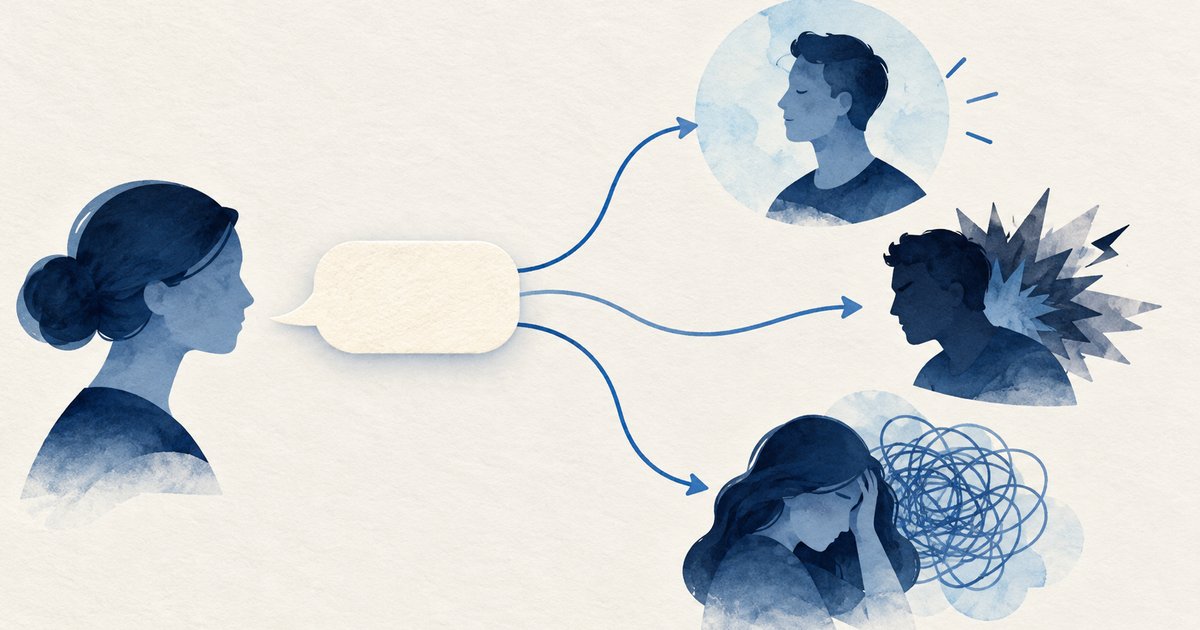
So, back to “we need to talk.” Three people, three appraisals:
- High threat, low control, total uncertainty about what is coming. That produces anxiety.
- Read as unfair blame arriving without warning. That produces anger.
- Read as ambiguous and probably about the Q3 planning doc. That produces nothing much at all.
Same nine characters, and the difference was all in the reading.
This is the same gap Subtext sits in. It reads your draft as an outside reader would, not the way you meant it, so you can see which of those appraisals it might set off before you hit send. It cannot know how the actual person will take it.
The practical use is that appraisal has parts you can inspect. When something lands badly, run through them: was this actually relevant to something I care about, who do I think caused it, how certain am I about what happens next, and can I do anything about it? Most spirals I have watched people describe collapse on the third question, because the uncertainty was doing all the work.
SCARF and the five things you can be threatened about
David Rock’s SCARF model14 came out of the neuroleadership world in 2008 and it is the most immediately usable trigger taxonomy I found, especially for work messages. Five social domains where a threat produces a disproportionate reaction:
- Status. Being corrected in a group thread. Being left off the invite.
- Certainty. “Can we chat later?” with no subject line. Vague timelines.
- Autonomy. Being told how to do something you were trusted to own.
- Relatedness. A reply that is one word colder than usual.
- Fairness. Someone else presenting your work. Rules that move.
The value here is diagnostic. When a message annoys you more than it should, one of those five is usually the reason, and once you can name which one, you can write a message about the actual thing instead of a message about the tone.
Two more pieces worth knowing
Attachment style shapes which cues become triggers in the first place. Broadly, anxiously attached people are set off by delay, silence and distance, and tend to move toward the other person. Avoidantly attached people are set off by pressure for closeness and tend to move away. Put those two in a thread together and you get the loop where one person’s reaching triggers the other’s retreating, which triggers more reaching. I should flag that the attachment research itself is well established but the texting-specific applications come mostly from practitioners, not peer-reviewed studies, so hold them loosely. I went through what does and does not hold up in what anxious attachment looks like in texting.
The other piece is what Gottman calls enduring vulnerabilities, borrowing from Benjamin Karney and Thomas Bradbury’s work. Old sore spots from long before this conversation. A perfectly ordinary comment lands on one and produces a reaction that is wildly out of proportion to what was said. Everyone has a few. Knowing yours does not remove them, but it does help you notice when the thing that just hurt you is not really about the thing that just happened.
I want to be clear that everything here is about everyday interpersonal triggers, the ordinary friction of texting people you know. Trauma triggers are a different mechanism and deserve proper support, not a communication framework.
Text makes all of it worse
Everything above applies to conversation in general. Written messages add their own problems on top, and this is the bit I care about most.
There is no face. Text removes tone, expression, timing and body language, so ambiguity is the default state. “ok” reads cold. A full stop reads angry. None of that was necessarily in the sender’s head.
Ambiguity gets filled in, and rarely generously. When information is missing, prediction fills the gap, and an anxious brain reliably picks the worst available option. This is what brains do with incomplete data, so it is no reflection on your character. It is also why Subtext reads a draft as someone with only the words in front of them would, not the way the sender hears it in their own head.
Delay feels like a decision. Read receipts and typing indicators turned silence into a readable event. When Naomi Eisenberger and colleagues put people in a scanner17 and had them excluded from a virtual ball game in 2003, the anterior cingulate cortex was more active during exclusion than inclusion, and that activity tracked how distressed people said they felt. The stronger reading of that study, that social pain and physical pain are the same thing, has been argued over ever since, so take that version with some salt. The finding that being left out reliably registers as distress has held up fine. What the silence means is a separate question, which I cover in what it means when someone reads your message and doesn’t reply.
The always-on expectation. The norm of instant replies manufactures guilt on one side and pressure on the other. In SCARF terms it is a certainty and autonomy problem wearing a politeness costume.
So what do you actually write
Two frameworks do almost all the work here.
Rosenberg’s four steps
Observation, feeling, need, request. State what happened as a camera would record it. Name the real emotion. Say what you needed. Ask for something specific and doable.
Take a message I have seen some version of a hundred times. The notes underneath the draft are mine:
Draft “You never reply to me. It’s honestly exhausting.”
Reads as an accusation · “never” is almost certainly inaccurate · no actual ask
Rewritten “I sent a few messages last week and didn’t hear back. I felt kind of lonely about it. It matters to me to stay in touch, even if it’s just a thumbs up. Could you let me know when you’re heads down so I’m not guessing?”
The second one is longer, which people always object to. It is also the only one of the two that has a chance of getting what you wanted.
Gottman’s four horsemen, used on yourself
John Gottman spent decades watching couples argue and identified four patterns18 that predict relationships falling apart. They are usually taught as things to spot in a partner. I think they are more useful as a checklist for your own draft.
- Criticism attacks character, not behaviour. Anything with “you always” or “you never” in it. The fix is to swap the character judgement for the specific thing that happened plus what you need.
- Contempt is mockery, sarcasm, superiority. Gottman calls it the single strongest predictor of divorce. There is no clever version of this. Delete it.
- Defensiveness is counter-blaming and playing victim. The fix is taking responsibility for some part of it, even a small part.
- Stonewalling is going silent and leaving someone in the dark. You do not have to force yourself to keep talking. The fix is saying you need an hour and then actually coming back.
A note on the famous statistic. You will see “93% accuracy at predicting divorce” attached to this research everywhere. It comes from Gottman and Levenson’s work, and it is real, but Richard Heyman and Amy Smith Slep published a paper in 200120 showing that when you apply those prediction equations to a fresh sample they were not built on, the accuracy drops hard. The patterns are well worth knowing. The number deserves a shrug.
The pause
Yale’s RULER programme calls it the meta-moment: the gap you deliberately open between being triggered and responding. I’d call it the least sophisticated idea in this entire article, and probably the one with the biggest payoff.
There is even a neat mechanism for why naming helps in that gap. Matthew Lieberman’s team found in 20074 that putting a feeling into words reduced amygdala activity in response to emotional images. Label it, and some of the heat comes off. Which is, more or less, what Subtext is built to do, so take that with the appropriate amount of suspicion.
A fight the field has not resolved
For decades the standard story was Paul Ekman’s: six emotions, universal, written on the face the same way everywhere. It is a good story and it is under real pressure.
Carlos Crivelli and colleagues took Western emotion faces to the Trobriand Islanders of Papua New Guinea in 2016 and found that Trobriand Islanders consistently read the wide-eyed “fear” face, which reads as fear and submission to Western eyes, as anger and threat22 instead. Then in 2019, Lisa Feldman Barrett and four co-authors reviewed the whole literature and concluded24 that facial movements are not universally diagnostic of emotional states, and that we should stop treating a face as a readout of what someone feels.
Barrett’s alternative is that the brain constructs emotions in the moment out of raw bodily sensation plus learned concepts. If she is right, then your emotional vocabulary is not a description of your feelings. It is part of the machinery that builds them. She makes the case herself in one of the TED talks about emotions I think are worth the time, and people who cannot picture anything are an unusual test of it, which I look at in why feelings fade so fast with aphantasia.
I am not qualified to referee this. I will say the constructionist view is the one that makes an app like ours make sense, which is exactly why I try not to get too attached to it.
What this is good for
None of this makes anyone a calmer person. It will not stop your stomach dropping when someone types for eleven seconds and then stops.
What it gives you is a bigger set of words for what just happened, and the research links telling feelings apart to handling them better. You stop sending “you never reply to me” because you can now tell that the feeling underneath is loneliness rather than anger, and loneliness asks for something completely different.
The message you have been avoiding is usually one accurate word away from being sendable.
That gap, between the word you reached for and the word that was true, is why Subtext exists. Paste your draft, or screenshot the thread so it sees both sides, and it names what your message is about to signal, flags the lines likely to be misread, and offers versions that still sound like you.  Try Subtext in your browserScan it with your phone camera to install.Try Subtext in your browser
Think I got something wrong here? Find me on LinkedIn.
Samet Durgun is the co-founder of Subtext, an app that catches the emotional tone of your messages and rewrites them in your own voice. He’s based in Berlin.
Sources and further reading
Every link above goes to the primary source where one exists.
Emotional vocabulary and granularity
- Kashdan, T. B., Barrett, L. F., & McKnight, P. E. (2015). Unpacking Emotion Differentiation: Transforming Unpleasant Experience by Perceiving Distinctions in Negativity. Current Directions in Psychological Science, 24(1), 10-16. Abstract · Full PDF
- Brown, B. (2021). Atlas of the Heart: Mapping Meaningful Connection and the Language of Human Experience. Random House. The full list of 87 emotions · TIME interview covering the three-emotion survey finding
- Pond, R. S., Kashdan, T. B., DeWall, C. N., et al. (2012). Emotion differentiation moderates aggressive tendencies in angry people: A daily diary analysis. Emotion, 12(2), 326-337.
- Lieberman, M. D., Eisenberger, N. I., Crockett, M. J., et al. (2007). Putting Feelings Into Words: Affect Labeling Disrupts Amygdala Activity in Response to Affective Stimuli. Psychological Science, 18(5), 421-428. Journal · Full PDF
- Ozomaro, B., Wein, P. Y., Miller, S., Ospina, L. H., Goodman, M., Torous, J., & Kimhy, D. (2025). Emotional granularity in health and psychopathology: A scoping review. Journal of Psychiatric Research, 190, 277-295. Journal
Naming and classifying emotions
- Willcox, G. (1982). The Feeling Wheel: A Tool for Expanding Awareness of Emotions and Increasing Spontaneity and Intimacy. Transactional Analysis Journal, 12(4), 274-276. Journal
- Plutchik, R. (1980). Emotion: A Psychoevolutionary Synthesis. Harper & Row.
- Russell, J. A. (1980). A Circumplex Model of Affect. Journal of Personality and Social Psychology, 39(6), 1161-1178.
- Brackett, M. A. (2019). Permission to Feel. Celadon Books. The Mood Meter and the meta-moment come from the Yale Center for Emotional Intelligence’s RULER approach.
- Cowen, A. S., & Keltner, D. (2017). Self-report captures 27 distinct categories of emotion bridged by continuous gradients. PNAS, 114(38), E7900-E7909. Full paper
Triggers, appraisal and needs
- Rosenberg, M. B. (2015). Nonviolent Communication: A Language of Life (3rd ed.). PuddleDancer Press. The stimulus-and-cause distinction and the observation-feeling-need-request model both come from here. The faux feelings handout (PDF)
- Lazarus, R. S. (1991). Emotion and Adaptation. Oxford University Press.
- Smith, C. A., & Ellsworth, P. C. (1985). Patterns of cognitive appraisal in emotion. Journal of Personality and Social Psychology, 48(4), 813-838.
- Rock, D. (2008). SCARF: A Brain-Based Model for Collaborating With and Influencing Others. NeuroLeadership Journal, 1, 1-9. Plain-English overview
- Mikulincer, M., & Shaver, P. R. (2007). Attachment in Adulthood: Structure, Dynamics, and Change. Guilford Press. Source of the hyperactivation and deactivation patterns. The texting-specific applications are practitioner extrapolations rather than findings.
- Karney, B. R., & Bradbury, T. N. (1995). The longitudinal course of marital quality and stability. Psychological Bulletin, 118(1), 3-34. Origin of the enduring vulnerabilities idea.
- Eisenberger, N. I., Lieberman, M. D., & Williams, K. D. (2003). Does Rejection Hurt? An fMRI Study of Social Exclusion. Science, 302(5643), 290-292. Journal · Full PDF
Conflict patterns
- The Gottman Institute. The Four Horsemen: Criticism, Contempt, Defensiveness and Stonewalling, and the corresponding antidotes.
- Gottman, J. M., & Levenson, R. W. (1992). Marital processes predictive of later dissolution. Journal of Personality and Social Psychology, 63(2), 221-233.
- Heyman, R. E., & Slep, A. M. S. (2001). The Hazards of Predicting Divorce Without Crossvalidation. Journal of Marriage and Family, 63(2), 473-479. Journal · PubMed
The universality debate
- Ekman, P., & Cordaro, D. (2011). What Is Meant by Calling Emotions Basic. Emotion Review, 3(4), 364-370. Journal · Ekman’s own summary of the universal emotions
- Crivelli, C., Russell, J. A., Jarillo, S., & Fernández-Dols, J. M. (2016). The fear gasping face as a threat display in a Melanesian society. PNAS, 113(44), 12403-12407. Full paper
- Gendron, M., Roberson, D., van der Vyver, J. M., & Barrett, L. F. (2014). Perceptions of emotion from facial expressions are not culturally universal: Evidence from a remote culture. Emotion, 14(2), 251-262.
- Barrett, L. F., Adolphs, R., Marsella, S., Martinez, A. M., & Pollak, S. D. (2019). Emotional Expressions Reconsidered: Challenges to Inferring Emotion From Human Facial Movements. Psychological Science in the Public Interest, 20(1), 1-68. Journal · Full PDF
- Barrett, L. F. (2017). How Emotions Are Made: The Secret Life of the Brain. Houghton Mifflin Harcourt.